The kitchen was doing what modern kitchens do: humming, flashing and bleeping like a miniature airport. The microwave door banged shut. A plate rotated. Something sizzled and spat, before the familiar irritated beep called for attention. No one responded. The owner was on a video call, the children were absorbed in homework and YouTube, and the microwave carried on shouting into an empty room.
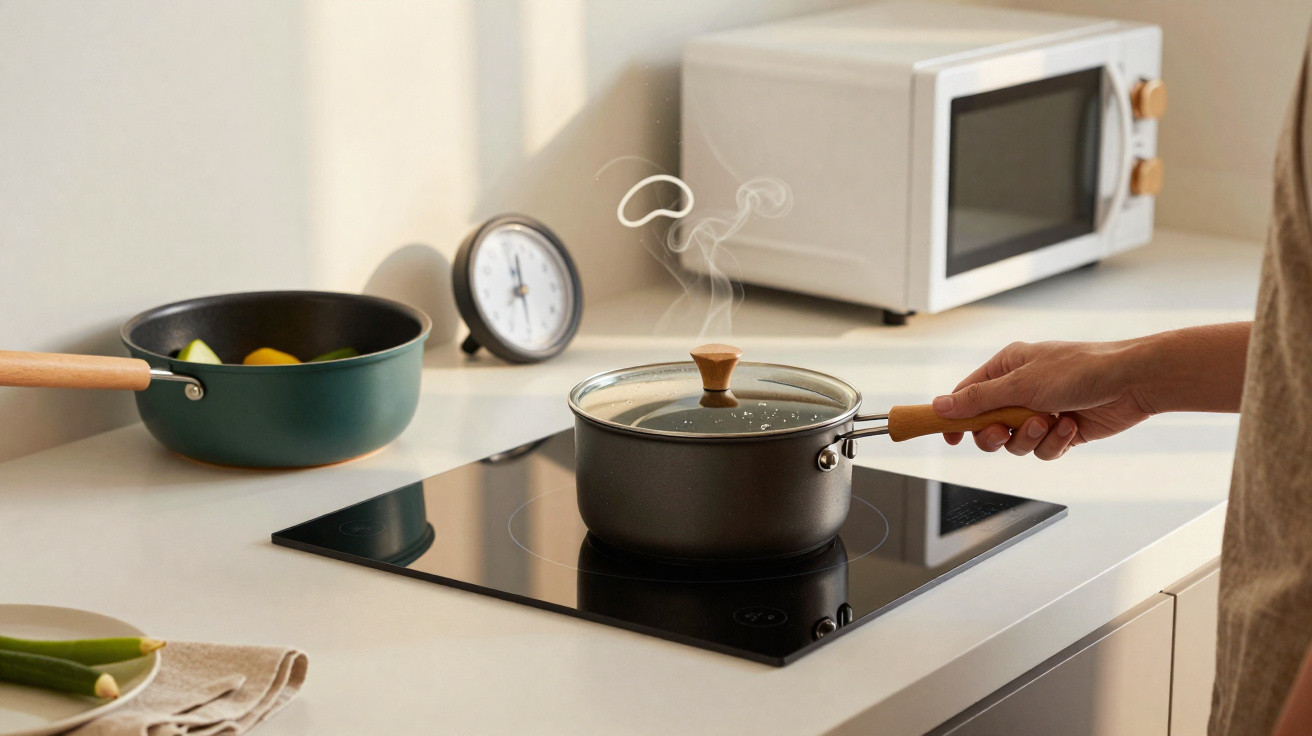
In a corner, almost unnoticed, a flat glass panel shone with a gentle amber circle. There was no rotating plate, no roaring fan and no digital shriek. Only a quiet glow and a pan giving off a soft stream of steam, like a hob that had acquired some manners.
When the man eventually ended his call, he did not go near the microwave. Instead, he walked straight to the silent appliance, slid out the pan and smiled as though he was in on a secret.
This is the machine that engineers believe could make your microwave seem decidedly 1998.
The quiet revolution on your worktop
Ask appliance engineers which item most lets down the contemporary kitchen, and many give the same answer: the microwave. It has a noisy fan, heats unevenly, takes up considerable room and announces itself with insistent beeps. It is an appliance that has never genuinely developed; it has simply acquired extra buttons and glossier doors.
The low-key innovation they are backing, on the other hand, scarcely resembles an appliance at all. It is the emergence of induction-style smart cooking hubs: thin, quiet and precise heating surfaces that operate more like a smartphone than an oven. There are no buzzing magnetrons and no microwave radiation. Controlled magnetic fields simply deliver heat directly to the pan.
To anyone looking at it, it is a serene black surface. To engineers, it represents the end of reheating by “blast-and-hope”.
If an old microwave resembles a hairdryer inside a shoebox, this device is closer to the gentle hand of a whispering chef.
The change is already visible in small everyday household moments. A young couple living in a 36 m² London flat replaced their bulky microwave with a portable induction hub that can be slipped into a drawer. They chose a brutally straightforward test: leftover pasta at midnight. Heated in the microwave, it had the familiar two consistencies - molten lava around the edge and an ice age in the centre. On the induction hub, it warmed evenly in a pan, with no splattering and no angry motor noise.
Before long, they used it for everything: delicate porridge at 6 a.m., ramen after a night out and reheated sauces without scorching them. Its silence became part of the routine. There was no longer a piercing beep to wake the baby, nor any need to apologise during Zoom calls when the microwave fan started up in the background.
A small German study from 2023 examined newly built flats below 50 m². In these homes, compact induction units were selling far more strongly than microwaves. It was not glamorous smart fridges or app-connected ovens driving the change, but simple, near-silent heat that performed its task without asking to be noticed.
Engineers describe the issue rather as sound designers discuss noise in films. Microwaves function by bombarding water molecules with high-frequency waves, an approach that is both efficient and forceful. Consequently, the edges warm quickly while the middle lags behind, leaving food for too long in the “lukewarm danger zone” where bacteria thrive.
Induction-style cookers work in a wholly different way. Alternating current passes through coils beneath the glass, producing a magnetic field that generates heat directly within the metal of the pan. There is less heated air and more targeted energy; less noise and greater control.
The newest models add software to that hardware. Sensors check the pan temperature dozens of times each second. Algorithms recognise what “reheat soup” truly involves, rather than merely applying “800 watts for 2 minutes”. The appliance subtly raises and lowers its power, without shouting or turning leftovers rubbery with excessive heat.
The result is a kitchen soundtrack that shifts from an angry drone to a quiet simmer.
Using induction-style smart cooking hubs for silent heat
The appeal of these quiet cooking hubs is that they do not require you to become a chef overnight. One easy approach recommended by some engineers is the “three touch rule”. On the first touch, place your pan and food on the surface. On the second, choose a straightforward programme such as “gentle reheat” or “boil & hold”. On the third, press the temperature icon once to reduce it slightly from the default setting.
That modest adjustment is where the difference lies. Soup stops raging and begins to sigh. Rice no longer fuses itself to the base of the pan. Leftover pizza develops a crisp bottom without becoming dry on top. Rather than programming a machine, you are simply adjusting it as you would a dimmer switch.
The quietness also lets you hear what the food is doing: the gentle hiss of steam and the faint crackle of oil. Cooking becomes feedback rather than noise.
The most frequent error made by people replacing a microwave is treating the induction plate as a “faster microwave”. They turn it up to maximum, expecting immediate results. Instead, they get splatters, burnt edges and frustrated sighs. Let’s be honest: nobody really does that every day without getting it wrong.
The key is to think in heat zones rather than speed. High power is for boiling water or searing food. Medium power becomes the ideal setting for reheating. Low power is where sauces, stews and delicate leftovers return to life. Many newer devices even use colour coding for these zones, so there is no need for your brain to translate numbers into levels of heat.
Some users also miss a microwave’s “set and forget” timer. The silent alternative is an integrated automatic shut-off linked to temperature: once food settles at the appropriate warmth, the power reduces automatically. There are no beeps and no fuss, only a pan kept comfortably warm rather than allowed to become volcanic.
Engineers enjoy discussing specifications and efficiency, but a softly spoken Copenhagen designer described the idea in more human language:
“I don’t want my kitchen to shout at me. The future is appliances that do their job and then disappear again.”
This outlook helps explain the features quietly appearing in these products. Instead of a forest of buttons, there are a handful of clear modes. Rather than a nagging countdown, a subtle light ring shrinks as food approaches its target temperature. In place of a beep, the glow simply fades.
- Silent magnetic heating instead of vibrating fans
- Pan-temperature sensing instead of blind timers
- Flat glass panels that can be wiped clean within seconds
- Slim designs that fit in drawers or beneath shelves
- Smart modes that learn your reheating habits
On an exhausting weeknight, this is more important than any glossy brochure. The kitchen feels less like a laboratory full of machinery and more like a peaceful part of daily life. On a good day, you barely notice the technology at all.
When the microwave begins to look out of place
Engineers are not forecasting a science-fiction kitchen in which robots prepare every meal. They are suggesting something more subdued: a gradual social awkwardness around the old microwave. The large box in the corner may come to resemble the DVD player beneath a smart television - still technically useful, but no longer truly welcome at the party.
As induction hubs become less expensive, easier to carry and increasingly widespread in small flats and co-living spaces, the question may reverse. It will no longer be, “do you really need one of those?”, but “wait, you still nuke your coffee in that thing?”. This change will not arrive with a press release. It will happen the first time a friend reheats leftovers on a silent glass panel and casually says, “Oh, we haven’t used the microwave in months.”
Once you have tasted food that is warm in the same way it was on the evening it was cooked, rather than food with rubbery edges and boiling centres, returning to the old method can be surprisingly difficult.
| Key point | Detail | Benefit for the reader |
|---|---|---|
| Silence and comfort | Induction-style hubs heat food without a noisy fan or aggressive beeps | A more peaceful kitchen, ideal for compact spaces and late evenings |
| More even heating | Heat is generated directly in the pan and managed by sensors and software | Better texture, with fewer burnt dishes or meals that are lukewarm in the centre |
| Discreet format | Flat panels are easy to store or integrate into the worktop | Saves space and creates a more modern, uncluttered kitchen |
















Comments
No comments yet. Be the first to comment!
Leave a Comment