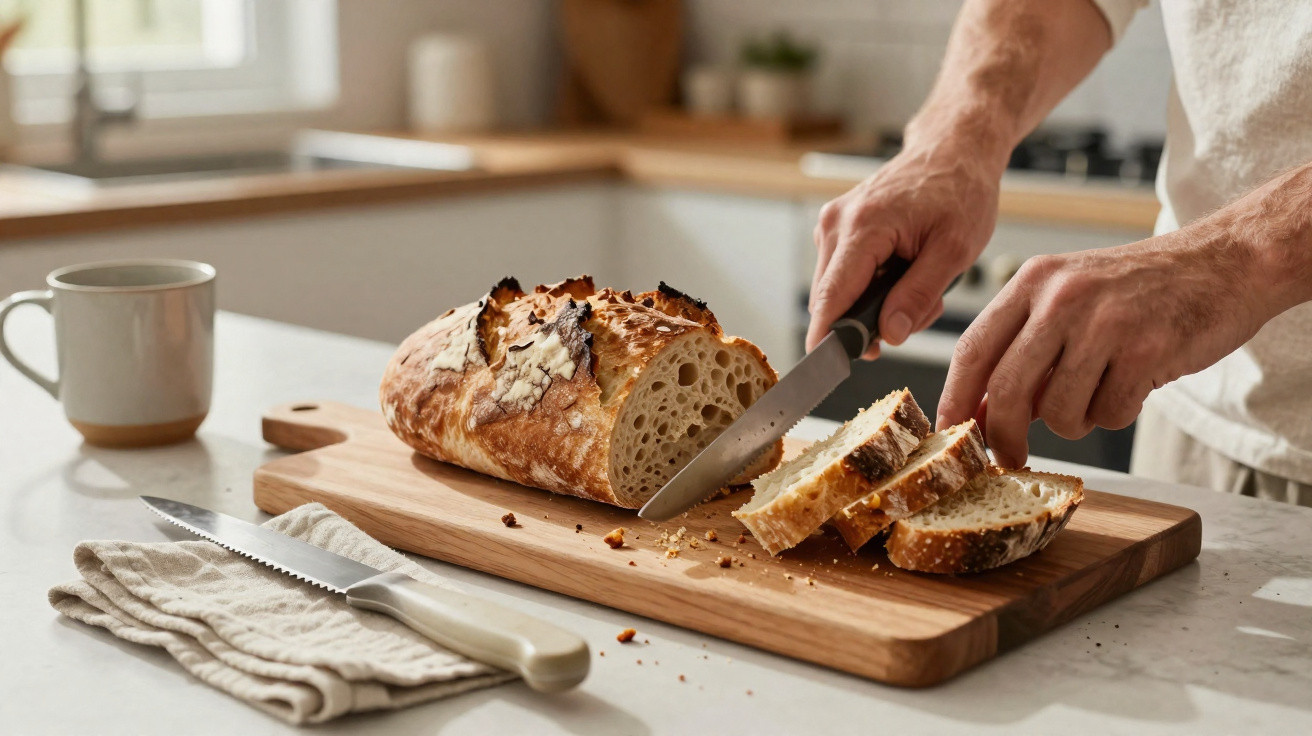
The loaf looks flawless on the chopping board.
Its crust is golden and it is still slightly warm: the sort of bread that costs more than it should, yet never feels like a waste. You lift your bread knife, set its serrated edge against the crust… and the loaf collapses as though someone has let the air out of it.
Crumbs scatter all over the worktop. Each slice is bulky at one end and almost transparent at the other. As you saw back and forth, your fingers creep far too near the blade and your irritation grows with every pass.
Eventually, you blame the baker, the flour, the method – anything except the well-known handle you are holding. But the answer is right there, on the tips of those tiny teeth. It is also not the answer most home cooks expect.
Why your “always sharp” bread knife lets you down
Many people quietly assume that a bread knife lasts forever. Its serrations appear fierce and nearly unbreakable, like a miniature line of saws capable of tackling crust indefinitely. As a result, it is used for everything from sourdough to frozen baguettes for years, with barely a thought given to its condition.
Then, one day, it simply starts to feel off. You apply more force, the blade skids over the crust and the bread tears instead of cutting cleanly. The loaf ends up looking as if a raccoon has gone after it. Rather than blame the knife, you blame the bread, return the tool to its drawer slot and let its gradual decline continue.
Surely sharpening is for chef’s knives – those polished blades that slide through tomatoes in television cookery programmes? Meanwhile, the serrated bread knife sits in the corner as the dependable workhorse, neither maintained nor fussed over. In reality, it may be the knife that needs attention first.
Consider what your bread knife encounters in normal use: firm crusts, sticky centres, wooden boards, and occasionally marble or plates. Every sawing stroke pulls the fine teeth across abrasive materials. The crust of a baguette is essentially sandpaper baked into a long loaf. Frozen bread and part-baked rolls are even more demanding.
With every cut, the points of the serrations bend and wear down. Once those tips become rounded, they can no longer grip the crust properly. You compensate by pressing harder, causing the blade to slide and twist instead of bite. That is when slips occur, and a beautiful loaf becomes a pile of crumbs before it ever reaches the toaster.
Professional bakers understand this without making much of it. Some replace their bread knives every year or two rather than struggle with worn serrations. At home, however, many people hold on to the same tired serrated knife for ten years and wonder why their bread “never cuts nicely”. The difference is enormous, yet it sits in those almost invisible edges.
There is another slightly uncomfortable truth. Plenty of households sharpen their chef’s knife once or twice a year and feel rather virtuous, while allowing the bread knife to wear away unnoticed. Yet you may slice bread every day and chop onions only three times a week. Frequency matters: more use means more contact, more wear and more dulling.
Serrated blades lose their edge in a different way from plain blades. A smooth edge becomes blunt along its full length, making the problem easy to notice. Serrations retain a misleading sense of sharpness because the hollows between the teeth can still divide food. The actual damage lies on the high points, which are difficult to inspect.
The result is a knife that still cuts – but badly. It rips through soft crumb, squashes sandwiches and wrecks tomato slices while pretending to be suited to “bread duty”. You respond with extra pressure and more sawing, until that unpleasant resistance feels normal. You forget what an actually sharp bread knife feels like. That is unfortunate, because using freshly sharpened serrations for the first time can be genuinely surprising.
How to keep your bread knife cutting like new
For most people, the most practical approach is to hand the job to someone else. Many professional sharpeners now use specialist tools made to fit each individual serration. By selectively sharpening the inner curves, they restore cutting power without flattening the wavy edge. You can take in a knife that feels merely “ok-ish” and collect one that performs like a laser.
If professional sharpening is not available, there are manageable home methods. A tapered ceramic rod can be used on each serration separately. Place the rod gently in every groove, follow the existing angle and pull it through a few times. It is mildly meditative rather than something you will tackle every Sunday, but a half-hour session once or twice annually can make an enormous difference.
There is also an easier middle-ground option. A few gentle passes with a fine ceramic rod along the flat, non-serrated side may clear away small burrs and revive the edge slightly. It will not undo years of neglect, but it can make an aggravating saw usable again for a while. It is not a perfect fix, but everyday life seldom is.
Let’s be honest: hardly anyone actually does this every day. Bread knives usually sit in cutlery drawers rather than on magnetic racks, and they receive nowhere near the affection shown to a handmade Japanese chef’s knife. That is precisely why they drift into a half-dead state without anybody realising.
A few basic habits can reduce the rate of damage. Do not cut directly on granite or glass, as both quickly wear down serrations. Choose wooden or plastic boards, and avoid treating your bread knife as a general-purpose saw for cardboard, pizza on metal trays or birthday cakes served on ceramic plates. Every shortcut takes its toll.
If the thought of “maintenance” makes you tense up, make it simpler. Choose one annual date – perhaps the season’s first barbecue or the beginning of autumn – to send away your serrated knives or sharpen them with a rod. Attach the task to a real event instead of relying on an abstract resolution that will be forgotten next week.
“A dull serrated knife is sneaky,” says one London-based sharpener. “People think it’s still fine because it sort of cuts, but it’s actually one of the worst offenders for slipped cuts and ugly bread. A truly sharp bread knife feels like it’s doing the work for you.”
This quick mental checklist can help you decide whether it is time to take action:
- Your bread compresses more than it crumbles while you slice it.
- You need both hands on the handle to get through a crust.
- Crumbs are flung across a wide area after cutting.
- Soft sandwich loaves appear chewed instead of neatly sliced.
- You avoid baking crusty bread because of “the mess”.
One “yes” is not a major concern. If three or more apply, though, your knife is raising a small white flag. A fast sharpening session or replacement serrated blade could improve breakfast more than any expensive toaster.
The understated pleasure of a bread knife that works
There is a quiet, almost personal pleasure in a knife that passes through bread in one smooth movement. No fuss, no shower of crumbs and no crushed centre. Just a tidy slice that reveals the uneven holes in sourdough or the delicate crumb of brioche. It is strangely soothing – the sort of thing you only appreciate once it works properly.
On a hectic morning, that can make the kitchen feel a little more forgiving. You can cut toast for a child without fearing that the blade will slip towards your fingers. You can slice a fresh baguette for friends without turning the table into a battlefield of flour. Those small, effortless actions gradually change how everyday cooking feels.
More broadly, it is a gentle reminder that even durable tools require care. A bread knife illustrates this perfectly: inexpensive enough to overlook, but used frequently enough to make a difference. Sharpening it more often is not about becoming obsessively “perfect” in the kitchen. It is about keeping simple things – such as slicing bread – simple.
| Key point | Detail | Why it matters to the reader |
|---|---|---|
| Serrations wear quickly | Every cut through a hard crust rounds off the tips of the teeth | Explains why a knife that “always cuts” eventually starts tearing bread |
| More frequent use | A bread knife is often used daily, sometimes several times a day | Helps reassess priorities: it deserves maintenance as regularly as a chef’s knife |
| Simple solutions | Professional sharpening or a ceramic rod can refresh the teeth | Provides a practical plan for restoring clean, safe slices |













Comments
No comments yet. Be the first to comment!
Leave a Comment