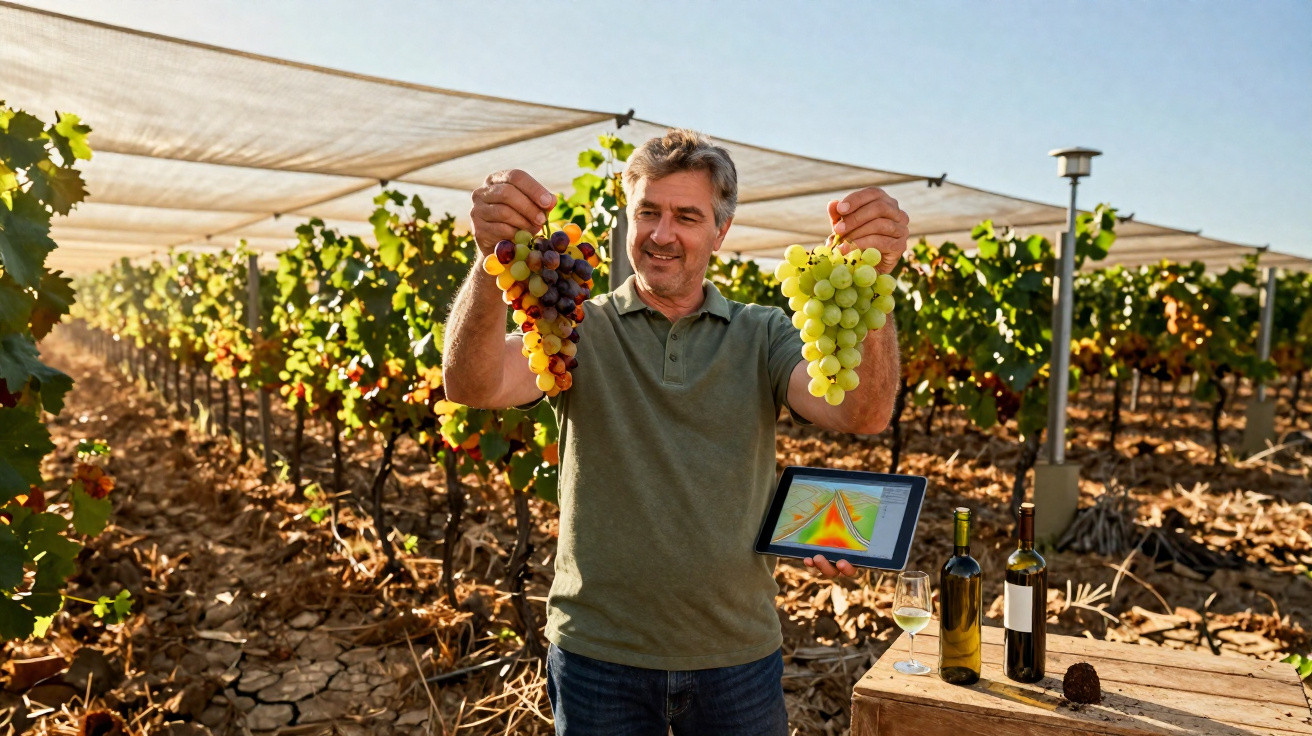
Wine buyers commonly make their choice according to both the grape variety and the region in which it was grown.
Radishes rarely command that sort of loyalty, and the contrast helps to explain an increasingly serious issue for the wine sector.
With temperatures climbing, producers may have to replace the grapes they cultivate or relocate their vineyards to different areas.
Yet wine consumers are frequently loyal to recognised varieties and renowned wine-producing regions.
New research from Cornell University examines this problem, suggesting that consumer reactions to climate-driven changes could matter more than climate change itself.
Why wine is different
A vegetable grower can replace one crop with another with little to lose. For a wine producer, the situation is very different.
The variety of grape and its place of origin make up half the product, and consumers are reluctant to abandon either.
Researchers have developed more resilient vines for a warmer climate, but relatively few growers use them because customers continue to choose familiar names.
“Wine grapes are unique in that people are very attached to certain cultivars and the sense of the place where they come from,” said Justine E. Vanden Heuvel, professor of horticulture and one of the study’s authors.
“That’s not true with most other crops. Do you care where your radish comes from?”
Buyers love tradition
This loyalty is evident across every price bracket.
“Wine around the world has this tradition of having on the label the name of the grape and where it came from,” said Bradley Rickard, professor of food and agricultural economics.
“Even inexpensive box and jug wine has the name of grape and place of origin on the front, and even among less-sophisticated consumers, there’s recognition of that.
“This paper is trying to understand if changing anything about that formula – whether the grape, the location or the production method – can affect what consumers are willing to pay.”
A vineyard is not a single-season risk. Establishing one can cost more than $200,000 per hectare before its first meaningful harvest, after which it can remain productive for 30 years.
Consequently, a producer planting today is making a judgement about weather conditions decades ahead. The researchers calculated all future income and expenditure to establish which option offered the best return.
What the heat does
Severe heat can harm grapes. At excessively high temperatures, vines find it difficult to generate energy, while grapes start to lose colour and quality.
Under intense heat, the cells within grapes can also be damaged.
In heatwaves, grapes in direct sunshine may reach exceptionally high temperatures. Researchers have recorded grape bunches at around 58°C (136°F).
At such temperatures, grapes may lose both flavour and colour. For Cabernet Sauvignon, extreme heat can cut yields and alter the wine’s flavour.
Cooling the vineyard
The first approach lets growers continue producing the same grapes in the same location. Rather than altering the vineyard’s variety or site, they shield the fruit from extreme heat by fitting shade cloth above the vines.
This can lower fruit temperatures, particularly during heatwaves.
The study found that shade cloth could substantially limit crop losses in exceptionally hot years. Installing and maintaining these systems, however, can be costly.
Nevertheless, consumers reacted favourably to the measure.
Once people were told that a wine producer used shade cloth to safeguard grapes against extreme heat, they were prepared to pay approximately 17 percent more for the wine.
This represented the greatest price rise of the three strategies examined.
Trading tradition for resilience
The second solution involves changing the grape variety. In place of Cabernet Sauvignon, growers could choose a heat-tolerant grape such as carignane, which performs more effectively in hotter climates.
Although it sells for less than half the price of cabernet, it produces more than twice as much fruit, leaving revenues broadly similar.
More importantly, its yield declines very little in an extremely hot summer, whereas cabernet’s output falls sharply. Consumers were willing to pay roughly 12 percent more for this change.
The high cost of moving
The third option means changing location. A producer might transfer the same cabernet vines to a nearby, cooler area such as Lake County, where land is considerably cheaper. The difficulty lies with the label.
Cabernet from Lake County sells for less than one-third of the Napa price, meaning relocation delivered the poorest returns in almost every scenario.
The finding is notable: carignane grown in Napa commands a higher value than cabernet grown elsewhere, indicating that location matters even more than the grape variety.
Consumers may reward adaptation
The researchers reached these findings by surveying more than 300 American wine purchasers.
Every participant was shown the same wine on two occasions: first without additional information and then with a note explaining how it had been adapted for heat. This enabled the team to assess the value consumers placed on that account.
“It is safe to say that consumers are beginning to understand how climate change is affecting wine production,” said Alex M. Susskind, professor of wine education and management.
“And they appear to be willing to pay a price premium as wine makers adjust to the new their normal.”
There is, however, a limitation: those additional payments are likely to diminish.
Because people’s interest in environmental selling points tends to wane, the researchers assumed that the premium would last only through the first few years.
The argument for adaptation therefore depends heavily on this initial consumer enthusiasm.
No single strategy
Which route should a grower take? The answer depends on the climate.
If warming remains limited, conventional cabernet in Napa remains the strongest option. With moderate heat, shade cloth becomes worthwhile.
Under the most severe conditions, resilient carignane performs best.
This is the central conclusion: vineyard adaptation is not a single remedy that can be introduced and then ignored.
Instead, it involves a series of decisions about an unpredictable future, each balanced against consumers who may or may not remain persuaded by the story presented on the bottle.
The Cornell team cannot remove that uncertainty, but it provides growers with a clearer framework for assessing it.











Comments
No comments yet. Be the first to comment!
Leave a Comment