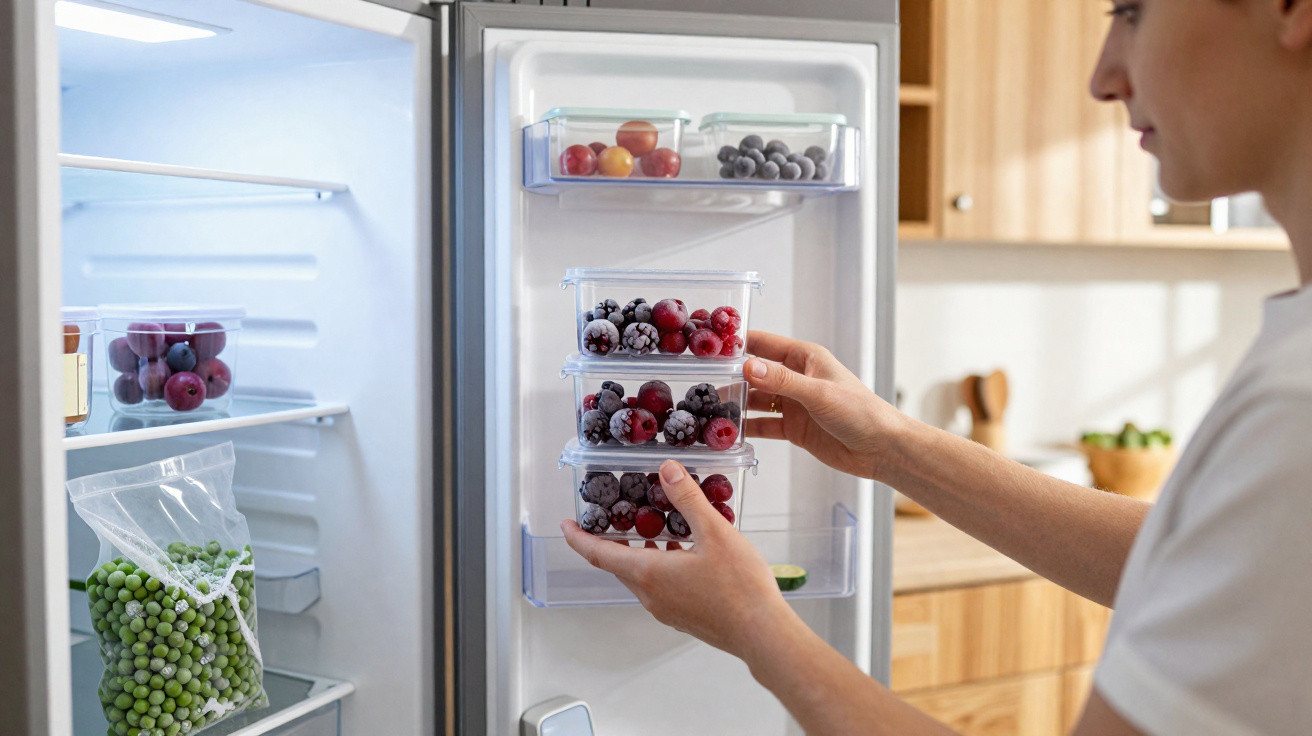
There is a particular sort of heartbreak waiting at the back of a freezer. You know the moment: you retrieve what ought to be a brilliant midweek find – the batch-cooked lasagne or those lovely salmon fillets you splashed out on – only to meet a shadow of the meal it once was. There are frost crystals, greyish edges and an oddly dry texture that tastes of let-down. Freezer burn spoils more than food: it wrecks plans, dampens moods and undermines that small sense that life is at least vaguely under control.
Most of us fault the freezer itself, or the budget freezer bags bought at 11pm in Tesco. Others simply accept it, telling themselves, “Well, that’s what happens in freezers,” as though it were as inevitable as gravity or the smoke alarm sounding when you make toast. Yet among the food science and kitchen-geek advice lies one straightforward detail that can make a real difference: where food is stored. Oddly, nearly everybody gets this part wrong.
When frozen peas rebelled
My own freezer epiphany began with a bag of peas. Hardly dramatic, I know. At the rear of the bottom drawer, behind some chicken thighs of uncertain vintage and a tub of ice cream transformed into sweet, crunchy snow, they had fused into one solid icy lump. I can still recall the dull thump as the peas landed on the worktop and would not separate, as if they were objecting to years of being ignored. That was when I understood that I had been using my freezer as a storage dungeon rather than a useful appliance.
Naturally, I did what mildly alarmed adults tend to do: I disappeared down a rabbit hole of food science, chefs’ tips and forums for freezer obsessives. Somewhere between a food-safety chart and a sous-vide fan debating vacuum sealers, I came across one curious instruction: shift delicate foods away from doors and vents, placing them in the middle-back “thermal sweet spot”, and freezer burn can be reduced by around 40%. It felt suspiciously simple, rather like being assured that life improves if you simply “drink more water and go for walks.”
Then again, it makes sense. Whenever you open the freezer, food warms slightly, warm kitchen air enters and cold air escapes. So where do we place the best items? Ice cream goes in the door, salmon sits right at the front, and leftovers perch on another item in a half-open container. We effectively arrange them for sacrifice.
What freezer burn really means – and why freezer layout counts
First, let’s remove the guilt: freezer burn is not grime, mould or an unexplained freezer illness. It is simply moisture leaving your food and then freezing again as surface ice crystals. Freezer air is both cold and dry, so if food is poorly packed or repeatedly exposed to slight warming and cooling, moisture is literally drawn out of it. A delicious chicken breast becomes dry and stringy. Chips turn pale and brittle. That lasagne develops strangely grainy edges, as though it has aged ten years within two months.
Many people assume packaging is the entire issue. They are not mistaken, since exposure to air matters greatly. However, the more food scientists and chefs I spoke with, the more one point was repeated: stable temperatures matter just as much. Each small temperature change – not enough to thaw food completely, merely enough to alter it – causes water inside to move and freeze again elsewhere. Across weeks or months, this is what destroys texture.
Here is what few people are told at home: every part of a freezer behaves differently. It has warmer areas, colder areas and draughty areas. The door is the most temperamental location, repeatedly exposed to warm air from the kitchen. Spaces near vents, fans and evaporator coils receive more direct cold air, but also experience greater turbulence. That peaceful shelf or drawer in the middle-back? It is the ideal home for food, where temperatures remain low and even. This is the area that can quietly prevent up to 40% of the freezer burn you are fighting.
The 40% freezer burn trick: finding the “thermal sweet spot”
Here is the key point: moving your most vulnerable items – meat, fish, ice cream and saucy leftovers – to the middle-back of the freezer, away from the door and direct airflow, gives them far better conditions. Think of it as premium seating in your frozen world. They are not disturbed whenever someone pauses to decide what to eat. They are not hit by shifting air currents. Instead, they remain in still, dependable cold, quietly getting on with things.
Food-laboratory tests and kitchen trials reveal something unexpectedly precise. Compared with the door and front edges, the central-back section generally undergoes smaller temperature changes whenever the freezer is opened and shut. These are not huge fluctuations, only a few degrees here and there. Over several weeks, however, those minor shifts accumulate like a slowly dripping tap. Put identical pieces of chicken in the door and in the steady middle-back area, and the one in the “good seat” may emerge with around 30–40% less surface dehydration and visible freezer burn.
Which foods belong in the sweet spot
This is the place to show favouritism. Reserve the freezer’s sweet spot for food you genuinely want to enjoy later, rather than items you are merely concealing from yourself. That includes raw meat and fish, cooked stews and curries, homemade sauces and stocks, and the bolognese you were particularly pleased with. Keep ice cream and sorbet there too, especially those pricier brands you claim not to buy on a Tuesday.
The principle is straightforward: the higher a food’s water content, and the more noticeable any change in texture would be, the more it gains from a cold, stable middle-back position. Chips and peas can tolerate the more unpredictable areas. A steak or delicate fish fillet, on the other hand, suffers from poor placement. Give these foods the quiet central space and you will waste much less of the good stuff.
Why the freezer door is not your friend
We tend to treat the freezer door as desirable property. It has neat little shelves, it is within easy reach and it feels “handy”. In freezer terms, though, it is chaos. Each time someone stands with the door half open, staring into the illuminated void while considering dinner, that section warms up. Anything stored there becomes a frontline soldier in the battle against your own indecision.
Honestly, nobody opens a freezer, takes precisely one item and closes it again within two seconds like a disciplined kitchen ninja. Children search it for ice lollies. Flatmates open it because they cannot remember what is inside. You look in merely to establish that there is “nothing to eat”, despite it being completely full. For a tub of ice cream in the door, the result is a temperature rollercoaster.
So here is the simplest change that truly makes a difference: use the freezer door for items that are not especially bothered. Frozen vodka, ice packs, bags of ice cubes, herbs frozen on a whim and half a bag of oven chips all work well there. None will cause heartbreak if it becomes slightly frosty or clumped together. Move prized foods further inside, and treat the door as your freezer’s practical, slightly untidy hallway rather than its sitting room.
Shelves, drawers and draughty areas
Every freezer has its own behaviour, which is where this becomes oddly personal. Upright freezers often show greater temperature differences between shelves, particularly when they are packed too tightly or left almost empty. Drawer freezers can protect food more effectively simply because the drawers reduce the amount of cold air that escapes on opening. Still, the overall pattern is nearly always the same: edges and spaces near vents are more erratic, while the middle-back is steadier.
You do not need a thermometer or a spreadsheet to learn your freezer’s character. Try a simple, low-tech approach instead: observe where ice cream softens first and where frost develops most quickly. Take note of the shelf that seems to cover everything with tiny ice crystals, like winter on a windowpane. That is unlikely to be the sweet spot. The section where food remains solid and unchanged week after week is where your best meals should go.
Create a “quiet corner” for food
Airflow is another overlooked cause. Freezer vents and fans circulate cold air, and although this keeps the appliance cold overall, foods directly in that path receive more drying airflow. A narrow stream of moving air can gradually strip moisture from unprotected surfaces. It is much like leaving damp washing directly in front of a fan: it will dry more rapidly whether you intended it to or not.
Avoid pressing your favourite steak or leftover Sunday roast directly against a vent, and do not stack soft foods immediately beneath a fan. Move them slightly to one side and let them sit in a calmer area. It is such a minor adjustment that shifting a bag ten centimetres to the left can feel faintly ridiculous. A month later, though, you may open the container to find the gravy still resembles gravy rather than an archaeological dig.
The emotional cost of freezer burn
Freezer burn is often discussed as a minor technical nuisance, but it carries a quiet emotional sting. One evening, fork in hand, you face the icy remains of something you prepared on a Sunday when you had more energy. You remember the chopping, stirring and washing-up. Now the edges are grey and flaking, the sauce has split, and you begin to wonder why you make the effort to be organised at all.
We have all reached the point of deciding, “Forget it, I’ll just order a takeaway,” before pushing the damaged meal back into the freezer, because throwing it away feels like admitting defeat. This is not only about food; it is about feeling that your effort does not endure. Freezer burn erodes that modest, hopeful belief that good days can be stored for later. It tells you that you tried, yet time won anyway.
That is why this understated 40% trick has more significance than it first appears. It is not merely about better-tasting salmon. It is about opening the freezer on a Tuesday in February, when the rain feels personal and your coat still has not dried, and discovering something made weeks earlier that remains appetising. It is a small reassurance that “past me had my back,” rather than “past me messed this up too.”
A practical freezer reshuffle that lasts
Most kitchen advice disappears within days because it requires you to become an entirely different person. Label every item. Rotate stock each week. Maintain an inventory. People with jobs, children and mountains of laundry do not generally live that way. Their reality is more like this: open the door, push the item in, hope for the best, then close the door with a hip because both hands are occupied.
The advantage of concentrating on placement is that it requires a one-off change in perspective rather than daily discipline. You need neither a costly organiser nor special containers, although decent bags and boxes certainly help. Simply divide your freezer into “zones”: keep the good items in the middle-back sweet spot, and assign the door and edges to foods that can look after themselves. Afterwards, whenever you freeze something, you are only deciding which area suits it, much as you would choose between a cupboard and a junk drawer.
Perfection is not necessary. Mystery tubs will still appear, and some items will remain crammed in at peculiar angles. You will still lose the occasional serving of soup behind the frozen berries. But once you mentally reserve the centre-back space for the best food, your default behaviour changes. The food you most want to preserve will naturally migrate to the steadiest, safest spot. That by itself quietly cuts the number of tragic, frost-covered dinners.
When the freezer begins to give something back
After my own rather absurd evening of freezer Tetris, the kitchen resembled a crime scene, with half-open bags and melting ice everywhere. I gathered the “premium” foods – meat, fish, homemade meals and decent ice cream – in the calm central section. The door shelves were reassigned to ice, inexpensive frozen vegetables and stray pieces of bread. Bottom corners became long-term storage for ingredient-like items: frozen stock cubes, chopped onions and small tubs of tomato paste.
The improvement was not immediate. I noticed it several weeks later, when I took out a tub of chilli that had been frozen months before and realised, with a small jolt, that it still looked… fine. There was no thick icy beard on the lid, and no discolouration around the edges. It was simply a rich red sauce, exactly as I remembered it. It tasted just as it had on the day I cooked it. For once, the freezer no longer seemed like a bin operating in slow motion. It felt like a pause button that genuinely worked.
That is the understated benefit of knowing where food belongs. No specialist equipment or complex charts are needed, only the awareness that a freezer is not one uniform mass of cold. It has weather and microclimates. By treating the middle-back area as a protected space for your best food, you avoid a substantial share of the freezer burn you may have always regarded as unavoidable.
The small change that feels surprisingly capable
There is a distinct satisfaction in opening the freezer without meeting a wall of icy regret. It is not about becoming a domestic god who alphabetises spices and remembers to soak beans overnight. It is about modest, useful victories that genuinely improve everyday life. Putting your best leftovers in that central area takes seconds, while the benefit arrives quietly weeks later, when it matters most.
There is no need to tell anyone or turn it into a grand project. The next time you unpack shopping or put away leftovers, pause briefly and consider: should this go in the protected middle-back, or can it cope with the wilder edges? That is all there is to it. That is the entire “hack,” if we have to call it that.
Then, the next time you retrieve a perfectly good lasagne from deep in the freezer – still rich and tender, rather than crystallised into misery – you will notice it. There is that small flash of relief and quiet competence. You did not merely freeze dinner; you safeguarded it. Having 40% less freezer burn is not only about food. It is about feeling, just this once, that your future self may actually catch a break.






Comments
No comments yet. Be the first to comment!
Leave a Comment