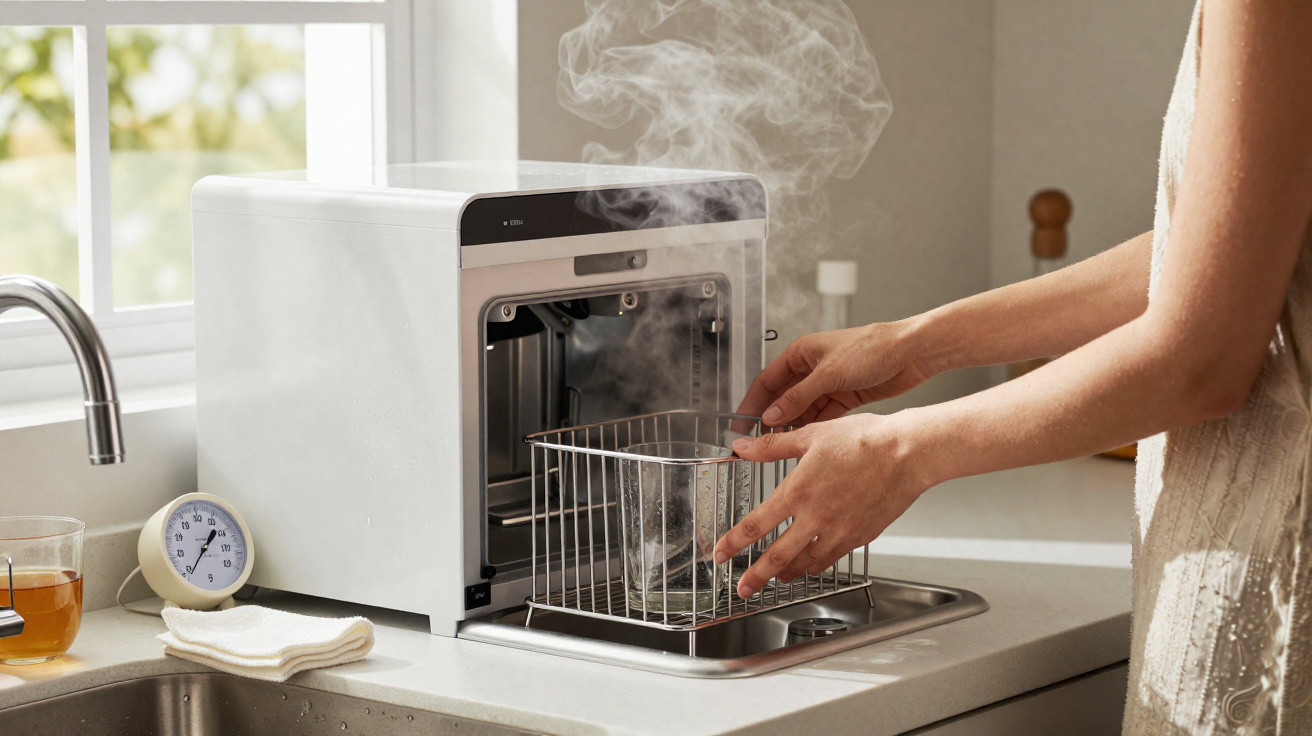
The dishwasher beeped, the kitchen fell silent, and you know what happens next.
You bend down, open the still-warm door and a wave of damp steam rises like an invisible cloud. The plates gleam, the glasses sparkle and everything looks clean. So you stack it away, shut the cupboards and move on, without giving another thought to what has just happened in the air.
In many homes, emptying the dishwasher is an automatic response triggered by that familiar beep: a sort of domestic Pavlovian reflex. We want the job done immediately so we can cross it off the mental list of chores.
But what if that timing quietly reveals who really understands hygiene - and who is still being caught out by steam?
Why that impatient “beep reflex” might be the dirtiest part of your clean routine
Step into any open-plan kitchen at 7 pm and you will usually spot the same scene. The appliance has just beeped, someone pulls the door open, a warm cloud fogs their glasses and leaves a faint film on the drinking glasses. The scent of detergent rises alongside a slight note of reheated food. It all looks clean, almost like an advert.
What remains unseen is what the steam carries with it: tiny droplets that have travelled through the filter, the tub and the racks. There may be traces of detergent and organic residues that the cycle has greatly reduced, but has not magically sent into another dimension. The dishes are not dirty; they are simply still exposed, still warm and still in the process of settling.
We have all hurriedly put away glasses that are still lukewarm, only to find them sticking together in the cupboard. In restaurant kitchens, professionals know not to take out a piping-hot glass to serve wine in. At home, we often assume it is different because it is “only” for the family. Yet the same physical rules apply: heat + moisture + a smooth surface = ideal ground for anything that thrives in damp conditions.
The US Environmental Protection Agency and several microbiology teams have examined household dishwashers. They found populations of yeasts, black fungi and opportunistic bacteria on seals and inside the tubs. It is hardly glamorous, but it is not surprising: a dishwasher is warm, damp, frequently closed and can contain food remnants trapped in the filter.
Modern cycles generally wash effectively, especially at higher temperatures. The more sensitive stage comes afterwards. Once the door opens, the internal ecosystem is suddenly released into the kitchen air. That warm steam, condensing on glasses and plates, can carry minute traces of what was present inside the machine before washing. It is not dramatic as a one-off, but it can become a repeated habit, day after day.
So what does waiting 30 to 60 minutes actually change? First, the temperature of the dishes falls. A cooler surface creates less condensation when it is removed into a cooler room. Less condensation means less standing water at the bottom of clean bowls or between stacked plates.
Secondly, some of the moisture settles back into the tub or disperses if the door is left slightly ajar. The temperature contrast is less abrupt, the steam is less dense and the invisible cloud leaving the machine no longer has the same ability to wet surfaces. The result is dishes that dry more thoroughly, with fewer micro-films, fewer stale cupboard smells and, at the margins, fewer ideal conditions for residual micro-organisms to develop.
Finally, waiting alters the way you handle the load. You do not burn your fingers, place a still-scorching dish on a slightly damp worktop or close a cupboard while steam remains trapped inside. It is a small change in timing, but it says a great deal about understanding hygiene as a collection of actions rather than simply a machine cycle.
The 30–60 minute rule: how to actually use your dishwasher like someone who knows hygiene
The easiest method sounds almost trivial: when the beep goes off, do not fling the door fully open. Press stop if necessary, wait 20 to 30 minutes, then open the door by a few centimetres. Let the appliance vent gently, like airing out a sauna. At that point, the steam can escape without hitting you straight in the face.
Between 30 and 60 minutes after the cycle has ended, the dishes should be warm rather than hot, and close to room temperature. That is the best time to empty the dishwasher: dry enough to put away without drips, yet cool enough not to turn your cupboards into a steam room. That modest adjustment in timing radically changes the sense of “cleanliness” when you pick up a glass the following day. It feels drier, glasses cling less to your fingers and plates smell less enclosed.
Many people assume that putting everything away faster means being more “clean”. In practice, that rush produces a subtle side effect: it seals moisture into cupboards and drawers. Glasses stacked while still damp can retain a slight smell, particularly in cupboards with poor ventilation. Let us be honest: nobody really manages this every day with a perfect manual routine involving a tea towel and an inspection under the light.
More commonly, people run a cycle in the evening, hear the beep, open the door wide and put everything away in one movement. The next day, there is a slightly dull glass, a bowl that remains damp at the bottom or a spoon with a dried droplet stuck to it. The dishwasher, tablet or programme gets blamed. In reality, the story is often told by that combination of steam, timing and overly quick storage.
Domestic hygiene specialists who study our routines often discuss these “grey areas”: actions viewed as clean that nevertheless recreate ideal conditions for moisture and biofilms. Your dishwasher is not a sterile autoclave; it is a compromise. Water does not always reach every corner, filters are not emptied after every cycle and the interior can stay damp for hours.
“It is not the machine that creates hygiene; it is the sum of the small choices made around it,” a domestic microbiology specialist told me. She stressed one simple point: dishes come out broadly clean, but the microbial world never falls to zero.
For anyone who prefers clear guidelines, these are the key habits to adopt:
- Wait 30–60 minutes after the beep before unloading the dishwasher, especially in the evening.
- Leave the door slightly ajar for ventilation instead of opening it fully all at once.
- Empty the dishwasher in one go, rather than in small stages that repeatedly reopen the “damp chamber”.
The quiet social signal behind waiting: what your dishwasher habits say about you
There is something revealing about the way we respond to that beep. People who rush to it may want to show that they are “on top of” the housework and that no chore is left hanging around. Those who wait a little are not necessarily lazier; they have simply absorbed a different approach to hygiene, one based less on the visible action and more on invisible timing.
Waiting 30 to 60 minutes is not fussy behaviour. It means accepting that clean dishes are not only about detergent, but also about drying, air and materials. Anyone who has lived in a small, damp flat understands this: a cupboard that smells musty often starts with dishes that were put away while still slightly wet. That discreet delay says a lot about how attentively we listen to the signals our homes give us.
There is also something socially interesting here. The person “in the know” may be lightly teased: “Aren’t you emptying the dishwasher? It finished ages ago.” Meanwhile, they are watching the steam, noticing the dampness and mentally counting the minutes. It is not obsession; it is a quiet language of understanding how air moves, how heat escapes and how cleanliness is also decided after the cycle ends.
The next time the beep sounds, you may see the scene differently. You may think about that invisible cloud, the smell inside cupboards and those glasses that become dull for no obvious reason. Perhaps you will let the end of an episode play out, start another task or simply resist the instinct to hurry straight towards the handle.
That pause, that apparent “delay”, could become a new invisible sign of attention to modern hygiene. It is neither spectacular nor Instagrammable, but it is deeply everyday. And the next time you see someone open the dishwasher into a burst of steam, you may find yourself wondering which camp you would rather be in.
| Key point | Details | Why it matters to readers |
|---|---|---|
| Wait 30–60 minutes before emptying | Allow the cycle to end, then leave the dishwasher for at least half an hour before opening the door fully and unloading it. During that time, the heat and steam naturally reduce. | This reduces hot, wet surfaces that retain moisture in cupboards and makes “clean” dishes feel properly dry rather than merely hot and damp. |
| Leave the door ajar; do not pull it wide open | Open the door by only a few centimetres once the programme has finished, then leave it that way while you get on with something else at home. | Steam can escape gradually into the room instead of rushing onto your face, walls and supposedly dry dishes. |
| Empty it all at once, rather than in several short trips | Choose a time when you can unload the dishwasher completely instead of taking out two plates now, three glasses later and reopening the steamy compartment each time. | It reduces the length of time that kitchen air stays humid and limits how often newly dried items are exposed to fresh, warm moisture. |











Comments
No comments yet. Be the first to comment!
Leave a Comment