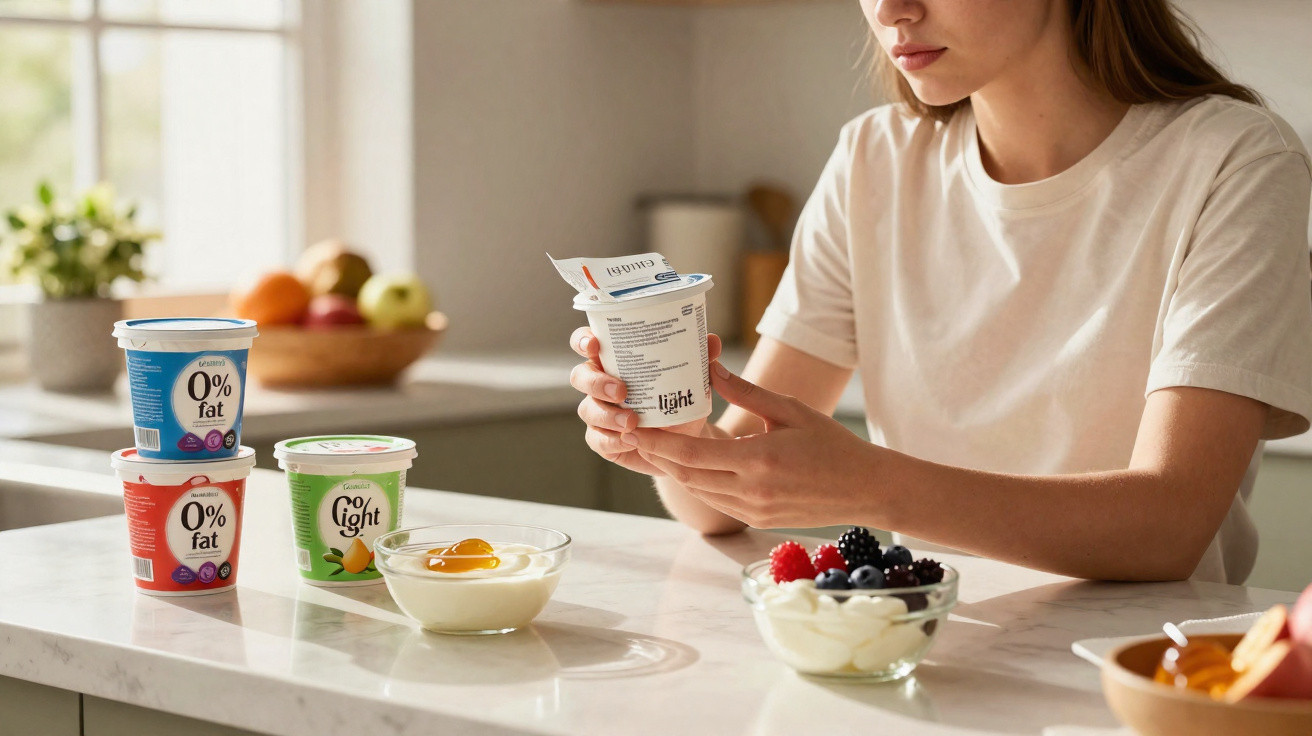
A quick glance at the ingredients list on my favourite low-fat yoghurt – and suddenly the “healthy” snack no longer seemed quite so harmless.
What began as a routine reach into the chilled aisle ended in a small moment of shock. For the first time, I properly examined what was in the low-fat yoghurts I bought. What I discovered bore little resemblance to the straightforward dairy food I remembered from childhood – and it fundamentally changed the way I shop.
Why “low-fat” does not automatically mean healthy
In supermarkets, brightly coloured pots practically demand attention with claims such as “0% fat”, “no added sugar” and “30% fewer calories”. They suggest a guilt-free choice and an easier way to manage your weight. The key question, though, is this: what replaces the fat or sugar when it has been drastically reduced?
Fewer calories on the front can mean a more complicated chemistry set on the back.
Reducing the fat content significantly changes the basic recipe. Fat provides flavour, contributes to fullness and creates a creamy texture. Once it is removed, manufacturers need to compensate – otherwise few people would choose the product again.
Calories reduced, complexity increased
Traditional natural yoghurt requires very little: milk, live yoghurt cultures and, occasionally, a little cream. Many low-fat versions, however, suddenly come with a lengthy list of extra ingredients. The pot can start to resemble a small laboratory project:
- Thickeners to replace the missing creaminess
- Stabilisers to stop ingredients from separating
- Flavourings to imitate the taste lost when fat is removed
- Several types of sugar or sugar substitutes to keep the product sweet
The result is a lower calorie count but a noticeably longer ingredients list, with natural simplicity falling by the wayside.
“No added sugar” – yet still very sweet
The label “no added sugar” can be especially misleading. Many shoppers expect a mild product with a lightly tangy flavour. In reality, some of these yoghurts taste almost like desserts from the confectionery aisle.
The method lies in hidden carbohydrates and sweeteners. They provide few or no calories, but they can keep the palate accustomed to intense sweetness. Anyone eating these products every day may become used to that level of sweetness, making fruit seem bland by comparison.
Sweeteners may save calories in the moment, but they can also increase cravings for sweet foods over time.
The possible effects of particular sweeteners on gut bacteria, blood sugar and food cravings have been debated for years. Research is not conclusive on every point, but one thing is clear: “no added sugar” does not automatically mean “without concern”.
When creaminess matters more than a simple recipe
A low-fat yoghurt is meant to feel on the tongue as though it were a full-fat cream yoghurt. Achieving that means carefully altering its texture. The spoon should almost stand upright, the yoghurt should look glossy and nothing should appear watery.
Additives for the perfect spoonful
A range of additives may be used to create this effect. Common examples include:
| Ingredient | Function |
|---|---|
| Gelling agents such as pectin | Makes the product firm and thick |
| Gums such as guar gum | Creates a smooth, creamy texture |
| Modified starch | Binds water and prevents a watery layer from forming |
| Gelatine | Gives a creamy mouthfeel |
These substances are permitted and their quantities are regulated. The more relevant question is whether you want them in an everyday staple, or would rather reserve them for an occasional cake.
Less fat, more replacements
A closer look reveals a pattern: the more aggressively a yoghurt is marketed as “light”, “low-fat” or “0%”, the longer its ingredients list tends to be. It may look like a light snack on the outside, while inside it is a construction of substitutes and processing aids.
In appearance and mouthfeel, much of it seems like “normal” yoghurt – but on paper it often has very little in common with it.
Reading the ingredients list: the chilled-aisle revelation
Comparing a low-fat yoghurt with a plain natural yoghurt is often the turning point. Suddenly, the supposedly “old-fashioned” product seems remarkably modern simply because its composition is so clear.
Why plain yoghurt usually has the advantage
A good natural yoghurt contains just two or three components. Set beside a low-fat alternative, the latter can quickly reach a double-digit number of ingredients. Typical additions include:
- Skimmed milk powder to raise the protein content
- Several sweeteners used together
- Flavourings that suggest fruit despite little or no real fruit being present
- Colouring ingredients so strawberry yoghurt really does appear bright pink
Anyone who consciously compares these lists side by side can understand why many nutrition specialists favour simple products. Calories alone are not what matters; overall quality matters too.
Is trust in flavourings and colourings justified?
Flavourings and colourings are tightly regulated, but they can still leave an unpleasant impression. After all, they mask the simple taste of milk and real fruit. We are known to eat with our eyes, and vividly coloured pots can easily mislead them.
If you often find yourself asking, “How much of this is actually food, and how much is simply appearance and show?”, you soon notice how strongly packaging shapes perception. The pack promises naturalness, while the small print often tells a different story.
Marketing often beats nutrition on the supermarket shelf
Why do these products keep ending up in shopping baskets despite all the criticism? The design of the pots offers an answer: psychology, colour theory and nutritional promises work together here.
Slim silhouettes and pastel colours
Narrow waists, delicate shades and reassuring slogans all speak directly to the guilt that can follow a holiday or an indulgent weekend. “I am making a better choice with this yoghurt,” you might think. It creates the impression that you are automatically doing something good for your heart, figure and health.
The promise of a “better self” sells far more effectively in the chilled aisle than a sober ingredients list.
The myth that less is always better
A simple equation has become firmly established: less fat and less sugar must automatically mean healthier. The reality is more complicated. A yoghurt with a little more fat but no long list of additives may be the more sensible choice in the long term.
There is another factor too. People who rely on light products may be more inclined to eat extra food elsewhere. Psychologically, the thought, “I have saved calories”, can feel like permission for additional snacks.
How to make a better choice in the chilled aisle
The good news is that you do not need to be a nutrition expert to make better decisions in the dairy aisle. A few straightforward rules are enough, and they are easy to remember.
The three most important questions to ask when looking at the pot
- How long is the ingredients list? In this case, shorter is almost always better.
- Do I understand most of the terms without using my phone or a chemistry reference book?
- Are milk and yoghurt cultures listed first, or are sweeteners and starch?
It also helps to place two products next to each other briefly: a simple natural yoghurt and a heavily advertised low-fat yoghurt. A direct comparison can make the difference clear within seconds.
Why natural yoghurt is often the smartest option
Natural yoghurt or whole-milk yoghurt offers several advantages from the outset: naturally occurring calcium, minimal processing and a short ingredients list. Its flavour may initially seem less exciting, but it is easy to enhance yourself.
Practical ideas include:
- Stirring through fresh berries or pieces of apple
- Using a small amount of honey or maple syrup instead of ready-made sugar-heavy additions
- Adding variety with cinnamon, vanilla or chopped nuts
- In autumn, choosing a spoonful of apple or pear compote instead of a ready-made fruit preparation
Anyone who decides the flavour of their own yoghurt also keeps track of the sugar, fat and additives it contains.
What terms such as sweetener, starch and stabiliser actually mean
Many of the descriptions on yoghurt pots sound technical. They are legally permitted in small quantities and have undergone toxicological assessment. Even so, it is useful to have a broad understanding of several categories.
Sweeteners such as acesulfame K and sucralose provide very little energy, but they influence how sweetness is perceived. Sugar substitutes such as sorbitol and xylitol contain calories, though generally fewer than table sugar, and can cause bloating or diarrhoea when consumed in larger amounts.
Starches and thickeners are used to bind water and simulate creaminess. Taken individually, they are not necessarily dramatic, but in everyday products they often indicate that considerable work has gone into appearance and mouthfeel because savings were made elsewhere.
How your view of yoghurt can change over time
Once you have consciously read the backs of yoghurt pots, you are unlikely to buy low-fat yoghurt as unthinkingly as before. The fat content is no longer the only consideration; the whole composition becomes important. Many people then gradually move away from heavily advertised diet products towards plain yoghurt, local brands or even homemade yoghurt made with milk and cultures.
Ultimately, this is not about bans but about clarity. A dessert can be sweet and a yoghurt can be creamy – but it is worth knowing how those effects have been achieved. Once you understand that, you can make more informed choices in the chilled aisle and need fewer colourful promises on the front of the pot.















Comments
No comments yet. Be the first to comment!
Leave a Comment