Fresh chestnuts should be one of autumn’s easiest treats, but they can be frustratingly unpredictable. A small batch in the oven may end up dry or floury, while the shell and inner skin refuse to come away neatly.
The useful trick is to score the chestnuts, soak them in cold water, then cook them in the air fryer. The soak adds a little moisture, while the air fryer cooks a modest batch quickly. The result should be tender chestnuts with shells that are easier to peel while warm.
The air fryer is handy for speed, but scoring, soaking and peeling while warm are the details that matter most.
Choose edible sweet chestnuts
Use fresh sweet chestnuts sold for eating in supermarkets, greengrocers or market stalls during autumn and early winter. Look for nuts that feel firm and heavy for their size, with smooth brown shells and no mould, holes or obvious damage.
Do not collect chestnuts from parks unless you can identify them with complete confidence. The shiny conkers commonly found in the UK are horse chestnuts, not edible sweet chestnuts. They should not be eaten.
Chestnuts do not keep as long as many other nuts. Buy what you expect to cook within a few days and store them in the fridge in a paper bag or a loosely covered container. Avoid keeping them in a sealed plastic bag at room temperature.
Avoid any that are very light, deeply wrinkled, mouldy or sour-smelling. Older chestnuts can be dry before cooking, and no method will fully restore them.
What you will need
- 400g to 500g fresh sweet chestnuts
- A small sharp knife or chestnut knife
- A stable chopping board
- A bowl of cold water
- An air fryer
- Tongs or a heatproof spoon
- A clean tea towel
Butter, flaky salt, honey, cinnamon or rosemary are optional for serving.
Why the soak helps
Chestnuts have a soft, starchy centre that can dry out in strong circulating heat. Soaking scored chestnuts in cold water for around 45 minutes gives them a little extra moisture. As they cook, that moisture creates steam inside the shell, helping the cut open and supporting a softer texture.
It is not a guarantee that every chestnut will peel perfectly: freshness, size and the thickness of the inner skin all make a difference. But it is a simple preparation step worth adding when you want chestnuts that are less dry and fiddly.
Never air fry chestnuts whole. Each one needs to be scored first so steam can escape during cooking.
A cut shell is a safety step as well as a peeling aid: unscored chestnuts can split or burst as pressure builds.
How to cook chestnuts in an air fryer
Air fryers differ in temperature accuracy, basket depth and fan strength. Use the timings below as a starting point, then check a chestnut near the end of cooking.
1. Wash and score every chestnut
Rinse the chestnuts under cool running water and dry them enough to handle safely. On a stable board, use a sharp knife to cut a cross into the rounded side of each shell.
Cut through the hard outer shell and into the thin inner skin, but do not try to cut deeply into the flesh. A cross often makes peeling easier, though a single slit can also work.
Take particular care with this job. Chestnuts are firm and can roll, so keep your fingertips away from the blade, work slowly and do not attempt to hold a chestnut in your hand while cutting it.
2. Soak for 45 minutes
Put the scored chestnuts in a bowl and cover with cold water. Leave them for about 45 minutes.
Some chestnuts may float. This can indicate that they are dry, but it is not a definitive test. Cook them if they otherwise look sound, then discard any with an unpleasant smell, mould or discoloured flesh when opened.
3. Drain and dry the shells
Drain the chestnuts well and pat the outside dry with a tea towel. They do not need to be bone dry; the moisture retained around the cuts is part of the point.
There is no need to add oil. If you would like a little extra browning, a very light coating of neutral oil is enough, but chestnuts cook well without it.
4. Air fry until tender
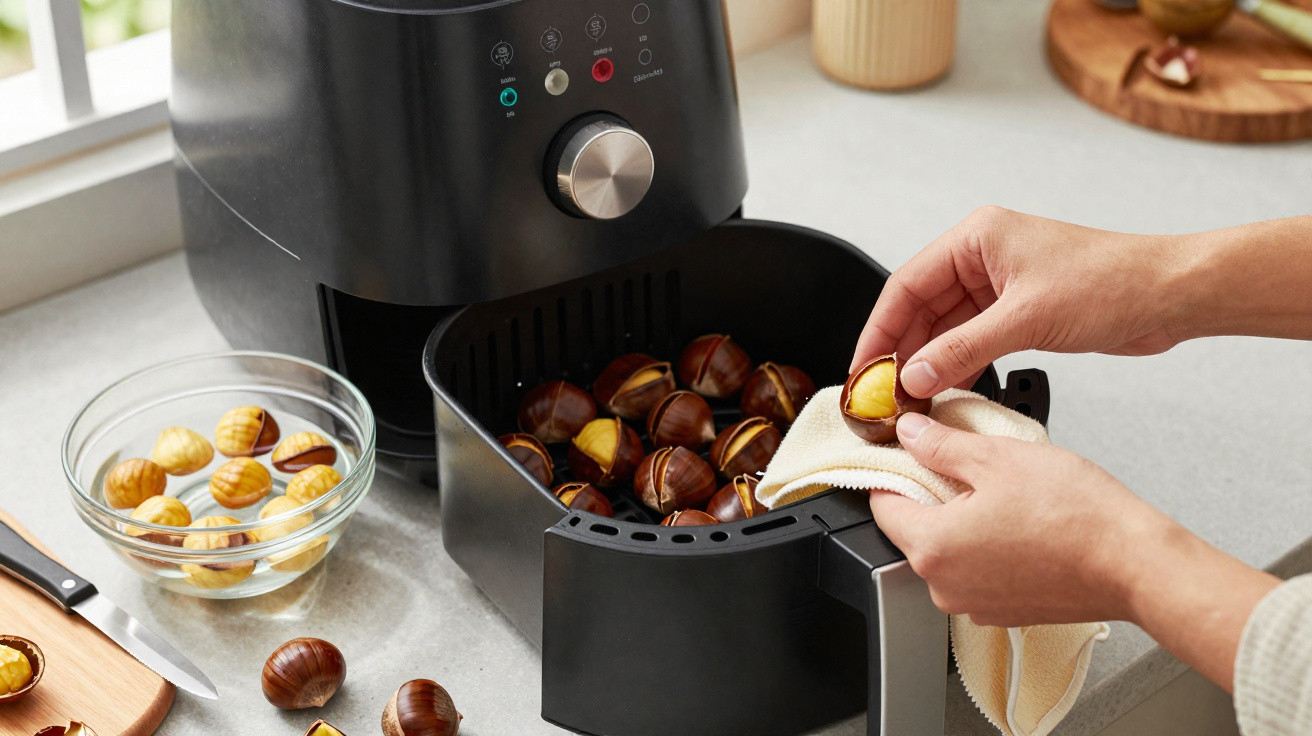
Preheat the air fryer only if the manufacturer’s instructions recommend it. Arrange the chestnuts in a single layer, leaving space for air to circulate. Cook in batches rather than piling the basket high.
Air fry at 200°C for around 12 to 16 minutes. Shake the basket or turn the chestnuts halfway through with tongs. They are ready when the cuts have opened and curled back, and a chestnut from the middle of the basket feels tender when pierced carefully.
Large chestnuts may need a few more minutes. If the shells are darkening quickly but the centres remain firm, reduce the temperature slightly and continue checking at short intervals.
Steam, then peel while warm
Tip the cooked chestnuts into a bowl and cover loosely with a clean tea towel for five minutes. This traps a little steam, which can help loosen both the outer shell and the papery inner skin.
Peel one or two at a time as soon as they are cool enough to handle. Keep the rest covered so they stay warm. Once chestnuts cool completely, the skin tends to grip the flesh much more tightly.
Be careful when opening them: hot steam can escape from the score. Use the tea towel for grip if needed, and do not give hot chestnuts to children until they have cooled sufficiently.
Common mistakes that lead to disappointing chestnuts
A few small details make a noticeable difference.
- Not scoring every shell: Whole chestnuts can split or burst in the heat.
- Cutting towards your hand: The shell is tough and slippery; always use a board and keep fingers clear.
- Overcrowding the basket: This restricts airflow and encourages uneven cooking.
- Relying only on the timer: Chestnut size and air fryer performance vary, so test one near the end.
- Cooking by shell colour alone: A dark shell does not always mean the centre is tender.
- Letting them cool uncovered: Cold chestnuts are much more awkward to peel.
- Using stale chestnuts: Dry, shrivelled chestnuts are unlikely to become soft and sweet.
- Mistaking conkers for sweet chestnuts: Use only chestnuts sold or clearly identified as edible.
Ways to serve them
Warm chestnuts need little more than a pinch of salt and a knob of butter. Their mild sweetness also works particularly well in autumn and winter cooking.
Try using peeled chestnuts:
- with roast squash, kale and blue cheese;
- chopped through stuffing with sage, onion and breadcrumbs;
- stirred into a mushroom risotto near the end of cooking;
- blended into a parsnip or celeriac soup;
- with honey and cinnamon as a simple pudding;
- folded through Brussels sprouts with bacon or pancetta.
If you are adding them to another dish, peel them while warm, then cool before chopping. Refrigerate leftovers promptly in a covered container and use them within two days. Reheat gently if desired, although they are usually best on the day they are cooked.
Is an air fryer better than the oven?
For a small portion, an air fryer is often more convenient than heating a full oven. It reaches cooking temperature quickly, takes up less kitchen heat and makes it easy to check the chestnuts as they cook.
That does not mean an oven is wrong, especially for a large batch. The air fryer’s main advantage is control: you can cook enough for one or two people, check after 12 minutes and make another batch if needed.
Make it a simple autumn routine
When sweet chestnuts appear in the shops, start the soak before you make dinner or put the kettle on. Forty-five minutes later, they need only around a quarter of an hour in the air fryer.
Score each shell, avoid overcrowding, cook until tender and peel while warm. Those straightforward steps make the difference between dry, stubborn chestnuts and a properly soft autumn snack.




Comments
No comments yet. Be the first to comment!
Leave a Comment