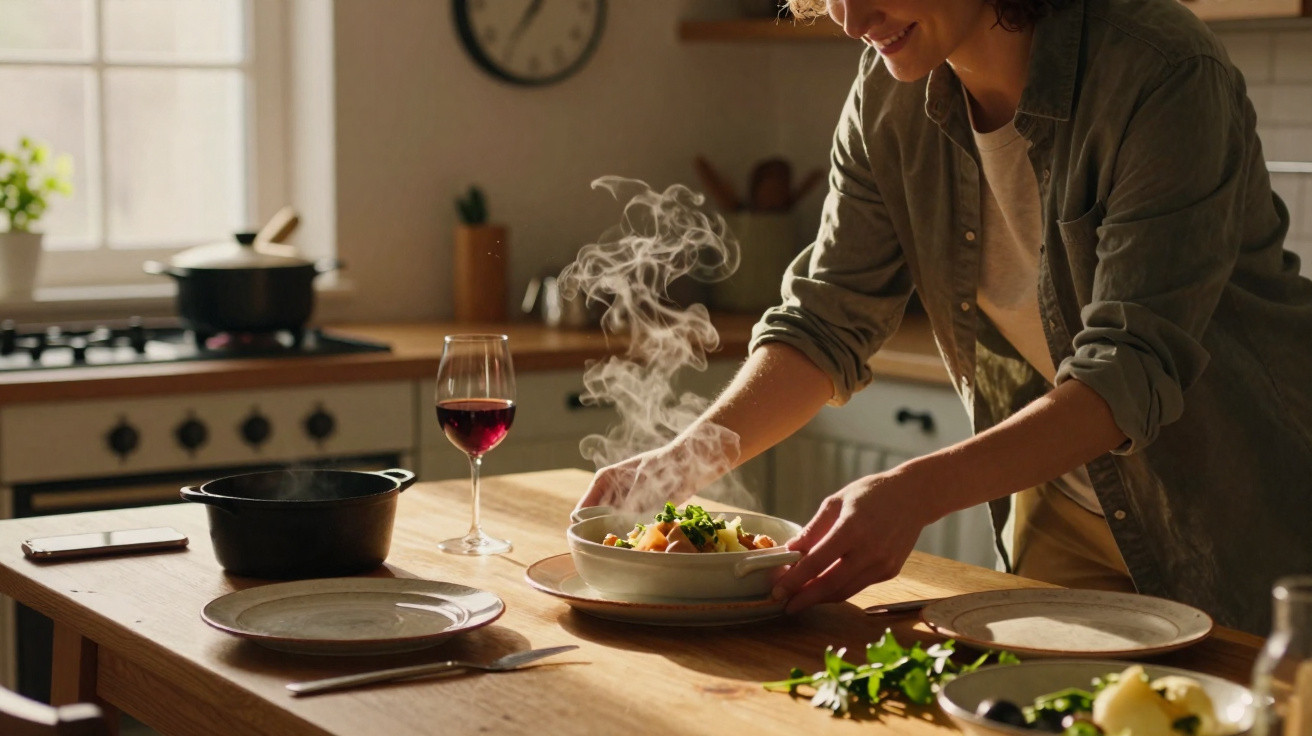
The first sound was the gentle crackle of onions landing in the pot. It was unhurried and easy-going, as though they had nowhere else to be. Beyond the window, the street was still in a frenzy: scooters passing, emails being checked on phones, last-minute alerts vibrating across kitchen worktops. Indoors, the light was slightly too dim and too golden, and the evening began to feel as if it could unfold at its own pace.
On an ordinary Tuesday, I chose to make dinner as though time simply did not matter. There would be no shortcuts, no microwave and no promise that it would be “ready in 15 minutes”. Only a weighty pot, a low flame and a recipe slow enough to lull you into calm.
Thirty minutes later, the rhythm of the entire flat had shifted.
So had mine.
The evening I let dinner set the pace
It began with one straightforward thought: I don’t want to rush tonight. The day had worn me down, leaving tension in my shoulders and my mind endlessly scrolling despite my phone lying face down. Rather than ordering a takeaway, I took down the large Dutch oven from the top shelf - the one normally reserved for weekends or visitors.
I gathered onions, garlic, carrots, a slightly weary leek and a pack of chicken thighs that I had intended to use days before. There was nothing elaborate about it. The ingredients were not really the choice; the pace was. Low heat, plenty of time and no multitasking.
As the onions softened at their own speed, their aroma gradually filled the kitchen. I seasoned them early, waiting until their edges became translucent and their centres turned sticky. Next came the chicken, skin-side down, browning until it looked as if it might catch on the base of the pot. I did not hurry it along with a spatula. I watched. I listened. I let it loosen when it was ready.
Once I poured in the white wine and stock, the kitchen became its own little climate. Steam clouded the windows, the pot gave out a quiet hiss, and the sounds from the street seemed increasingly distant. I looked at my phone once, then moved it into another room, like a guilty person being led away.
There is a change that happens when cooking stops being a race and becomes a ritual. Your breathing begins to follow the simmer. Instead of mapping out three steps in advance, you focus on the one happening in the pan. The prolonged, gentle bubbling of a stew or braise has a subtle effect on the mind. It draws your attention into the present, but softly - not in the prescribed “be mindful” way often found on wellness blogs.
Time doesn’t exactly stop, it just stops shouting.
By the time the dish was finished, it felt as though the whole evening had gone into the pot alongside the stock.
The cosy slow-cooked meal that brought me back to myself
To experience that shift, begin with a slow one-pot dish. Mine was a comforting braised chicken with root vegetables. Nothing viral and nothing “chef-y”. Just well-browned chicken thighs, carrots, potatoes, leeks, garlic, bay leaf, thyme, a dash of wine and a generous amount of patience.
First, I browned the chicken thoroughly, then set it aside. The vegetables went into the same pot, collecting every golden scrap left on the bottom. I returned the chicken, poured in enough liquid to come halfway up it, reduced the heat to the faintest possible simmer and covered it with the lid. After that, the recipe came down to one instruction: wait.
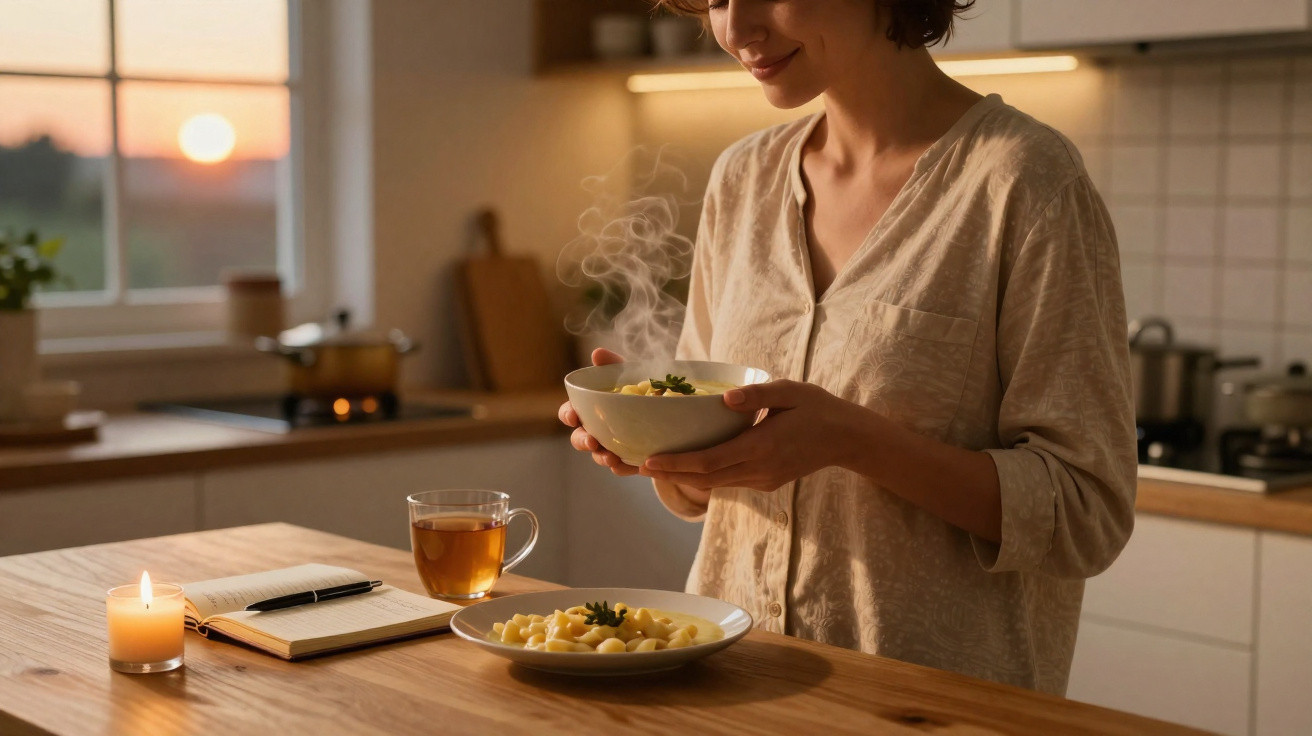
This was the point at which the evening truly changed direction. As the chicken gradually became tender, there was nothing pressing to get done. I silently cleared the worktop. I laid the table sooner than usual, using proper plates rather than the mismatched ones I tend to eat from beside the sink. I lit a single candle, despite it being Tuesday and there being no special reason.
We all know the feeling of dinner technically being “cooking” while our minds are still rushing through the day. This time, the reverse was true. The meal took charge. It created a quiet countdown that no one wanted to win. Nobody asked, “How long until we eat?” The answer was: whenever it’s ready.
There is a simple truth in it: the slower the dish, the softer the evening feels. Food that requires time makes you extend the moments around it. Long cooking lets you leave productivity mode without having to make a declaration about it. You are still “doing something” - cooking - yet the process itself invites your internal pace to ease.
While the stew simmered, I lifted the lid every few minutes to stir, assess the texture, taste the broth and correct the seasoning. They did not feel like chores. They became small pauses in the evening, bringing me back whenever I was close to slipping into another spiral of thought. When we eventually sat down to eat, we were not hungry in that frantic, wolf-it-down way. We were ready.
How to use slow cooking to shape the evening
This is the uncomplicated approach that changed things for me: pick a dish that cannot be hurried. Make a stew, a braise, a tray of slowly roasted vegetables or lentils that need an hour rather than ten minutes. Begin earlier than seems necessary. Allow a 90-minute buffer, even if the recipe says 45.
Then stick to low heat. Not medium - low. Use the sort of flame that barely flickers. Allow ingredients to soften, release their flavour and deepen in their own time rather than yours. Step away if you like, but not too far. Remain within the pot’s orbit.
The main error is attempting to cook “slow” while your mind remains on fast-forward. If you doomscroll at the kitchen table throughout the simmering time, the food may be gentle but your thoughts will not be. Connect one small ritual to the cooking instead. Perhaps sort out one drawer. Perhaps put on one album from its first track to its last, without skipping anything. Or simply sit and watch the steam for five minutes, doing nothing remotely “useful”.
Let’s be honest: hardly anyone does this every day. That is completely fine. The aim is not perfection. It is to have a few evenings when food becomes the metronome, and everything else in life takes half a step back.
Sometimes the pot isn’t just cooking dinner, it’s quietly recalibrating the whole room. One gentle bubble at a time.
- Choose one “slow” night each week – It is not a rule, only a possibility. Mark a day when you know you will be at home.
- Choose recipes needing at least 45 minutes – Consider stews, braises, baked pasta, slow-roasted vegetables and dried beans.
- Keep preparation straightforward – Use fewer ingredients and allow more time. Let time achieve what additional spices and clever tricks often try to do.
- Build a small ritual – Light a candle, make a playlist or set the table properly. These are little signs that tonight is not a rush job.
- Eat without a screen nearby – Not permanently. Only for this one slow-cooked, gently reclaimed evening.
When a Tuesday supper becomes a quiet act of rebellion
That night, the chicken eventually slipped from the bone with the lightest push of a spoon. The broth was silkier, the vegetables were softer, and the dish had become one complete comfort rather than a collection of separate elements. We ate slowly, almost without deciding to. Conversation had space to spread out instead of arriving in brief bursts between emails and notifications.
There was nothing extraordinary about the dinner. No viral recipe. No startling ingredient twist. Only heat, time and the decision to follow their rhythm.
What surprised me most was everything afterwards. There was no exhausted collapse onto the sofa, scrolling until midnight. The evening carried on at the pace the pot had created. The washing-up was done without resentment. A book was opened, not as a productivity hack, but because there was finally enough mental room to read three pages without thinking about something else.
Slow cooking had discreetly rewritten the evening’s script. It did not make the night perfect. It simply made it gentler, kinder and easier to breathe through.
You may not manage this every evening. Life does not yield that readily. But you can place one slow, cosy meal in the middle of a hectic week and see how its effects spread.
The next time the day is accelerating and will not let you go, take down that heavy pot, gather a few humble ingredients and dare to cook as though the clock is not in charge. The meal will be good. The pace of your evening might be even better. Somewhere between the first sizzle and the final mouthful, you may find yourself settling into a tempo that truly suits you.
| Key point | Detail | Value for the reader |
|---|---|---|
| Choose recipes that need time | Stews, braises, beans and slow roasts requiring at least 45–90 minutes | Turns an ordinary dinner into an in-built pause from the day’s rush |
| Align your pace with the simmer | Stay close to the pot, avoid frantic multitasking and add small, peaceful rituals | Helps your mind slow naturally without forced “relaxation” techniques |
| Make slow cooking a weekly anchor | One planned cosy meal night instead of the daily pressure to “cook properly” | Makes slowness realistic, sustainable and genuinely enjoyable to anticipate |
FAQ:
- Question 1 What is an easy slow meal to try first if I am not an experienced cook?
- Question 2 How can I stop everything from overcooking when I simmer it for so long?
- Question 3 Can slow cooking work on a weeknight if I arrive home late?
- Question 4 Do I need specialist equipment, such as a Dutch oven or slow cooker?
- Question 5 How can I include my partner or children so the entire evening feels different, rather than only the food?


Comments
No comments yet. Be the first to comment!
Leave a Comment