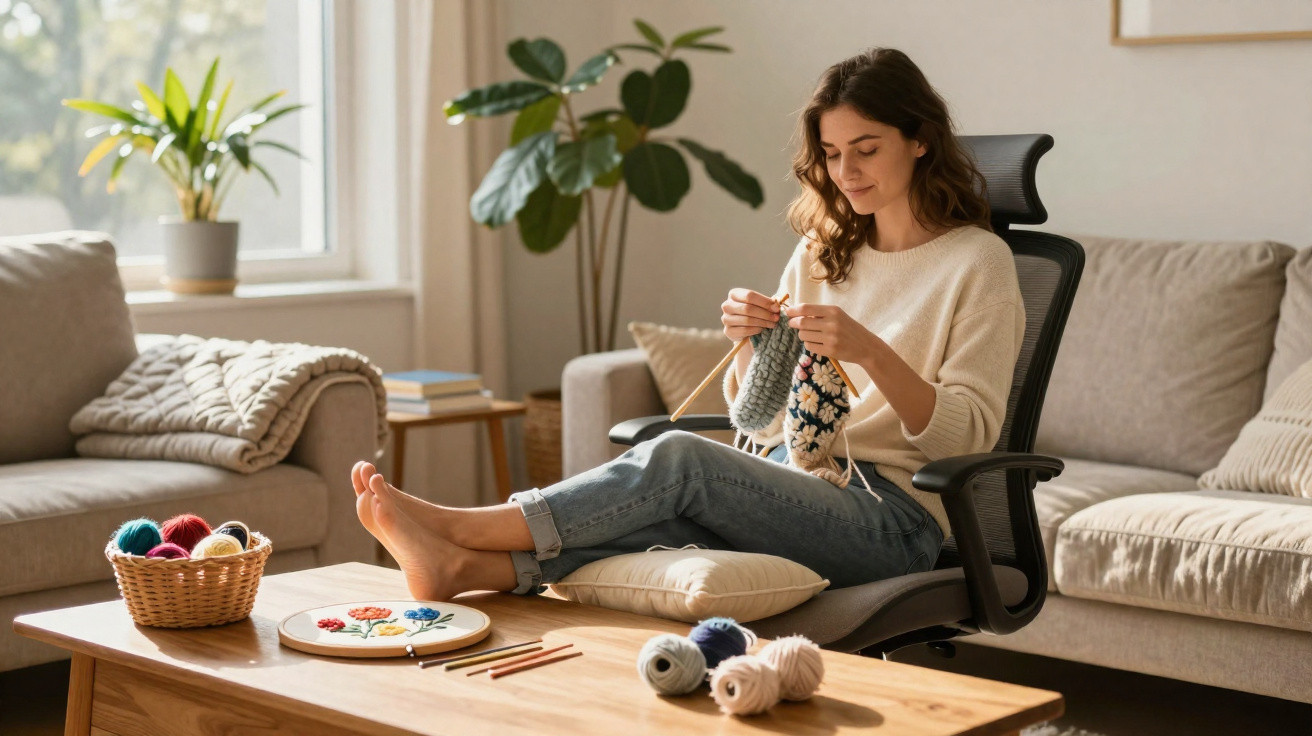
The only sounds in the room are the faint click of needles and the steady whirr of a sewing machine.
A woman in her forties bends over a row of minute backstitches, narrowing her eyes, her shoulders drawn almost up to her ears. A message flashes on her phone, yet she leaves it unanswered. The embroidery hoop commands all her focus - and, little by little, takes its toll on her neck. Twenty minutes on, she sits upright with a grimace and massages the familiar sore patch. She admires her work, checks the time and exhales. Her favourite pastime is beginning to resemble office work.
She is far from the only one. In sitting rooms, on trains, in waiting areas and at kitchen tables, people knit, sew and embroider - while hurting in silence. Fingers begin to tingle, wrists feel hot and lower backs start to ache. The finished work may be beautiful, but the body often feels anything but.
Somewhere between the pleasure of making and the toll it takes on our muscles, an essential pattern piece is missing.
Why beautiful stitches can carry a painful cost
Watch knitters gathered in a café and the same positions soon appear. Backs curl over the yarn. Elbows are held too close to the body. Heads dip as though the stitches might escape. The repeated motions can feel calming, even meditative, until someone winces while stretching a wrist.
Most people picked up needlework from a parent, grandparent or friend. They learned the techniques but not the ergonomics. While mastering a first scarf, nobody tended to mention shoulder position or keeping wrists neutral. The aim was to avoid dropping stitches, rather than considering how your spine might feel by the 200th row. Comfort was seen as an optional extra, not the foundation.
Speak to almost any craft group and familiar experiences emerge. “My hands go numb after ten minutes.” “I love quilting but my neck is killing me.” A 2022 survey of home crafters in the UK found that over 70% reported regular pain linked to their hobby, especially neck, shoulders and wrists. Many discreetly shorten their crafting time or stop altogether for weeks when symptoms flare up.
One retired teacher recalled regularly embroidering late at night on her sofa. The television played in the background, while she twisted her back towards the screen and worked tiny stitches beneath a weak lamp. “I thought my neck pain was age,” she said. “Turns out it was just bad furniture and worse posture.” She did not give up embroidery; she altered how she sat. Her pain reduced, and the enjoyment returned.
The body does not object to needlework itself. It objects to repeated movements in uncomfortable positions. Fine, accurate actions repeatedly call on the same muscles and tendons. If your shoulders are rounded, neck is bent and wrists are sharply angled, those tissues are already working hard before the first stitch is made. Continue in that position for an hour and the tension compounds.
Ergonomics means arranging your workspace around your body, rather than making your body conform to the workspace. When sewing, that could involve lifting your chair until your hips sit slightly above your knees. For knitting, it means allowing your project to rest on your lap rather than suspending it in the air. With embroidery, simply tilting the hoop may prevent you from straining your neck. Comfort is not a premium add-on. It’s the only way to keep creating for years without quietly burning out your hands.
Creating a craft space that lets your body breathe
Begin with your seating. Your chair and table are effectively the machine your body is attached to, whether you are using a sofa and coffee table or dedicated furniture. Choose a seat that lets your feet rest flat, your hips stay slightly open and your back lean against support rather than floating unsupported. A dining chair with a cushion at the lower back will often serve you better than a soft, sagging sofa that swallows your posture.
Next, consider working height. Ideally, your hands should be positioned around navel to lower-rib height. If your shoulders rise towards your ears while sewing, your table is too high. If you have to fold yourself over to view the stitches, it is too low. Placing a stable stack of books under a sewing machine or using a footrest beneath your feet can create a more comfortable angle without requiring new furniture. Minor adjustments can bring major relief.
Lighting is an overlooked essential. Poor light encourages you to lean forwards, whereas effective light enables you to sit back. Positioning a basic adjustable lamp opposite your dominant hand can reduce shadows and strain. Many embroiderers favour daylight bulbs, which improve contrast without the glare of a spotlight. Whether you are on a train or sitting on the sofa, a clip-on light can dramatically improve the way your neck feels.
Support matters too. If you knit or crochet, place the project on your lap or on a pillow. For embroidery, a stand or frame releases one hand and prevents you from gripping the hoop excessively. When hand-sewing, resting your elbows on chair arms or rolled towels helps stabilise the work while easing the burden on your shoulders. It may seem almost overly simple - and that is precisely the benefit.
Breaks are the unexciting advice that few of us consistently follow. Set a 25-minute timer and gently stretch for 3 minutes may sound perfect in principle. Let’s be honest: hardly anyone truly does that every day. Even so, your body benefits from the smallest interruptions. After every few rows, lift your eyes from the work. Relax your jaw. Slowly circle your shoulders. Between pattern repeats, stand up to get a glass of water or take a progress photograph.
Treat a crafting session as you would interval training: concentrated bursts of stitching separated by brief moments of movement. Do not wait for your hand to scream; respond to the first hint of tightness instead. That is the time to alter your position, gently rotate your wrists or change tasks - pinning rather than sewing, for example, or reading the chart rather than knitting. The goal isn’t discipline; it’s sustainability.
“I almost quit knitting at 35 because of wrist pain,” says Marta, a software engineer who now teaches ergonomic techniques in her local yarn shop. “I thought I had to push through. Then someone showed me how to hold the needles with less tension and take micro-pauses. Same projects, same yarn. Totally different body.”
Certain habits quietly intensify the problem: gripping tools with white knuckles, holding your breath during difficult passages and perching on the edge of a chair instead of leaning into its backrest. On a difficult day, all three can combine into a perfect storm of tension that becomes painful only hours later.
Before starting your next project, run through this quick comfort checklist:
- Are my shoulders loose and away from my ears?
- Can my feet reach the floor or a firm foot support?
- Is the project supported, rather than held in mid-air?
- Is there enough light to see fine details without leaning forwards?
- Have I moved at all during the past 20–30 minutes?
Building a lasting relationship with your needlework hobby
Needlework is often described as a gentle, timeless pastime: peaceful evenings and cups of tea. In practice, it can be less idyllic. There are long projects, late-night deadlines for presents and the temptation of “just one more row” at 1 a.m. Your body makes no distinction between working at a factory machine and hunching over cross-stitch on the sofa. Strain remains strain. At home, however, nobody is carrying out the safety checks for you.
From a human perspective, this makes ergonomic thinking feel almost radical. It means declaring that your comfort is as valuable as the completed quilt. A jumper is not worth nerve damage, and an heirloom table runner should not require six months of shoulder physiotherapy. This is the quiet limit that keeps a hobby enjoyable rather than allowing it to become a slow-building injury.
Comfort-first ergonomics is not something you set up once and forget. It is an ongoing dialogue with your body. As seasons change, furniture moves and moods vary, different needs become apparent: hands in winter may need warmer yarn and more frequent stretching, while summer evenings may tempt you to craft outdoors on unsteady garden chairs. On some days, you can happily knit for an hour; on others, 15 minutes is sufficient.
When pain is particularly bad, allowing yourself to move on to pattern planning, sorting fabric or watching tutorials is not “cheating”. It keeps you connected to your craft without repeatedly stressing the same overworked joints. The most skilled makers are often the ones who learned to stop early, not the ones who pushed the hardest.
The more profound change is one of mindset: replacing “I must finish this” with “I want to keep doing this for years to come.” That shift affects your decisions, from choosing lighter tools and looser grips to working in shorter sessions and stitching more slowly. It may involve declining a rushed commission or reconsidering how you spend a Sunday afternoon. Socially, speaking about this openly can be disarming. Physically, it is a quiet revolution.
On a practical level, exchanging comfort tips within craft groups can have real impact. One person brings a lumbar cushion to knitting night, another begins using a hoop stand, and someone else demonstrates gentle hand stretches learned from a physiotherapist. Small, imperfect trials gradually become normal practice. More deeply, it sends a message that we value not only one another’s projects, but one another’s bodies too.
Most of us have experienced the moment of looking up from our work to find a numb leg, cold tea and two vanished hours. That absorbed state is part of crafting’s magic. It is also why ergonomics for needlework is less a rulebook than a quiet craft of its own - creating a setting in which both your stitches and your spine can flourish.
| Key point | Detail | Benefit for the reader |
|---|---|---|
| Basic posture | Stable feet, supported back and hands at a comfortable height | Reduces neck, shoulder and lower-back pain while working |
| Light and support | Directed lighting, with the project supported by knees, cushions or stands | Limits visual fatigue and muscular tension caused by a hunched position |
| Micro-breaks | Brief pauses to move, stretch or switch tasks | Protects hands and wrists over time without sacrificing the pleasure of making |






Comments
No comments yet. Be the first to comment!
Leave a Comment