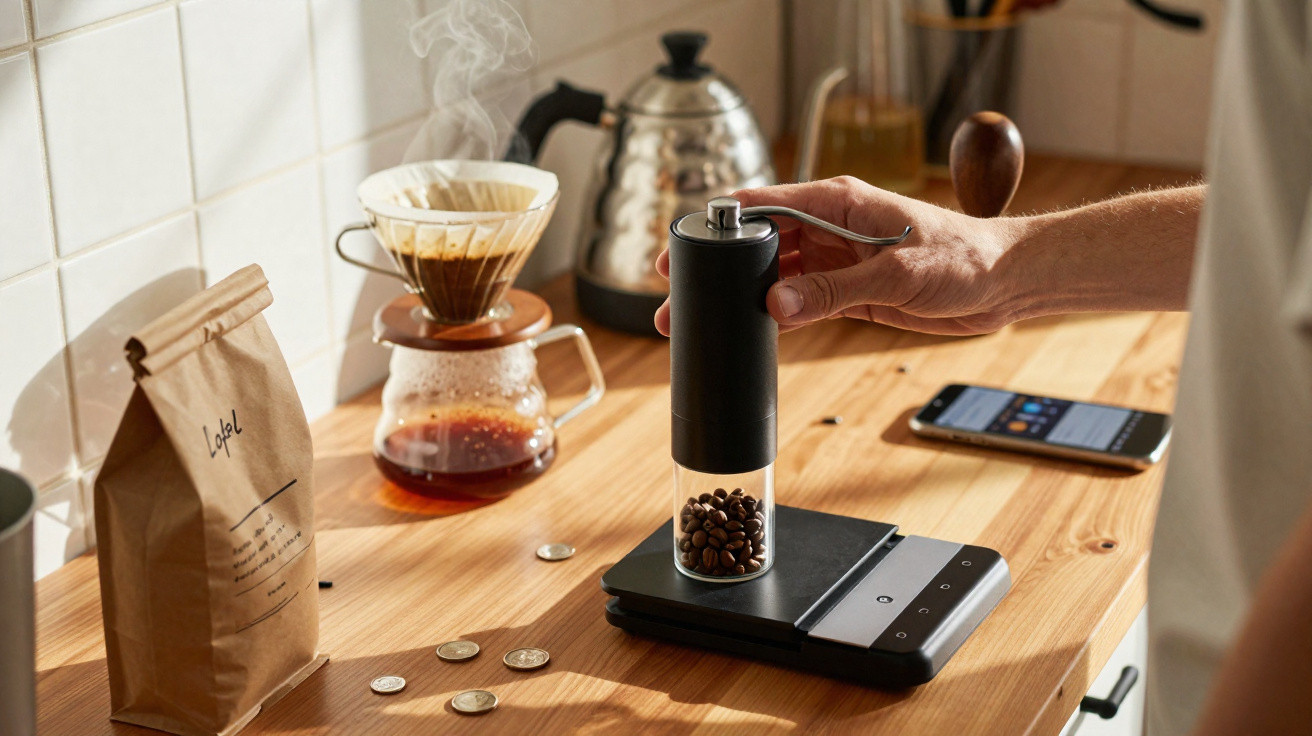
An unassuming coffee grinder is climbing online bestseller charts while expensive models gather dust.
Something about it is reshaping quiet kitchen routines.
It keeps appearing in forums, on social networks and across retailer platforms: a basic manual coffee grinder costing less than 10 euros. It is neither a design statement nor a high-tech gadget, yet reviews, photos and conversations are mounting up. What is behind this mini trend, and is this budget model genuinely worth buying?
Why a coffee grinder under 10 euros is suddenly going viral
Few kitchen tools seem more ordinary than a small hand grinder. Even so, precisely this type of model is currently seeing a sharp rise in sales. Retailers report consistently strong demand, while review totals are increasing week by week.
Its appeal comes from the combination of price, everyday practicality and the feeling of making coffee “by hand” again.
Several converging trends are driving this:
- Many people are cutting back on energy use and electrical appliances.
- Hand-brewed coffee is enjoying a revival, even without professional equipment.
- Inflation and rising living costs are putting pressure on household budgets.
- Social media promotes affordable “tricks” for improving everyday coffee.
The compact grinder has therefore become a symbol of moving away from costly machines and towards simple, controllable steps, without the financial pain.
What the affordable manual coffee grinder can actually do
From a technical perspective, the design remains straightforward. It is usually a cylindrical hand grinder with a crank handle, a basic grinding mechanism and a plastic or glass collection container. There are no unnecessary extras, displays or motors.
Typical features at a glance
| Feature | What buyers can expect |
|---|---|
| Price | Under 10 euros, often as little as 6–9 euros when on offer |
| Grinder | Usually steel; some models use ceramic, with basic adjustment |
| Capacity | Around 20–30 g of beans, enough for 1–2 cups |
| Drive | Hand crank, no electricity required and relatively quiet |
| Care | Easy to dismantle; clean with a brush or dry cloth |
For most buyers, the key point is that the grind setting can be changed across several levels. The grinder will generally handle everything from a fairly fine grind for a Moka pot to coarser grounds for French press or cold brew, though it is not as precise as a high-end machine.
Why so many people say their coffee “suddenly tastes better”
Anyone switching from pre-ground supermarket coffee to freshly ground beans will nearly always notice a considerable difference. That has little to do with the romance of turning a crank and much more to do with chemistry.
Coffee beans contain volatile aromatic compounds that escape quickly after grinding. The fresher the grounds, the more vibrant the aroma and flavour seem.
Many users say that their filter coffee suddenly tastes less bitter, releases more aroma during brewing and feels more rounded overall. Several factors contribute to this:
- Freshly ground beans lose less aroma before the water reaches them.
- The grind size can be tailored to the brewing method, reducing over-extraction or under-extraction.
- Grinding makes people more aware of quantity, time and water temperature when pouring.
Even if an inexpensive grinder does not produce a perfect grind, it moves many users from standard industrially ground coffee to a noticeably higher level of flavour, with minimal investment.
Where the budget coffee grinder reaches its limits
The enthusiasm does have a downside. Anyone accustomed to a professional grinder with conical or flat burrs will quickly spot its weaknesses.
Inconsistent grind size
Very cheap grinders are more likely to produce fine particles, known as “fines”, alongside larger pieces. This can create a slightly bitter taste because some of the grounds become over-extracted. For many everyday users, however, the effect remains acceptable, especially with filter brewing methods.
A slower grinding process
Grinding a dose for two large cups takes a little over a minute at an average hand-cranking pace. For anyone watching the clock in the morning, that can feel like a delay. On the other hand, many users describe that minute becoming a small ritual. Some deliberately listen to the steady crunch of the beans before switching on the kettle.
Durability and adjustment
Cheap components wear out more quickly. On some models, the grind adjustment becomes loose after a few months, while plastic parts can develop play. Anyone grinding daily for a large family will clearly reach the limits here. For one-person households or occasional use, the quality is usually sufficient.
Why so many people are choosing hand grinders now
The rapid spread of a simple grinder reflects a broader shift in coffee culture. Three developments stand out:
Many users want better coffee without having to learn about the expensive world of bean-to-cup machines and espresso machines.
First, there is growing interest in “small upgrades”: minor, targeted everyday improvements that make a noticeable difference without straining the bank balance. A hand grinder for under 10 euros fits this pattern exactly.
Second, the old divide is breaking down: it is no longer simply bean-to-cup machine versus capsule machine. Instead, many people are mixing approaches, using simple filters, manual grinders and inexpensive Moka pots. The budget grinder often acts as an entry point and opens the door to this experimental combination.
Third, social platforms are accelerating the trend. One user shows how they brew visibly creamier coffee using an 8-euro grinder and a simple filter, triggering a chain of follow-up purchases. The principle of “If it works for them, I’ll try it too” is particularly powerful here.
Practical tips: getting more from an affordable coffee grinder
Anyone choosing the cheaper model can achieve noticeably better quality with a few simple techniques:
- Grind the beans immediately before brewing rather than preparing grounds in advance.
- Experiment with the grind size: coffee too bitter? Set it a little coarser; too sour? Grind more finely.
- Clean the grinder regularly with a brush so that old oils do not distort the flavour.
- Use it for espresso only to a limited extent; focus instead on a Moka pot or filter coffee.
- Keep the crank movement steady while grinding to encourage more consistent results.
Anyone interested can even run small comparison tests: use the same beans and the same brewing method, once with pre-ground coffee and once with freshly ground beans. This makes it clear whether the purchase was worthwhile.
Terms that repeatedly come up in discussions
Many reviews include specialist terms that can initially confuse coffee newcomers. Buyers of the budget grinder encounter three of them particularly often:
- Extraction: Describes how much of coffee’s soluble material ends up in the water. Too little tastes flat; too much tastes bitter.
- Grind size: Indicates how fine or coarse the particles are. It directly affects extraction time.
- Fines: Extremely small particles in the grounds, which extract more quickly and can strongly influence flavour.
People starting out with an affordable grinder often learn these terms playfully. They turn the adjustment dial, watch how quickly the filter drains and taste how the coffee changes. Over time, this develops a sense of what works for their own palate, entirely without a barista course.
What this trending product reveals about everyday life
At first glance, the booming coffee grinder under 10 euros may appear to be a minor footnote in online retail. Look more closely, however, and it says a great deal about consumer behaviour during economically difficult times. People are seeking small, affordable things that improve their day without demanding a major commitment.
Anyone who deliberately spends a minute turning the crank each morning is also trying out a different form of consumption: less automation, more manual work; less status symbol, more personal ritual. The budget grinder thus becomes a space for experimentation, not only for better coffee but also for the question of how much technology everyday life really needs.













Comments
No comments yet. Be the first to comment!
Leave a Comment