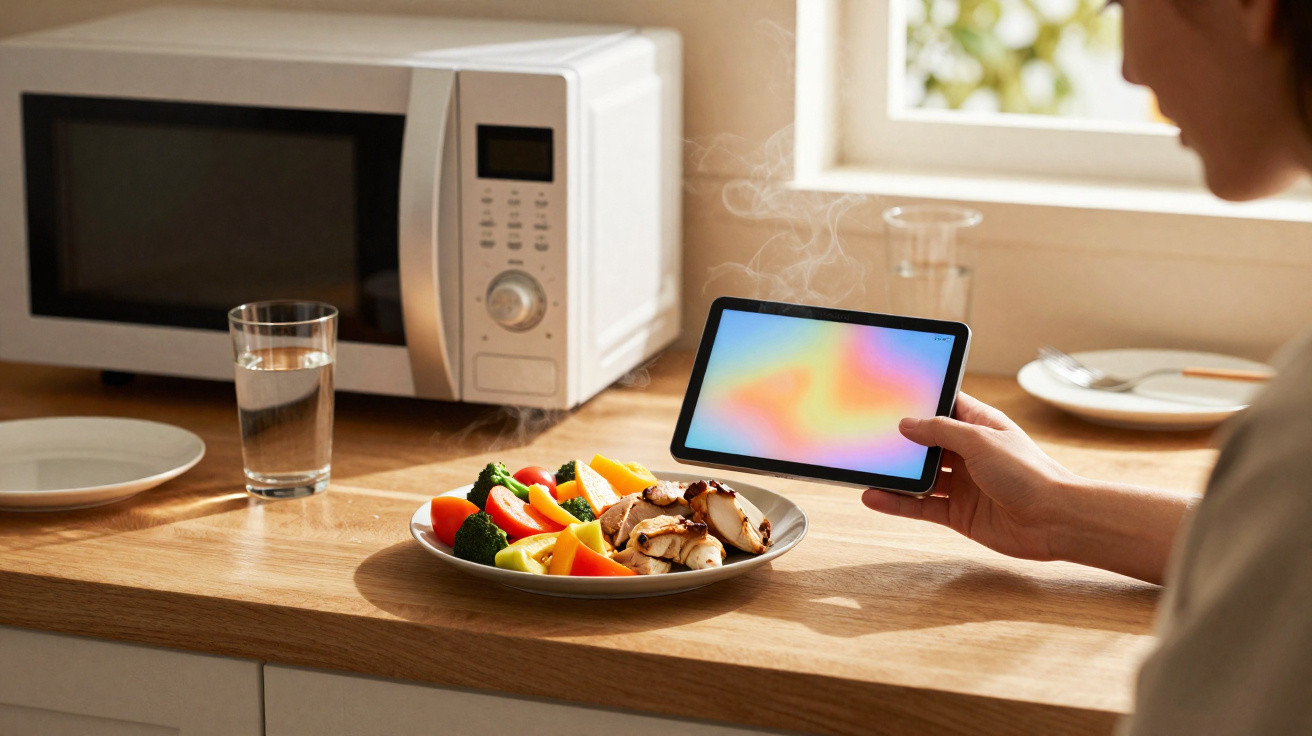
Steam escapes in irregular bursts. The cheese has become a rubbery layer, the vegetables have taken on a slightly grey hue, and the aroma seems strangely muted. Still, you eat it while scrolling through your phone, telling yourself that this is simply how “reheated food” tastes.
Ten minutes on, you are still peckish, a little bloated and oddly unfulfilled. Yesterday, when it was freshly cooked, the same meal felt rich and comforting. Now, it tastes like a blurred photocopy of the original.
Somewhere between the rotating glass plate and that insistent “ping”, your food has quietly lost something.
Microwaves are quick – but what are they really doing to your food?
Visit any workplace kitchen at lunchtime and the soundtrack is unmistakable: beeps, doors shutting and a queue of people holding plastic containers. The microwave has become an unofficial canteen, therapist and time-saving tool, all contained in one humming box.
We tend to think it merely “warms things up”. But each time that plate rotates, your meal is being altered at a microscopic scale. Water molecules are driven into frantic movement. Heat pockets appear and disappear. Fragile compounds that gave last night’s soup its fragrance are pushed beyond their limit.
From the outside, it seems straightforward: hot food in no time. Beneath the surface, it resembles a miniature storm.
A small Swiss nutrition start-up recently set out to demonstrate this. It created a handheld device, roughly the size of a TV remote, equipped with infrared sensors, a rapid spectrometer and a basic traffic-light display. It was designed to scan food before and after microwaving, monitoring three measures: nutrient density, moisture balance and structural integrity.
The team assessed everyday dishes, including leftover roast chicken, vegetable curry, frozen lasagne and baby purées. On paper, the changes did not seem dramatic. The figures, however, suggested otherwise. Aggressive microwaving reduced vitamin C in vegetables by up to 25%. Certain proteins denatured into tougher forms. Moisture was distributed far more unevenly, leaving some areas soggy and others dry.
One particularly revealing graph tracked the “aroma profile” of homemade tomato sauce. Following two minutes in a microwave, over half the volatile compounds behind its rich, sweet scent had disappeared entirely.
Food scientists who examined the results were not surprised. They have understood for years that heat is not all the same. Rather than slowly heating food from the outside towards the centre, microwaves stimulate water molecules within it. As a result, delicate vitamins close to high-moisture areas can receive too much heat while the rest of the dish remains lukewarm.
Texture also takes a hit. Starches in foods such as pasta and rice may swell, split and then dry out within seconds. Proteins contract and force out moisture, leaving succulent chicken with the chewiness of a pencil eraser. Fatty coatings melt off, producing a thin greasy film rather than a smooth sauce.
The Swiss device converted these changes into a straightforward score out of 100. The same trend emerged repeatedly: a meal cooked on the hob might receive 86, while that very meal, reheated from cold in a microwave, could fall into the low 60s.
The PlateSense device reveals microwave damage – and how to prevent it
In its beta form, the gadget is called “PlateSense” and functions rather like a lie detector for food. Aim it at a plate, tap it once and a coloured bar appears on its small display. Green indicates that “structure and nutrients largely intact”. Orange signals a moderate loss. Red points to serious damage: dried proteins, degraded vitamins and flavours cooked away into nothing.
A coloured bar alone is not especially remarkable. The real surprise comes from scanning the same meal before and after a brief microwave blast. Test participants saw leafy greens fall from a vivid green 84 to a weary orange 57 in just ninety seconds. Leftover fish dropped into the red zone after a single full-power reheat.
The device does not lecture or shame anyone. It simply presents, through brutally clear graphics, the cost that hungry impatience can impose on food.
The PlateSense team soon reached an important conclusion: the microwave itself was not the enemy. The problem was how people used it. That tray of roasted vegetables which fell into the orange zone at full power? When testers reheated it at 30–40% power, kept it covered and paused halfway through to stir, its score fell by only a few points.
They began experimenting with controls that many of us overlook: lower wattage, shorter heating intervals and resting time on the worktop. Each adjustment improved the data. Moisture remained in the food rather than escaping as steam. Nutrient loss slowed. The middle of the plate finally came up to temperature with the edges, without blasting the whole meal into oblivion.
One beta user, a young father who prepares large batches of vegetable purée for his toddler, altered his routine overnight. Before using the device, he heated small bowls at full power and simply hoped for the best. Once he saw the red-score spikes, he moved to gentle, repeated 20-second bursts, using a lid and adding a little water. The scores rose, along with his feeling of control.
PlateSense logs also exposed frequent errors. People favour the “maximum power, minimum time” combination because it feels efficient. It is not. The data found that high-power microwave use creates extreme temperature spikes, which the tongue does not always notice due to uneven hot and cold areas. These micro-spikes are precisely where nutrients and textures deteriorate most rapidly.
Another clear pattern involved uncovered food. It may seem harmless, and even more convenient, but uncovered plates repeatedly lost more moisture, flavour and structure. A basic cover, whether a reusable silicone lid or an upturned bowl, kept scores higher almost every time.
“When we started, we thought we’d build a gadget for health geeks,” explains Lara Müller, co-founder of PlateSense. “What we accidentally created was a mirror, showing people how their habits quietly downgrade the food they work hard and pay good money for.”
The beta report closes with a short, almost blunt set of survival rules drawn directly from the data logs:
- Reheat at 30–60% power, using short bursts.
- Keep food covered to retain steam and preserve moisture.
- Add a spoonful of water to rice, pasta or stews before microwaving.
- Stir or turn food halfway through rather than relying solely on the turntable.
- Let the plate stand for 1–2 minutes to allow the heat to distribute evenly.
None of this is rocket science. But unless somebody shows you that your favourite leftover lasagne has just lost twenty points on a simple quality scale, the issue remains abstract. PlateSense does not nag; it merely makes the invisible suddenly, strikingly visible.
So what now: ditch the microwave, or learn to use it properly?
The uncomfortable truth uncovered by the device is this: your microwave only “destroys” food when it is used like a blunt instrument. With a little care, it can work more like a precision tool. Food scientists collaborating with the PlateSense team found that smaller portions, spread across a wider plate, consistently achieved higher scores than tightly packed, overfilled bowls.
Replacing plastic tubs with glass or ceramic dishes helped as well, distributing heat slightly more evenly and avoiding hot edges with cold centres. Even cutting chicken or vegetables into similarly sized pieces produced fewer device warnings for structural breakdown. These modest habits can quietly bring everyday meals closer to how they tasted when first prepared.
At a deeper level, the data made people reconsider their routines. We claim that we “don’t have time” to reheat food more gently, then spend those extra minutes staring at the microwave door and waiting for the beep. Let’s be honest: nobody really does that mindfully every day.
We have all had that moment when we open the microwave door, breathe in, take a taste and immediately sense that the meal has lost something - without being able to name it. That missing “something” is what this small device seeks to measure. It transforms vague disappointment into a number, a line on a graph and a story you cannot unsee.
Some testers felt guilty, while others felt relieved. The guilt came from recognising how often they had turned good ingredients into mediocre meals by rushing. The relief came from discovering that the solutions were neither extreme nor costly. Nobody needed to become a full-on chef on a Tuesday evening. They simply reduced the power, added a spoonful of water, stirred once and found that lunch tasted like food again.
What lingers after looking at this research is not the gadget itself, but a broader question: how many other “time-saving” shortcuts are quietly draining quality from our lives, one small compromise at a time?
You may well keep your microwave; most people will. Yet once you have seen what aggressive reheating does to that beautiful curry you made on Sunday, it becomes difficult not to hesitate with your finger above the “Start” button. It is equally difficult not to share that quiet shock with the colleague beside you in the office kitchen, bowl in hand, waiting for the familiar beep that no longer sounds quite so harmless.
| Key point | Detail | Why it matters to the reader |
|---|---|---|
| Maximum power damages food | PlateSense tests show rapid losses of nutrients, aromas and texture in “full power” mode. | Better understand why microwave-reheated meals can seem bland, dry or heavy. |
| Simple steps reduce the damage | Lower the power, cover food, add a little water, stir halfway through and leave it to stand for 1–2 minutes. | Reheat more intelligently without wasting time or buying expensive equipment. |
| The microwave is not the enemy; habit is | Quality falls mainly when bowls are overloaded, unsuitable containers are used and reheating is rushed. | Regain a degree of control over the quality of everyday meals without sacrificing convenience. |












Comments
No comments yet. Be the first to comment!
Leave a Comment