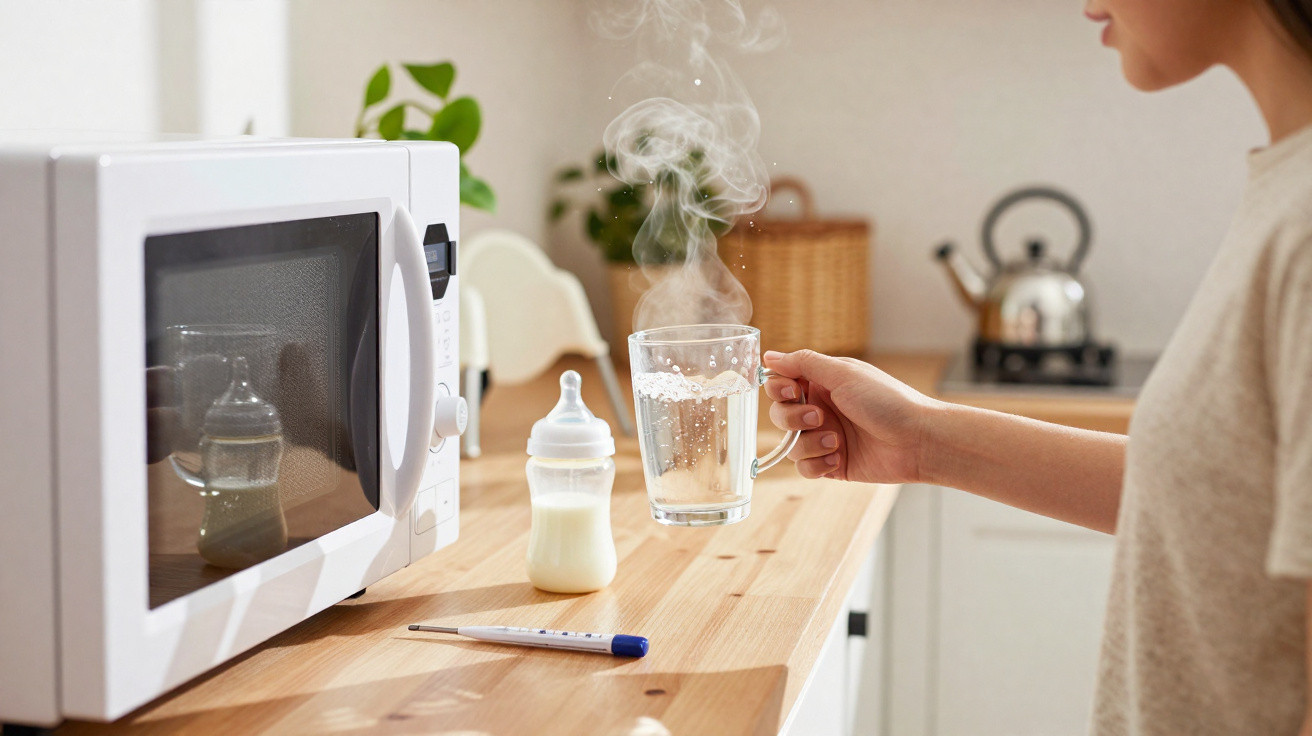
The microwave saves time, rescues every lukewarm meal and has become indispensable in most homes. Yet heating water, milk or baby bottles quickly brings a risk that many people underestimate: some liquids remain calm on the surface, only to suddenly turn into a fiercely hot fountain.
How a microwave really heats liquids
A quick look at what happens inside the appliance helps explain the issue. Microwave radiation sets water molecules in motion, generating heat. In a saucepan on the hob, the temperature rises relatively evenly. A microwave works differently: it creates so-called hot spots, areas that are substantially hotter than the rest.
This is less noticeable with solid food because its structure helps spread the heat. Liquids such as water and milk have very little of that structure. They can heat unevenly in a mug, and that is where the danger starts.
Water that looks still after being heated in a microwave can be well above 100 degrees Celsius – without any visible bubbling.
A dangerous effect: when water “boils over” without boiling
Water would normally start bubbling at around 100 degrees Celsius. In a microwave, however, it can become superheated. This means the water is significantly hotter than 100 degrees, yet shows no bubbles at all. Particularly clean cups or glasses lack something crucial: tiny imperfections where steam bubbles can form.
The result is a liquid that appears harmless but is actually on the verge of erupting. A very small trigger is enough:
- taking the mug out of the appliance
- putting in a spoon
- stirring in coffee or sugar
- lightly knocking the mug
At that point, a large number of steam bubbles can form all at once. The liquid shoots upwards, spills over the rim and, in the worst case, sprays directly onto the face or hands.
The US Food and Drug Administration (FDA) reports serious scalds to the face and hands caused by superheated water from microwaves.
Particularly risky: milk and baby bottles
Many parents use a microwave when they need to warm a bottle quickly. It is understandable, but risky. Milk and baby food do not heat evenly in the appliance. While the bottle may feel only hand-warm on the outside, scalding-hot areas can form inside.
If the bottle is then given straight to the child, the first sip can scald the sensitive lining of their mouth or throat. This is precisely what the US Food and Drug Administration explicitly warns about.
Why baby products are especially problematic in a microwave
Babies cannot say that their milk is too hot. They often cry only once the pain has already begun. In addition, their bodies are more sensitive to heat, scalds take longer to heal and may leave scars.
Parents are therefore better off using another method:
- place the bottle in warm water
- use a dedicated bottle warmer
- shake it thoroughly and test it in several places, not just on the outside
Baby milk does not belong in a microwave – neither breast milk nor powdered milk.
How to heat water and milk more safely in a microwave
In day-to-day life, it is often difficult to manage without a microwave. Anyone who wants to use one can greatly reduce the risk by following a few rules. Many manufacturers and safety authorities recommend similar measures.
Before heating: preparing the container
- Never heat liquid in extremely smooth, brand-new glass mugs without moving it first.
- Fill the mug only two-thirds full, leaving enough room in case the liquid does boil over.
- If necessary, stir once before starting or add something that helps bubbles to form, such as sugar or instant coffee.
During heating: monitor the temperature
Long, uninterrupted heating periods are problematic. Short intervals are better:
- Heat the liquid for 10–20 seconds.
- Stop the appliance, stir it or gently move the mug.
- Heat it again briefly if it is not warm enough yet.
This gradual approach significantly lowers the risk of superheating, as steam bubbles can form and escape in good time.
Metal in the microwave: really an option?
Most people have been taught that metal is forbidden in a microwave. Broadly, that is true: cutlery, aluminium foil and decorated plates can create sparks and, in extreme cases, cause fires. Interestingly, some manufacturers make an exception for liquids under certain conditions.
Some brands therefore advise fully submerging a small metal spoon in the mug. The reasoning is that the spoon may improve heat distribution and reduce hot spots. However, the spoon must be completely immersed in the drink and must not touch the appliance wall or door.
| Advantage | Risk |
|---|---|
| a slightly more even temperature in the drink | sparks if the spoon touches the inner walls |
| a lower chance of sudden superheating | unsafe handling by inexperienced users |
Anyone who feels unsure should avoid this trick and stir more frequently instead. This can also even out the temperature, entirely without metal.
After the beep: the critical seconds
The most dangerous stage often begins once the microwave has already stopped. Many people reach for the mug immediately, impatiently open the door and quickly pull out the container. That is exactly what can cause superheated water to erupt.
A safer method looks like this:
- Wait 10–20 seconds after the heating cycle ends before opening the door.
- Remove the mug carefully, without any sudden movement.
- Stir thoroughly with a spoon, keeping your face away from the mug.
- Wait a few more seconds, then take a small test sip.
The extra 30 seconds of patience after the beep often prevents exactly the scalds that later end up in A&E.
What many people do not realise: risks with ready meals and soups too
Uneven heating is not limited to plain water. Soups, sauces, hot chocolate and instant noodles can also develop isolated areas of extreme heat. Everything may seem lukewarm at the top, while a spoonful from deeper down holds a scalding surprise.
Anyone heating ready meals in bowls should therefore always stir them partway through and follow the recommended wattage. High power for a short period leads to overheating more quickly than moderate power over a slightly longer time.
Practical alternatives to the microwave
There are safer alternatives for many uses. Water for tea or instant coffee can be heated precisely in a kettle. Milk can be warmed more controllably in a small saucepan on the hob, especially when it is stirred continuously.
Those who still do not want to give up their microwave can use it selectively: for solid foods, leftovers from the previous day or frozen products, where the risk of sudden superheating is considerably lower than with pure water.
Why superheating remains so deceptive
Superheated water looks harmless. There is no bubbling, no steam and no warning signs. That is exactly why so many people underestimate the effect. Physically, this happens because the liquid appears to ignore its “normal” boiling point as long as no particles or imperfections trigger bubble formation.
A tiny cause – a grain of sugar or a knock against the mug – is enough to release the stored energy. The sudden conversion of water into steam rapidly increases its volume and throws the liquid out of the container.
In everyday terms, anyone heating water or milk in a microwave should never lean directly over it, should remain careful when removing it and should not rely blindly on their own senses. Appearances can mislead; temperature cannot.


Comments
No comments yet. Be the first to comment!
Leave a Comment