It tends to happen just after you have finished cleaning. The sink gleams, the worktops are uncluttered, and your stainless steel fridge finally has the look of a showroom display. Then somebody takes hold of the door. Two fingertips. One casual tug. Suddenly, there they are once more: small greasy crescent-shaped fingerprints glaring back beneath the kitchen lights.
You wipe them away, and they smear. You polish, and they simply spread.
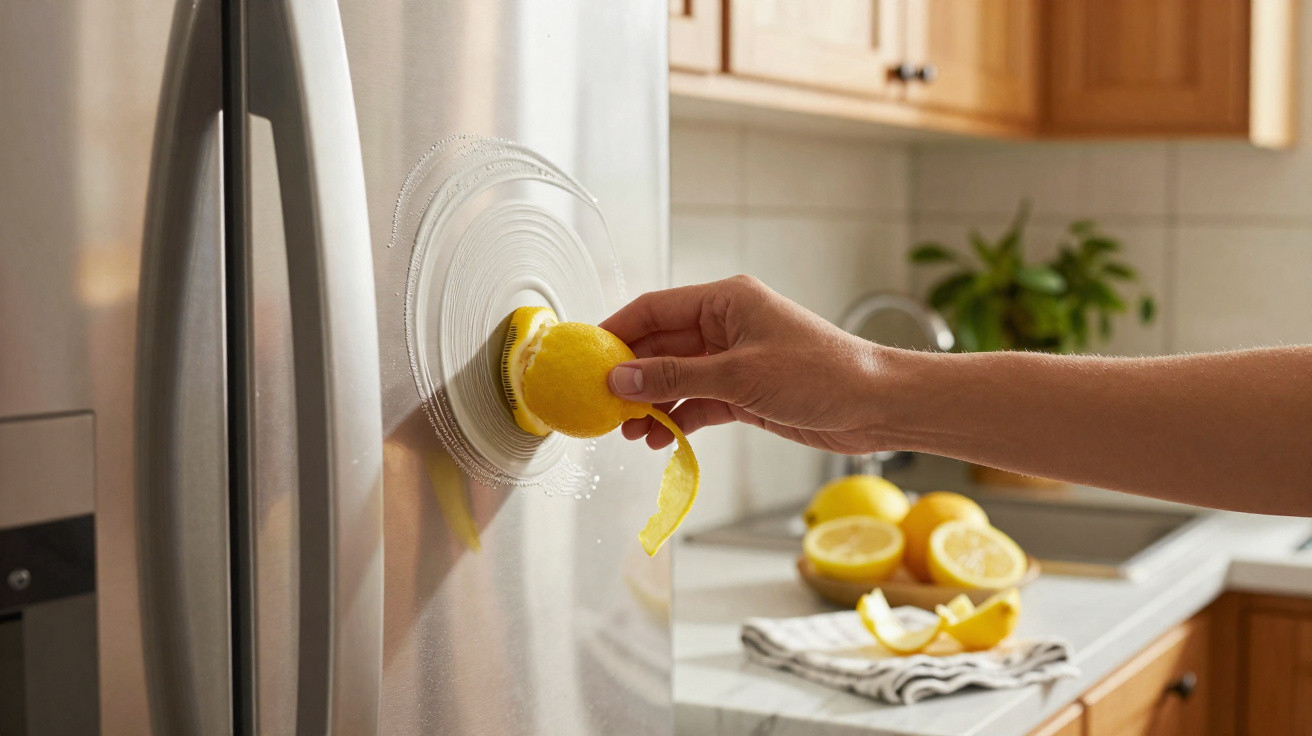
Then, one evening, you are holding the lemon you have just zested for supper, peel still in your hand, and decide to run it over the fridge door. The fingerprints vanish like an unpleasant recollection. The steel becomes glossy and almost silky, while the entire kitchen instantly appears pricier than it is.
So what has happened to that metal surface?
Why lemon peel achieves what a paper towel cannot
Stainless steel may seem hard-wearing, yet daily use leaves it surprisingly exposed. Fingers deposit oils, minute salt crystals, soap residue and even the unseen coating left by hand cream. On metal, that mixture does not merely rest on the surface; it sticks to it. This is why those faint marks never fully disappear when you use a dry cloth.
Lemon peel tackles the problem in a completely different way. It is mildly acidic, gently oily and faintly waxy when touched. That unusual combination is precisely what stainless steel responds to. Rather than simply wiping, the peel works on the surface: it loosens and lifts residue, then leaves behind a fine glossy layer that the eye interprets as a clean, polished finish.
Imagine a hectic Sunday lunch. Children are constantly running through the kitchen, somebody opens the fridge for drinks every few minutes, and the dishwasher is humming away. Once the washing-up is finished, your stainless steel appliances look as though they have hosted a food festival: sauce smudges, hazy fingerprints and one unexplained streak at a child’s height.
You reach for the usual tools: a microfibre cloth and perhaps a little washing-up liquid. They improve things, but certain marks remain visible from the right angle. Then you spot the lemon half drying on the chopping board. Gently run the peel along the handle, follow with a soft cloth, and the metal suddenly appears… new. It is not merely cleaner; it looks sharper, as though somebody has increased the contrast throughout the kitchen.
There is sound practical science behind this little trick. Citric acid in the lemon breaks down the thin greasy film left by fingertips, while the peel’s natural oils settle into microscopic scratches in the steel. Those tiny scratches usually hold both dirt and light, making the surface appear dull. Once they are covered by a light transparent film, light reflects more evenly.
Meanwhile, stainless steel has a passive chromium oxide layer at its surface that benefits from remaining smooth. The lemon’s gentle acidity helps freshen the material sitting above that layer without damaging the metal beneath. In other words, you are doing more than wiping: you are restoring how the surface interacts with grease and light. That is why fingerprints go from shouting to whispering.
How to use lemon peel on stainless steel properly
The method could hardly be simpler. Take a fresh lemon, use its juice in cooking or a drink, and retain one half of the peel. Use the inside of the peel, which should still be moist and fragrant. This is where the oils and acid are ready to work.
Hold it lightly against the stainless steel and move it with the grain rather than across it. Use short passes on handles and longer ones on doors or panels. There is no need to scrub; simply glide it over the surface. After covering the area, go over it with a clean soft cloth to remove loosened dirt and distribute the remaining oils in a fine, even coat.
This is the point at which many people become disappointed. They use an almost-dry lemon from the back of the fridge, rub as though they are shining shoes, and then wonder why nothing changes. Or they soak the surface in neat lemon juice, allow it to sit there, and are left with sticky streaks.
Take a gentle approach and allow a little patience. Stainless steel reacts more favourably to several light passes than to one forceful assault. You will also get better results on recent fingerprints than on cooking-fat smears that have been there for a month. Realistically, no one performs this task every day. If your oven door has made it through a long winter of roasts and splashes, first clean it with warm soapy water, then use lemon peel as the final touch.
Many home cooks quietly rely on this small citrus routine, even if they do not describe it as a scientific experiment.
“I used to buy special stainless steel sprays,” says Laura, a 39‑year‑old food stylist who spends half her life in bright, unforgiving kitchens. “Then one day I was on a shoot, no products on set, just lemons for a recipe. I rubbed the peel on a smeared fridge door, and the photographer literally stopped and said, ‘What filter did you just put on that thing?’ Since then, I travel with lemons.”
- Use fresh peel – Lemons cut recently contain active acids and oils that can properly tackle grease.
- Wipe with the grain – Moving in the direction of the steel’s brushed finish helps prevent additional micro-scratches.
- Finish with a soft cloth – This changes basic cleaning into an even, polished-looking result.
- Test a corner first – Some finishes described as “stainless” are coated, so begin with a small area.
- Keep it occasional – Lemon peel is a useful trick rather than a religion; using anything excessively on metal rarely ends well.
What this small cleaning hack reveals about our kitchens
Once you see how effectively lemon peel works, you may begin to view the items around your home differently. Stainless steel no longer feels like a cold industrial material, but something connected to everyday movements: the door opened without thinking, the tap you touch, the handle grabbed while you hurry out with coffee in one hand and a phone in the other.
We’ve all been there, that moment when you suddenly see your own fingerprints everywhere and think, “Do I really touch things that much?” The lemon peel trick offers an answer: yes, you do, and your kitchen keeps a quiet record of it.
| Key point | Detail | Value for the reader |
|---|---|---|
| Natural chemistry | Citric acid breaks down oils, while peel oils fill micro-scratches | Cleaner, shinier steel without specialist products |
| Simple method | Rub fresh peel with the grain, then buff using a cloth | A quick routine that fits naturally into everyday cooking |
| Everyday mindset | Using leftover peel turns waste into a practical tool | Saves money, cuts waste and makes cleaning feel less burdensome |












Comments
No comments yet. Be the first to comment!
Leave a Comment