You open the dishwasher hoping for one of life’s small daily victories: warm plates, streak-free glasses and cutlery that genuinely gleams. Yet there it is again: a light, sandy coating on your supposedly clean dishes, tiny food particles stuck to bowls and strange grit settled at the bottom of mugs. Run your thumb over a glass and you feel that unpleasant rough texture – something that is impossible to ignore once noticed.
It is easy to assume the detergent has failed, the appliance is on its last legs or you selected the wrong cycle. Usually, though, the answer is far less complicated: it sits beneath the lower spray arm.
Once a month, something can quietly become blocked, decay and then get sprayed back over everything in the machine.
Literally.
The mysterious grit on “clean” dishes
That gritty coating does not suddenly arrive in a single wash. It accumulates gradually, cycle after cycle, until your spoon carries a faint taste of yesterday’s pasta sauce – and you cannot stop noticing it. Initially, you might blame hard water, rinse-aid streaks or the discounted dishwasher tablets you picked up. You run the load again, trusting that hotter water will somehow solve it.
But the grit persists because it is not simply sitting on the dishwasher’s surfaces. It is being released from within the appliance.
Consider where the dirty water goes. Food debris is driven down by powerful jets and collects in a small area at the base of the dishwasher: the filter. It may be a mesh cup or a flat panel that you have not touched since the machine was fitted. Breadcrumbs, coffee grounds, vegetable fibres, egg residue and grease gather there, forming a wet paste.
Most people know the moment: you eventually twist out the filter and a smell powerful enough to make an adult recoil hits you. That smell is the grit in concentrated form.
Water passes through the filter’s tiny openings and slots. As those openings become obstructed, the water flow is altered. Rather than trapping particles, the filter begins behaving like a blocked shower head. Pressurised water strikes the dirty build-up and dislodges microscopic debris. It does not vanish; it is forced back through the spray arms and deposited on plates and glasses.
That is exactly why grit appears on freshly washed dishes: your dishwasher is literally recycling ground-up food residue back onto them.
Monthly dishwasher filter cleaning that makes the difference
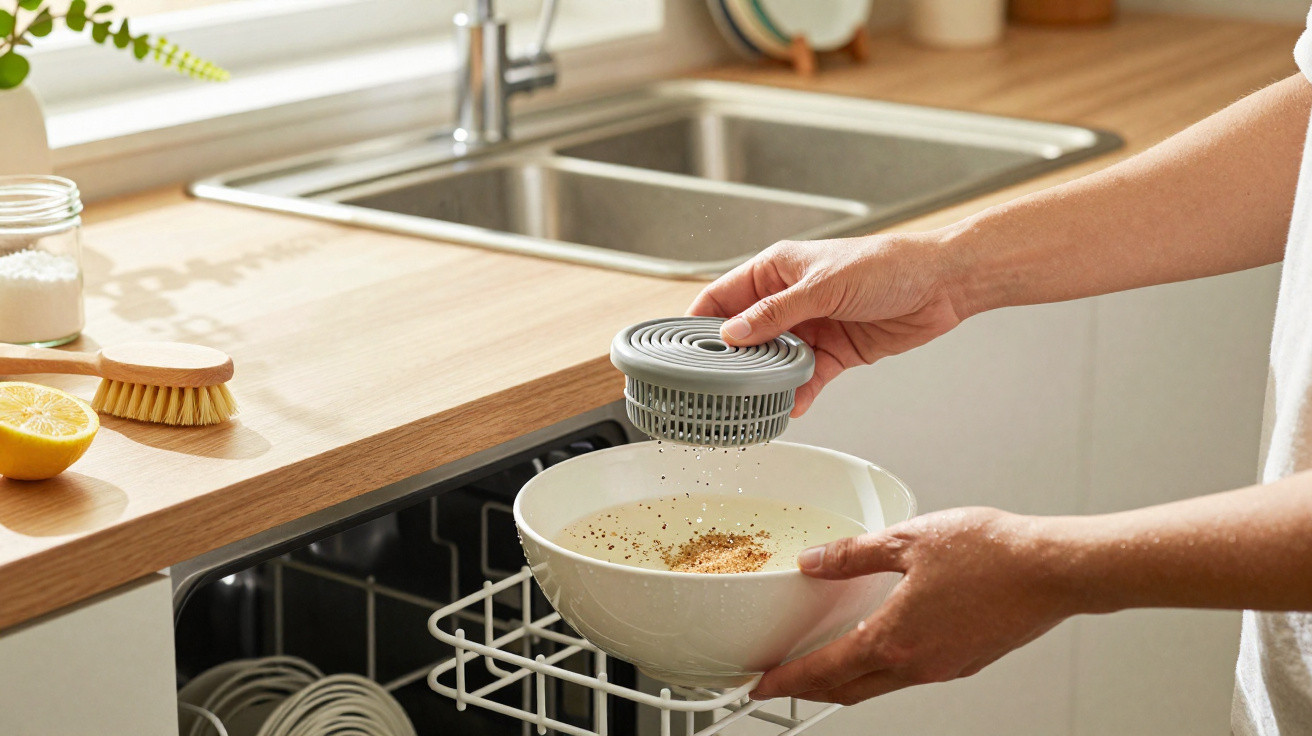
Cleaning the dishwasher filter every month may sound like the sort of job reserved for people in cleaning-product adverts. In reality, it is unglamorous but remarkably fast. Pull out the bottom rack, twist or unclip the filter and lift it free. Many machines have both a coarse mesh section and a finer cylindrical filter, and each requires cleaning.
Hold it under hot running water, then use a soft brush or an old toothbrush to remove the stuck-on residue. If a greasy layer remains, one drop of washing-up liquid and a minute of gentle brushing should break it down. Keep rinsing until the water is clear and daylight is visible through the mesh.
There is also the step that nearly everyone overlooks: cleaning the filter housing. The ring-shaped recess holding the filter can conceal a swamp-like combination of sludge and broken-glass fragments. Wipe it with a damp cloth or kitchen paper, taking care around the edges. You may uncover seeds, pieces of foil or even broken crockery that has restricted the water flow.
After the first attempt, this entire process rarely takes longer than five minutes. Even so, it greatly reduces grit, unpleasant odours and the occasional unexplained mark at the base of a mug.
Afterwards, every part of the wash cycle can function more closely as the manufacturer intended. Clean water circulates without restriction. Detergent dissolves as it should instead of clumping around greasy food deposits. The pump no longer has to work against a semi-solid mass of food residue on every cycle. The improvement is particularly clear with glasses and transparent containers: they emerge clearer, without the dusty, almost imperceptible film that makes a kitchen feel less clean.
Realistically, no one is going to do this every day. Once a month, however, is the low-effort habit that prevents a dishwasher from becoming a grit cannon aimed at your tableware.
How to prevent grit returning without becoming a neat-freak
The easiest approach is to connect filter cleaning with something else you already do each month: paying rent, paying your phone bill, replacing your toothbrush head or turning the mattress. Add “dishwasher filter” to that routine. Open the door, pull out the bottom rack and remove the filter before it slips your mind.
If visual reminders work for you, place a small piece of tape or an unobtrusive sticker close to the controls. Some people keep a small washing-up brush under the sink solely for this task. Positioned beside the washing-up liquid, it is ready for the five-minute clean.
Many people assume that thoroughly rinsing plates before loading will keep the filter clean. The slightly odd reality is that over-rinsing can limit enzyme activation in some modern detergents, while tiny sticky pieces of starch and fat still make their way through. Dishes do not need to be spotless before going in. Simply scrape them.
Other frequent issues include overloading the lower rack, obstructing the spray arms with tall items or placing a large saucepan straight over the filter area. Even if the filter is clean, these mistakes hinder circulation, leaving grit with few places to travel except back upwards.
“Think of the dishwasher filter as the kitchen’s hidden drain trap,” says many an overwhelmed repair tech. “When it clogs, the machine doesn’t just underperform. It starts throwing yesterday’s food at today’s dishes.”
- Clean the filter monthly rather than annually.
- Scrape dishes instead of fully rinsing them, helping both filter cleanliness and detergent performance.
- Inspect the filter housing for glass shards and seeds during every clean.
- Every few months, run a hot empty cycle to flush out residue you cannot see.
- Pay attention to new grinding or humming sounds, as these may indicate a blocked or strained pump.
A dishwasher that cleans instead of recycling grime
There is a modest but meaningful change in perspective once you treat the dishwasher filter as part of the kitchen, rather than a mysterious sealed component. You stop attributing every cloudy glass to “bad programmes” or “cheap tablets” and begin to recognise the route taken by the dirty water. Once you have seen the grey sludge yourself, it is difficult to forget it.
That is not disgusting; it means you finally understand the appliance that quietly manages a significant part of domestic life.
In time, the five-minute monthly task simply becomes another understated form of self-respect. Plates feel properly clean. Coffee tastes better from a glass that has not been blasted with old crumbs. Visitors do not lift a wine glass to the light and pause. You regain a small amount of control in a world where so much can seem unclear and disposable.
A dishwasher that does not spray grit is not a luxury. It is simply a well-maintained tool performing the function you bought it for – rather than quietly working against you.
| Key point | Detail | Value for the reader |
|---|---|---|
| Monthly filter cleaning | Rinse and scrub the filter mesh every four weeks | Stops grit and food residue being redeposited on clean dishes |
| Check the filter housing | Wipe away sludge, seeds and glass fragments beneath the filter | Enhances water flow and helps protect the pump against damage |
| Smart daily habits | Scrape plates, do not block spray arms and avoid overloading | Improves cleaning results and keeps the filter cleaner for longer |














Comments
No comments yet. Be the first to comment!
Leave a Comment