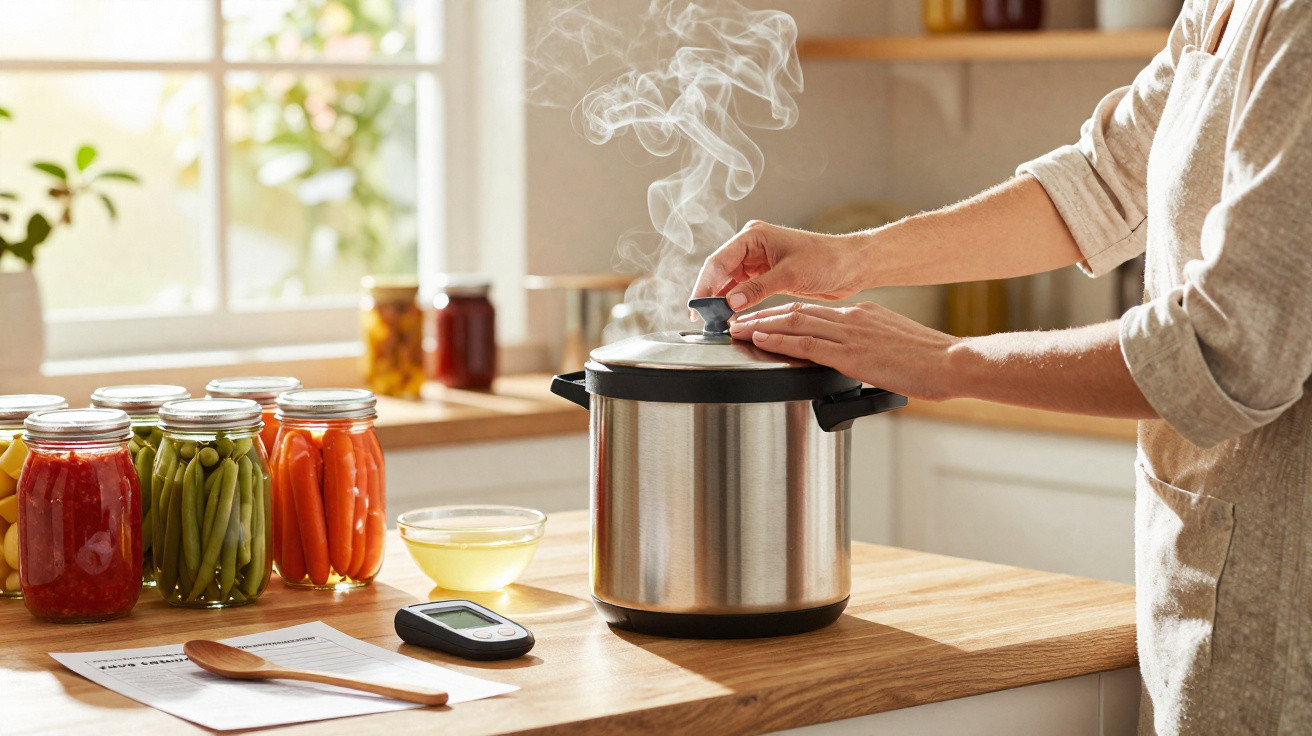
The jars arranged across the kitchen worktop looked flawless. Sunlight lit up the tomatoes’ ruby-red shine, the dark green runner beans and the gentle gold of sliced peaches. On Instagram, they would have made a miniature work of art. Outside the photograph, however, one minute, unseen factor could transform this comforting kitchen scene into a medical emergency.
The sort no one wants to discuss while the house still carries the scent of vinegar and warm fruit.
The person tightening that final lid felt pleased, perhaps nostalgic and even a little economical. They used a recipe vaguely remembered from a grandmother, improvised where it seemed “obvious”, and missed a step because the children were rushing about. Nothing appeared amiss. There was no odd odour, mould or broken jar - only the calm satisfaction of lids pinging as they cooled and sealed.
If danger is present, it remains silent.
And one error in homemade preserves appears time and time again.
The invisible risk in that beautiful jar
Home canning has made a strong comeback in recent years. Higher prices, sourdough baking and vegetable patches in the back garden all reflect the same desire to regain control. Neat rows of jars can feel like security stored on a shelf.
Yet the quality that makes those jars seem so reassuring is also what makes botulism so frightening: they are tightly sealed, quiet and concealed from sight.
For most of us, food safety depends on what we can see and smell. If food reeks, it goes in the bin. If it is mouldy, it is not eaten. None of those rules work with Clostridium botulinum, the bacterium responsible for botulism. Its toxin may be present in perfectly clear brine, with no smell, no cloudiness and no warning.
A single spoonful can be enough to paralyse breathing.
Public Health England has highlighted small clusters of botulism cases over the years, often traced to homemade jars. They may involve a family green-bean recipe, garlic preserved in oil, or a “natural” vegetable mix bought at a market stall.
Such stories rarely go viral - they are too disturbing.
In the US, the CDC has examined dozens of botulism outbreaks associated with home canning. Most involve what people describe as “low-acid foods”: vegetables, meat and fish. One outbreak began with a single jar of home-canned potatoes served at a church potluck. Thirty people became ill, and some required ventilators.
Nobody believed they were doing anything risky. They were simply feeding friends.
Across Europe and the UK, case numbers are lower, but the pattern remains unchanged. It often starts with an entirely ordinary choice: using a basic water bath, or “just boiling”, for vegetables rather than pressure canning them. Perhaps the recipe came from a blog that did not mention botulism. Perhaps it was handed down verbally over decades, before pressure canners became familiar in British kitchens.
Tradition collides with modern ignorance, and risk grows in the space between them.
The reasoning behind this danger is disturbingly straightforward. Botulism spores are widespread in soil. They can travel on carrots, beans, courgettes, garlic, mushrooms, fish and other foods. When these foods are sealed in an oxygen-free jar, kept at room temperature and lack sufficient acidity, the spores may become active and begin making toxin.
Ordinary boiling at 100°C does not consistently destroy those spores. You cannot see whether they have died - or survived.
The biggest repeated mistake in homemade preserving, documented in hospital reports and regretted quietly by families, is treating low-acid foods as though they were jam. It means using a simple boiling-water bath or merely “hot filling” vegetables, meat and savoury mixtures instead of pressure canning at a sufficiently high temperature.
That one choice marks the boundary between “rustic” and Russian roulette.
The one habit that actually changes everything
One practice can dramatically reduce botulism risk at home: divide preserves into two separate categories.
The first category is high-acid food that can safely be canned in boiling water - fruit jams, jellies, marmalades, pickles made with strong vinegar and correctly acidified tomato sauces.
The second category is low-acid food, which should only be preserved using a pressure canner or stored in the fridge or freezer - plain vegetables, meat, stock, beans, fish, garlic in oil, herb pastes and chilli sauces containing plenty of fresh vegetables.
The error is acting as though both categories follow identical rules.
In everyday terms, this means asking one non-negotiable question whenever you reach for jars: “Is this high-acid, or low-acid?” If you cannot answer with confidence using a tested recipe and a clear acidity level, do not make it shelf-stable. Let it cool, then refrigerate or freeze it.
It is not glamorous, but it separates attractive jars from safe jars.
At a weekend market on a farm in northern England, a couple began selling their own pickled vegetables. They were conscientious people: the type who label, clean, clean again, and Google every small detail. They boiled the jars and wiped each rim.
Even so, they did not understand that their mixed-vegetable “antipasti” required pressure canning or an appropriate acidification process.
Months afterwards, a customer became seriously ill. The hospital suspected botulism, and the small stall quickly became the focus of a nightmare investigation. The couple had done nearly everything correctly - except that they had placed their trust in an attractive online recipe and a pan of boiling water.
Nobody had plainly said: “This could kill someone if you get it wrong.”
Statistics do not care whether a jar was prepared with love. In the US, almost half of foodborne botulism outbreaks are connected to home-canned foods. Most result from precisely this confusion: people use boiling-water techniques for low-acid vegetables or meat because it seems “homemade” and traditional.
European reports quietly show the same trend, albeit with fewer headlines.
It is counterintuitive because the senses offer no help. Botulism toxin does not alter the smell or make food fizz. A jar can look and taste entirely normal. You may have years when “nothing bad ever happened” - until, one day, it does.
That long run of luck may be the most dangerous lesson of all.
Scientifically, the solution is almost dull. Botulism spores require very specific conditions before they are destroyed: temperatures above 116–121°C, maintained for long enough in the dense centre of the jar. A pressure canner alone achieves this, because it raises water above its usual boiling point.
Boiling-water baths stop at 100°C. Spending longer at that temperature does not guarantee the destruction of spores in low-acid food.
Acid alters everything. When pH is sufficiently low - as in traditional fruit jams or pickles made with strong vinegar - botulism spores cannot grow and produce toxin, even if they survive heating. This is why jam-making can seem so easy, and why so many people assume beans and courgettes follow the same rules.
They do not. The dividing line is chemical, not emotional.
The useful question for anyone preserving food at home is not “does this look safe?”, but “does this food belong in the low-acid category?”. If it does, the only safe ways to make it shelf-stable are pressure canning with a tested recipe, substantial acidification guided by reliable advice, or avoiding shelf storage altogether and using the freezer.
No Pinterest image is worth a ventilator.
Simple ways to keep the joy - and ditch the risk
Avoiding botulism does not mean abandoning homemade preserves. It means limiting what you put away in the cupboard and being almost stubbornly selective about it.
Choose three or four “signature” preserves to make strictly by the book: perhaps one jam, one chutney, one strong-vinegar pickle and one properly tested tomato sauce.
For anything that falls into a grey area - a beautiful roasted-garlic spread, chilli oil or vegetable “confit” - think cold. Prepare small batches, keep them refrigerated and eat them within days or weeks.
If you want to keep them longer, freeze individual portions instead of displaying them on a shelf like trophies.
People who have experienced a food-related health scare rarely turn into fanatics. Instead, they become exact. They measure vinegar, test pH and stop making assumptions.
They can still enjoy the ritual of steaming jars and bubbling pans; they have simply adopted one quiet rule.
Frequent errors generally come from affection rather than carelessness. It may be a parent determined not to waste a huge crop of green beans, a grandparent passing down a pre-war recipe that predates today’s knowledge, or a food-loving friend giving away homemade garlic in oil that has sat on the worktop for weeks.
On a human level, all of it appears generous and harmless.
Microbiologically, though, low-acid vegetables in an airtight jar at room temperature offer precisely what botulism spores would choose if they could: darkness, no oxygen, moisture and time. A great deal of time.
That is why modern canning experts gently resist “winging it”, even when recipes are family heirlooms.
Personally, challenging a cherished recipe may feel uncomfortable. Saying “I pressure can this now” can seem as if you are questioning your grandmother or the neighbour who “has always done it this way”. Let us be honest: nobody really does this every day.
Still, discreetly updating those techniques is an act of care, not disrespect.
“The jar isn’t dangerous. The combination of low-acid food, no oxygen and the wrong heat method is,” explains one UK food safety specialist I spoke to. “Change just one of those three, and you break the chain.”
Keep that chain in mind whenever you take out jars and lids. Oxygen-free? Check. Low-acid vegetables or meat? Possibly. A boiling-water bath rather than pressure canning? That is exactly the trio to avoid.
Break a single link and the level of anxiety falls sharply.
On a more emotional level, home preserving is often bound up with identity: being careful, resourceful, and “the one who knows”. Questioning it can feel like questioning yourself. On a quiet Sunday afternoon, that is a lot to process over a jam pan.
On a hectic Tuesday, most people simply want to clear the tomatoes from the worktop.
- Boiling-water bath: suitable for high-acid fruit and pickles, but not plain vegetables or meat.
- Pressure canner: essential for low-acid foods that you want to store at room temperature.
- Fridge or freezer: the safest support for garlic, herb oils, savoury spreads and mixed vegetables.
- Tested recipes: unexciting titles, potentially life-saving details. Trust them over “inspired” blog shortcuts.
- When in doubt: handle it as fresh food. Keep it cold, eat it promptly and do not keep it on a shelf.
A quiet skill that deserves more respect
There is something deeply human about lining up jars and feeling that you have captured a season. It is not solely about saving money. It is also about time, memory and the reassurance of turning something perishable into something that can wait for you.
That is what makes botulism feel so unfair: a gentle, domestic ritual can conceal such a brutal danger.
Once the risk is understood, it is difficult to ignore. You begin reading labels, pause before buying “artisan” preserves combining oil, vegetables and little vinegar, and look at last year’s jars wondering precisely how they were prepared.
Some people respond by throwing everything away. Others learn the rules correctly, then settle into following them.
In practical terms, this is about boundaries rather than fear. Jams and traditional pickles? Enjoy the process, share them and be generous. Low-acid vegetables and meat intended for shelf storage? Either invest in a genuine pressure canner and tested recipes, or keep them refrigerated or frozen.
You do not need to become a food scientist to remain safe; you only need to respect that one dividing line.
This is also where conversation matters. Saying to a friend, “Your chutney is amazing, I’d love the recipe - do you know if it’s from a tested source?” may feel strange the first time. But it shares knowledge gently, without shaming anyone.
At community level, that may be one of the quietest forms of public health.
The truth is that jars on a shelf contain more than food. They contain trust: trust in the past, in the person who made them, and in the recipe written on an old card. When sound science supports that trust, it is a beautiful thing.
When it does not, the gap between the two is where botulism lives.
We do not often discuss those gaps. They are invisible, just like the toxin. Yet every time someone calmly redesignates a recipe as “fridge only”, eventually buys that pressure canner, or stops giving away garlic confit left at room temperature, those gaps become a little smaller.
And somewhere, a future visit to A&E quietly never takes place.
| Key point | Detail | Benefit for the reader |
|---|---|---|
| Difference between acidic and low-acid food | Acidic foods, including fruit and pickles made with strong vinegar, prevent botulism growth; low-acid vegetables and meat do not. | Makes it possible to identify immediately which preservation method to use. |
| Choosing a preservation method | Boiling-water canning for acidic foods; pressure canning or cold storage for low-acid foods. | Dramatically reduces the risk of botulinum toxin in homemade jars. |
| A safe Plan B | Refrigerate or freeze higher-risk preparations, including garlic, oils, blended vegetables and meat. | Provides a straightforward alternative without major spending on equipment. |








Comments
No comments yet. Be the first to comment!
Leave a Comment