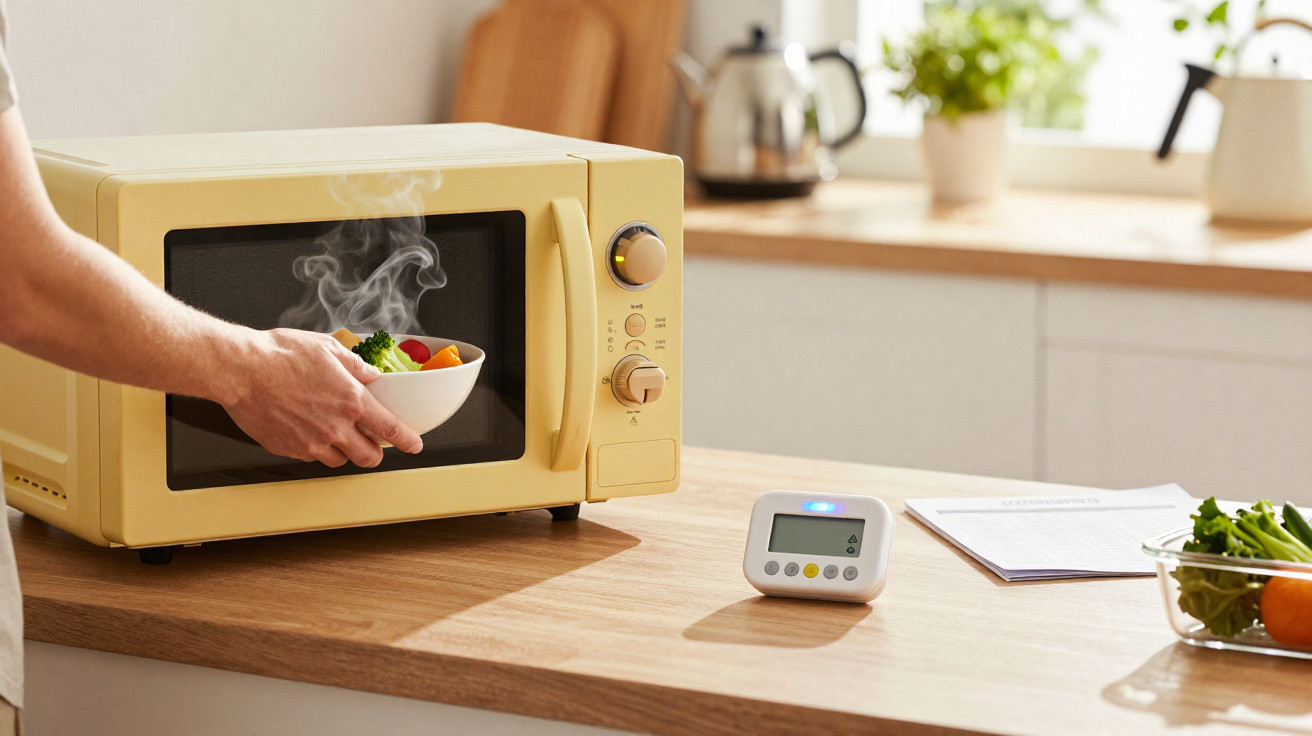
On the worktop, beside a fruit bowl no one had touched, a plastic tub drooped beneath leftovers stained orange. Two minutes later, the food was molten around the edges, freezing at its centre and carried a faint burnt-plastic smell. Its owner did not even glance at the appliance. It had occupied that spot for years: part of the kitchen, part of the daily routine.
Later that evening, half-asleep while scrolling on the sofa, they came across an odd new device claiming to “expose what your microwave is really doing to your food.” The video featured a test pad changing colour, steam measurements and something that looked disturbingly like melted chemicals. The comments were packed with people reporting tiredness, bloating and brain fog. It seemed dramatic, perhaps overstated. Yet once you have seen it, you cannot unsee it.
All at once, the humming box in the corner seemed rather less harmless.
Old microwaves, tired bodies
That ageing beige microwave in the kitchen corner resembles the colleague who never takes a day off: permanently present and scarcely ever challenged. It heats everything - yesterday’s pasta, supermarket soup and baby bottles - with the same relentless burst of patchy heat. Few people ask how it does this, or what the cost might be. You press 30 seconds, wait for the beep and eat.
Yet inside, that worn-out appliance is often badly out of step with what is now understood about food, plastic and heat. Door seals deteriorate, power can vary and hot spots develop where they should not. The quick blast relied on for lunch may overheat oils, distort containers and quietly cook away nutrients. It may still resemble food, but it no longer behaves like food in your body.
A recent rise in home testers and “microwave truth” gadgets has begun to lift the curtain. One of these newer devices - a flat, sensor-filled plate marketed as a blunt reality check - records surface temperature, steam strength and hot zones after a heating cycle. Users are finding that their supposedly “800 W” relics can randomly drive parts of a meal beyond 100°C while leaving the middle insufficiently heated.
One young father recorded himself warming a baby bottle on what he believed was a safe, low setting. The device revealed near-scalding pockets precisely where a newborn’s mouth would touch. Comments flooded in with accounts of cracked plates, warped lids and headaches following microwave-heavy days. There was no horror soundtrack or science-fiction storyline: simply untidy everyday kitchens and appliances well beyond their best.
Remove the drama and the reasoning is straightforward. Microwaves rapidly energise water molecules. In a newer appliance with intact seals and steady power, the process is reasonably predictable. In a cheap, ageing model that has been slammed shut 20,000 times, it is closer to a lottery. Food heats from the inside out, but in strange, uneven bursts. Delicate nutrients - particularly those in vegetables and breast milk - are heavily affected in certain areas while barely warming in others.
Bring plastic into the equation and the picture becomes worse. Thin, stained tubs were not made to endure years of microwave punishment. Micro-cracks retain food, grease and bacteria. Where local temperatures run high, minute quantities of chemicals can move into meals. The new diagnostic devices do not measure molecules, but they reveal the circumstances that may allow them to migrate: fierce, inconsistent surges of heat when you believed you had selected “medium power”.
The brutal wake-up call: a small device, big questions
At the centre of this fresh concern is a gadget roughly the size of a dinner plate, which initially appears harmless. It is a smooth disc with a straightforward display and a few icons. Place it below a bowl or plate, start your old microwave and watch. There is no spectacle and no blaring alarm - only data. That is exactly what makes it unsettling.
While the cycle is running, the device monitors how heat moves across its surface. Once the beep sounds, remove the food and view a map: red sections where temperatures climbed sharply, blue areas that remain cold and a small bar indicating how quickly heat surged. Certain models even identify “risk zones” where plastic in contact with the plate probably entered the danger range for common additives.
One user wrote that they had owned the same microwave since university. Testing it with the device showed the outer ring turning bright red in fewer than 40 seconds while the centre barely changed. It perfectly reflected how their meals had always emerged: soup boiling at the edges and lukewarm in the middle. Their regular complaints of bloating after speedy lunches no longer seemed so random.
The wake-up call concerns more than temperature; it is also about routine. On a forum devoted to testing microwaves with these sensors, people began measuring everything: frozen meals in their original trays, takeaways in flimsy cartons, children’s plates and reusable tubs that had already become cloudy. The device did not declare anything “toxic”, but repeatedly highlighted extremes: superheated corners, plastic slumping into hot spots and oily sauces driven far beyond anything that could be described as gentle warming.
We prefer to think of appliances in binary terms: safe or unsafe. The reality is less clear-cut. Old microwaves may still satisfy basic radiation-leakage requirements. The bigger issue lies in the everyday damage to materials and nutrients. Repeated local overheating may break down fats, particularly seed oils, into compounds that do not agree with your gut or arteries. Vegetables reheated excessively lose the antioxidants you hoped to preserve by “eating healthy”.
When your only cooking approach is to blast everything on high for one minute, three times daily, you are doing more than saving time. You are conditioning your body to rely on over-processed textures and poorly protected nutrients. The new device does not lecture you; it simply reflects that pattern back at you, harshly.
What to change tomorrow morning
You do not need a laboratory or a stylish new kitchen to change matters. The first measure is almost embarrassingly simple: regard your microwave as a blunt instrument rather than a magic box. Turn down the power - genuinely. Rather than nuking lunch at full power for 90 seconds, use 50–60% power for 3–4 minutes, pausing briefly halfway through to stir.
That change alone alters the heat map within your meal. There is less violence and greater balance. Oils warm rather than scorch, while proteins loosen rather than contract into a rubbery texture. Even without an expensive sensor device, you will notice the difference: fewer burnt edges and fewer icy surprises at the centre. Your tongue becomes the first basic “tester”, and it is remarkably truthful.
The next step is not glamorous, but it matters: part ways with worn plastic. Retire it if it is stained, warped or smells odd when heated. Glass containers with uncomplicated lids are your best allies in a microwave kitchen. They do not buckle and do not quietly leach when conditions become intense in the corners of your lasagne. An inexpensive glass dish does more for long-term health than every detox tea on your social-media feed.
Practically speaking, get used to covers and pauses. A basic vented microwave cover distributes steam, shields surfaces and reduces the severe hot spots repeatedly exposed by the new diagnostic plates. Heat, pause, stir and then reheat briefly if necessary. It may sound fiddly in writing, but in practice it takes 20 additional seconds and could prevent undercooked chicken or half-dead vegetables.
On a difficult day, you may feel inclined to dismiss all of this. You are exhausted, stressed and the microwave is the only barrier between you and an empty stomach. That is human. On a better day, however, you can use the very same appliance with slightly more care for your body. Cook on the hob or in the oven when time permits. Use the microwave mainly for gentle reheating, rather than brutalising food from frozen to boiling in one go.
People who begin using these “microwave truth” gadgets often pass through three phases: denial, disgust and recalibration. First, they question the device. Then they dislike what it reveals. Gradually, they make adjustments: lower power, less plastic, more stirring and checks for damaged door seals or rust. After a week or two, the old microwave remains unchanged. They do not.
“The microwave isn’t the villain,” says one home cook who tested ten different models with a sensor plate. “The villain is our fantasy that we can treat food like a file download: fast, invisible, and without side effects.”
We seldom link a lazy reheating session with how we feel an hour afterwards: brain fog after lunch, a heavy stomach after a “light” vegetable bowl, or children saying that food “tastes like plastic”. These are not invariably dramatic cases of allergy or poisoning. Often, they reflect the slow friction between rushed heating, tired ingredients and containers never intended to withstand the treatment we give them.
- Replace old plastic with glass or ceramic whenever food is hot.
- Choose medium power and longer heating times for most meals.
- Stir once halfway through heating, particularly sauces and soups.
- Replace microwaves with damaged doors, rusty interiors or inconsistent heating.
- Keep raw meat and baby food away from high-power blasts.
Food, tech, and the stories we tell ourselves
There is a reason this new generation of microwave-testing devices strikes such a nerve. It does not merely challenge your old appliance; it prods at a quiet bargain many of us made long ago: “I’ll trade a little unknown risk for a lot of convenience.” So long as the plate was hot and the timer beeped, we did not ask many questions.
Now, a basic sensor and heat map make that bargain feel less secure. You can see where food took a hit: where oils boiled, plastic sagged and the centre barely stirred. It is not a horror film; it is Tuesday’s lunch. Once that picture settles in your mind, the old “just nuke it” line no longer feels quite the same.
At a deeper level, this is about the way we value our time and treat our bodies. We plan meetings to the minute, count our steps and fixate on sleep. Then we heat food at full power, eat while standing and wonder why our energy collapses at 3 p.m. That new device on the worktop is less a gadget than a mirror, reminding us that speed has a flavour - and that flavour often resembles burnt edges, sagging plastic and half-dead vegetables.
Perhaps the genuine shock is seeing how swiftly routines can shift once they become visible. Nobody is asking you to throw your microwave out of the window. Simply stop treating it as neutral. The same box that made five-minute frozen dinners appealing can also help you enjoy slow-cooked leftovers without spoiling them, provided you treat it like fire rather than magic.
The next time that familiar hum begins in your kitchen corner, you may listen to it differently - not fearfully, but curiously. What is this ageing appliance truly doing to tonight’s meal? What sort of energy are you about to put into your body? These questions do not sit neatly on a product label. They occupy the quiet space between the microwave beep and the first mouthful.
| Key point | Detail | Why it matters to the reader |
|---|---|---|
| Old microwaves = extreme, uneven heat | Sensors reveal overheated zones alongside areas that remain almost cold | Understand why “quick” meals can leave you feeling heavy or unwell |
| Worn plastic + high heat | Reusing stained, distorted tubs encourages unwanted compounds to migrate | A practical reason to switch to glass and limit exposure to chemicals |
| Small changes, major effect | Less power, more time, stirring halfway through and better cookware | Straightforward strategies to use tomorrow morning for safer reheated meals |






Comments
No comments yet. Be the first to comment!
Leave a Comment