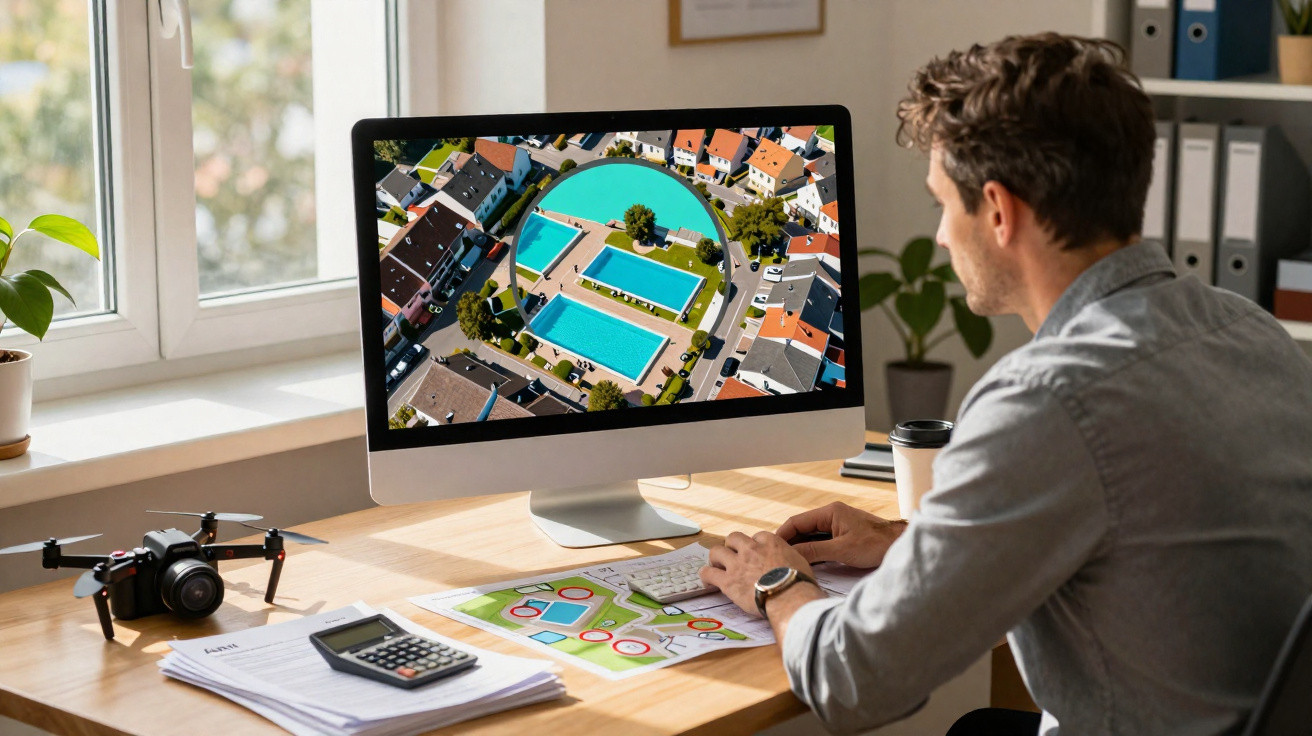
On a Saturday in July, in a quiet housing development, the neighbour’s swimming pool gleams behind a laurel hedge. It has been there for three summers: a permanent installation, neatly incorporated into the patio. Between two dives and another filtration-pump bill, it is easy to think: “No one will come looking.” Yet a pool assumed to be hidden from the road may now show up on a screen, be matched against thousands of other images, and then be flagged to the tax authorities. Technology has not removed the human element entirely, but it has transformed the scale of inspections. An undeclared swimming pool can lead to regularisation, unpaid taxes, interest and, in some cases, a penalty serious enough to spoil summer enjoyment. The pool is no longer quite so inconspicuous.
Undeclared swimming pools are no longer so easily missed
We all know the moment when a garden project seems fairly insignificant: excavation begins, a concrete slab is poured, a liner is chosen, and everyday life carries on. From the administration’s perspective, however, an in-ground pool or one permanently fixed to the ground is not merely leisure equipment. It can alter a property’s cadastral rental value and therefore affect the amount of certain local taxes due. For several years, the tax authorities have used aerial imagery and automated processing tools to identify structures that appear not to have been declared. An image does not automatically result in a tax adjustment, but it can certainly prompt an investigation.
The scheme, frequently linked with the “Foncier innovant” programme, has helped identify thousands of pools potentially missing from official declarations. Figures released by the authorities have made an impression: during the first campaigns, more than 20,000 undeclared pools were found across several departments, generating several million euros in tax revenue. Behind those numbers are also very ordinary circumstances: a pool installed by previous owners, a tradesperson who failed to explain the paperwork, or works that began as a modest installation before becoming a permanent pool over successive weekends.
Algorithms compare aerial photographs with available cadastral information, looking for shapes, colours and areas resembling a swimming pool. Officials then examine the files, since a blue cover, greenhouse or flat roof can mislead a machine. The owner may subsequently receive a request for information or discover that their tax position has been updated. Let us be honest: few people deal with this every day, particularly when administrative tasks arrive immediately after building work, just as they want to enjoy the water. Delaying matters, however, generally only increases the risk.
Planning declarations and taxes: steps that prevent a costly bill
The first step is to establish exactly what type of pool is involved. A permanent pool exceeding 10 m² will most often require a prior declaration to the town hall, while certain projects - depending on their size, enclosure or local planning rules - may require planning permission. Removable pools installed on a temporary basis do not always fall under the same arrangements. It is therefore essential to speak to the local authority’s planning department before reaching any conclusions. The sensible approach is to check the paperwork for the works before looking to the sky.
Once planning approval has been obtained, or once the work is complete, the tax position must be addressed promptly. A taxable swimming pool should in principle be declared to the tax administration within the required timeframe after completion, so that the information used to calculate property tax and, depending on the project, development tax can be updated. Many owners confuse the declaration submitted to the town hall with the one expected by the tax authorities: they do not serve precisely the same purpose. This misunderstanding is common and does not necessarily mean that someone intended to evade the rules.
Where the pool already exists and has never been declared, voluntary regularisation is usually preferable to waiting for a letter. An appointment at the town hall can establish whether the structure can be regularised under planning rules; the public finance centre, or the secure messaging service on impots.gouv.fr, can then help bring the file up to date.
“Data from aerial imagery are used to identify potential anomalies, which are then subject to checks,” the Directorate General of Public Finances regularly points out.
- Find the actual completion date for the works and gather the invoices.
- Check whether planning authorisation was submitted, or whether none was obtained.
- Declare the construction without waiting for a possible inspection.
- Request a written exchange if the circumstances are old or complex.
What an omitted swimming pool can really cost in tax declarations
The eventual bill differs greatly from one municipality to another, because property tax depends on the cadastral rental value and on locally approved rates. A swimming pool may also have incurred development tax when it was built, calculated using an updated standard value and the rates applied by the municipality and department. Add unpaid tax for previous years, late-payment interest and, depending on the circumstances, a surcharge, and the overall amount can become very uncomfortable. It is not invariably a dramatic sum, but it is often an unexpected expense arriving at the worst possible time.
The most difficult case is not necessarily a pool overlooked for a few months. It is more likely to involve a pool built without permission in an area subject to strict planning controls: close to a listed monument, within a protected area, on non-buildable land, too near property boundaries, or in breach of local development plan requirements. In such a case, tax regularisation alone will not resolve the planning issue. A town hall may require alterations, and some cases can ultimately reach the courts. The tax authorities and the town hall do not perform exactly the same role, even though their information may be shared.
The most sensible response is not to panic after reading an article or hearing neighbourhood gossip for the first time. A pool spotted in an aerial image still has to be identified, checked and linked to the correct property; mistakes do happen. Ignoring an official letter, on the other hand, is rarely a good strategy. Keeping plans, permission documents, dated photographs and invoices makes it easier to give a clear response. Technology gives inspections a new reach, but it does not prevent owners from explaining their circumstances, challenging an error or asking to regularise matters properly.
| Key point | Detail | Benefit for the reader |
|---|---|---|
| Aerial imagery | Tools identify swimming pools potentially missing from cadastral data. | Understand why a pool concealed by a hedge may still be detected. |
| Two separate processes | Town hall planning rules and tax obligations are distinct. | Avoid assuming that one declaration resolves the entire situation. |
| Regularisation | Acting before an inspection can simplify discussions and limit unwelcome surprises. | Have a practical course of action for a pool that has already been built. |

















Comments
No comments yet. Be the first to comment!
Leave a Comment