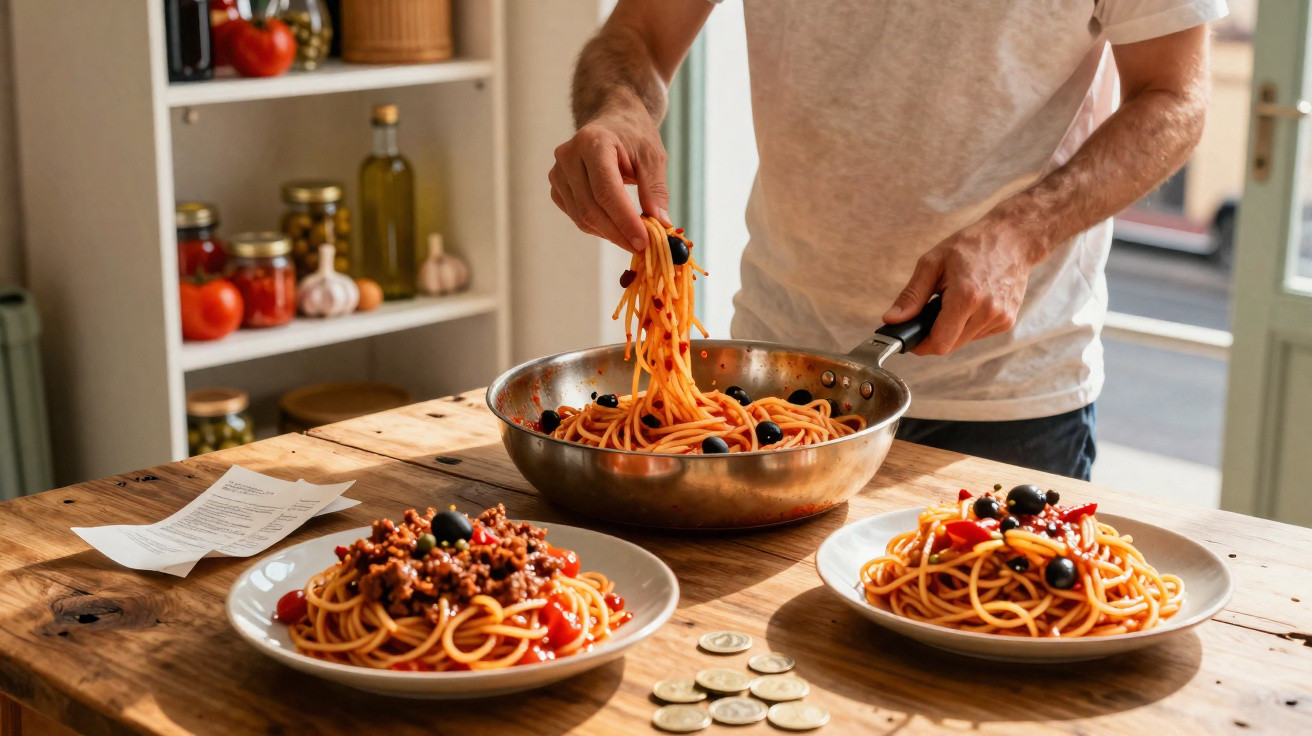
In Naples, an unassuming pasta dish with a scandalous name discreetly beats rich Bolognese for both flavour and value.
Throughout Italy, and particularly in the south, households repeatedly turn to a tomato spaghetti sauce that costs very little, relies on store-cupboard staples and still makes a satisfying meal. Although it is less celebrated internationally than carbonara or Bolognese, a Neapolitan nonna will tell you that this is the pasta which genuinely sustains the city.
The lighter sauce Italians really make at home
Browse the pasta-sauce aisle in supermarkets in France, the UK or the US and jars marked “Bolognese”, “carbonara” and “pesto” take centre stage. These options tend to be creamy, meat-based or indulgently rich, and are often rather heavy. Everyday cooking in Naples is frequently quite different.
The local favourite is spaghetti alla puttanesca: al dente strands of pasta wrapped in a lively sauce of tomatoes, olives, capers and anchovies. There is no minced meat, no cream and no lengthy simmering involved.
Spaghetti alla puttanesca is a classic Neapolitan pasta: bold in flavour, light on calories and surprisingly kind to your wallet.
It is built around tinned and preserved foods: peeled tomatoes, capers preserved in brine or salt, anchovies from a jar or tin, and olives. This makes it particularly useful for weeknights or the end of the month, when the fridge is nearly empty but you still fancy a filling dinner.
A colourful Naples origin story
Its name forms part of the mythology. Puttanesca approximately means “in the style of the prostitute”. Culinary historians do not agree on its precise origins, but Naples generally remains at the heart of the story.
Kitchen perfume for the street
A popular version claims that the sauce originated in brothels close to Naples harbour. Workers supposedly assembled garlic, tomato and anchovies into a speedy sauce, allowing its scent to escape through open windows and draw customers in from the street.
It is an evocative image: inexpensive ingredients, powerful aromas and a pan that is almost permanently on the hob. In a city defined by enterprise and improvisation, the tale feels plausible.
Or just a last-minute cupboard supper?
A second explanation, less theatrical but more recognisable to anyone facing a nearly bare cupboard, offers another account.
According to a more practical version, puttanesca was born when a cook needed to feed guests fast, using only preserved ingredients on hand: tinned tomatoes, olives, capers and anchovies.
Whichever account is accurate, the name endured. At its core is an idea that feels thoroughly contemporary: a good meal does not require fresh meat, cream or costly ingredients if you know how to make the most of what is already in the cupboard.
Spaghetti alla puttanesca: big flavour from ten basic ingredients
For two servings, Italian cooks generally use approximately the following amounts:
- 160 g dried spaghetti
- 200 g peeled tomatoes (tinned)
- 1 garlic clove
- 4 anchovy fillets, rinsed and desalted
- 1 teaspoon capers (usually packed in salt or brine)
- Around 10 pitted black olives
- A pinch of chilli flakes
- Olive oil
- Salt and black pepper
- Flat-leaf parsley, a couple of sprigs
Nothing else is needed: no stock, butter or cheese. Its flavour comes from the inherent saltiness of anchovies and capers, balanced by the sweetness of cooked tomatoes.
Step by step: the Neapolitan way to make the sauce
The sauce can be completed in the time it takes to boil the pasta. This is how a standard Neapolitan-style version is prepared.
- Fill a large pan with salted water, bring it to the boil and cook the spaghetti until it is just al dente.
- As the pasta cooks, warm a generous pour of olive oil, roughly 4 tablespoons, in a wide frying pan.
- Chop the anchovies finely and slice the garlic. Put both into the warm oil and allow them to soften gently for a minute or two. The anchovies should dissolve into the oil and form the sauce base.
- Add the crushed or chopped peeled tomatoes, followed by the capers, chilli flakes and coarsely chopped olives.
- Simmer the sauce quite briskly for 6–7 minutes, stirring occasionally, until it is glossy and slightly thicker.
- Drain the spaghetti, reserving a ladleful of its cooking water. Add the pasta to the sauce along with a splash of the reserved water and a further drizzle of olive oil.
- Toss over a high heat for one minute, so that the sauce coats every strand. Add chopped flat-leaf parsley and black pepper to finish.
The key move is finishing the pasta directly in the pan with the sauce, plus a little cooking water. This gives that restaurant-style silkiness.
Why Italians see it as lighter than Bolognese
Bolognese, including its most authentic versions, centres on minced meat slowly cooked with fat and wine. A substantial serving can easily feel like a complete meal on its own. Puttanesca provides satisfaction of a different sort.
| Aspect | Bolognese | Puttanesca |
|---|---|---|
| Main protein | Minced beef/pork | Anchovies (small amount) |
| Texture | Thick, heavy meat sauce | Loose, tomato-based, full of bits |
| Cooking time | Often 1–3 hours | About 15 minutes |
| Cost per serving | Higher (meat-based) | Low (mostly pantry items) |
Anchovies bring savoury depth and umami while containing far less fat than a pan filled with minced meat. As the sauce is largely made up of tomatoes and vegetables, it can feel generous without the drowsy slump that may follow a Bolognese.
What does it actually cost?
Costs differ, but with standard supermarket ingredients in the UK or US, two portions will usually cost less than a takeaway pizza. A broad guide is as follows:
- Dried spaghetti: a low-cost staple, using only a small portion of a full packet
- Tinned tomatoes: frequently under £1 / $1 for the amount required
- Anchovy fillets: just a few taken from the tin or jar
- Olives and capers: measured by spoonfuls rather than using an entire jar
- Garlic, chilli, parsley, oil: only small quantities needed
Once you’ve bought the jars and tins, you can cook puttanesca several times without another big shop, which keeps the price per bowl impressively low.
Making puttanesca work at home
Italian traditionalists are protective of their preferred recipes, yet the dish itself emerged from making do. Several practical changes suit a home kitchen well.
Familiar substitutions and variations
- No anchovies? A dash of fish sauce can provide comparable salty depth.
- Not keen on spice? Omit the chilli flakes, or use only a little black pepper instead.
- Prefer extra vegetables? Add a handful of diced courgette or peppers before adding the tomatoes.
- Serving someone who does not eat fish? Exclude the anchovies and increase the olives and capers for extra flavour.
The essential point is to avoid overcrowding the pan. Keep the sauce fresh and vibrant rather than burdening it with too many additions.
What “al dente” means here
Italian pasta recipes nearly always instruct you to cook it “al dente”. Here, this means that the spaghetti retains a slight firmness at the centre instead of becoming soft throughout. It will continue cooking for roughly another minute when it is finished in the pan with the sauce.
With supermarket packaged spaghetti, this normally means taking it off the boil one minute earlier than the packet advises, then completing the cooking in the sauce. Doing so allows the pasta to take on flavour and helps stop the sauce becoming watery or separating.
Where puttanesca belongs in a weekly routine
For people aiming to eat less red meat without becoming entirely vegetarian, puttanesca is a useful middle ground. The modest amount of anchovy supplies protein and umami, while tomatoes and pasta make up most of the dish.
During an ordinary week, it can serve as a reliable midweek option: one pan for sauce, one pot for pasta, and dinner ready in less than 20 minutes. Any leftover sauce works spooned onto toasted bread, mixed through beans or used as the starting point for a tray of roasted vegetables.
Think of puttanesca as a template: a quick, pantry-led sauce that can be stretched, reduced or tweaked depending on what you have and how hungry you are.
Serve it with a straightforward green salad and some crusty bread, and it becomes the sort of meal Italians have depended on for generations: inexpensive, intensely flavoured and light enough to leave you wanting a walk afterwards rather than a collapse on the sofa.











Comments
No comments yet. Be the first to comment!
Leave a Comment