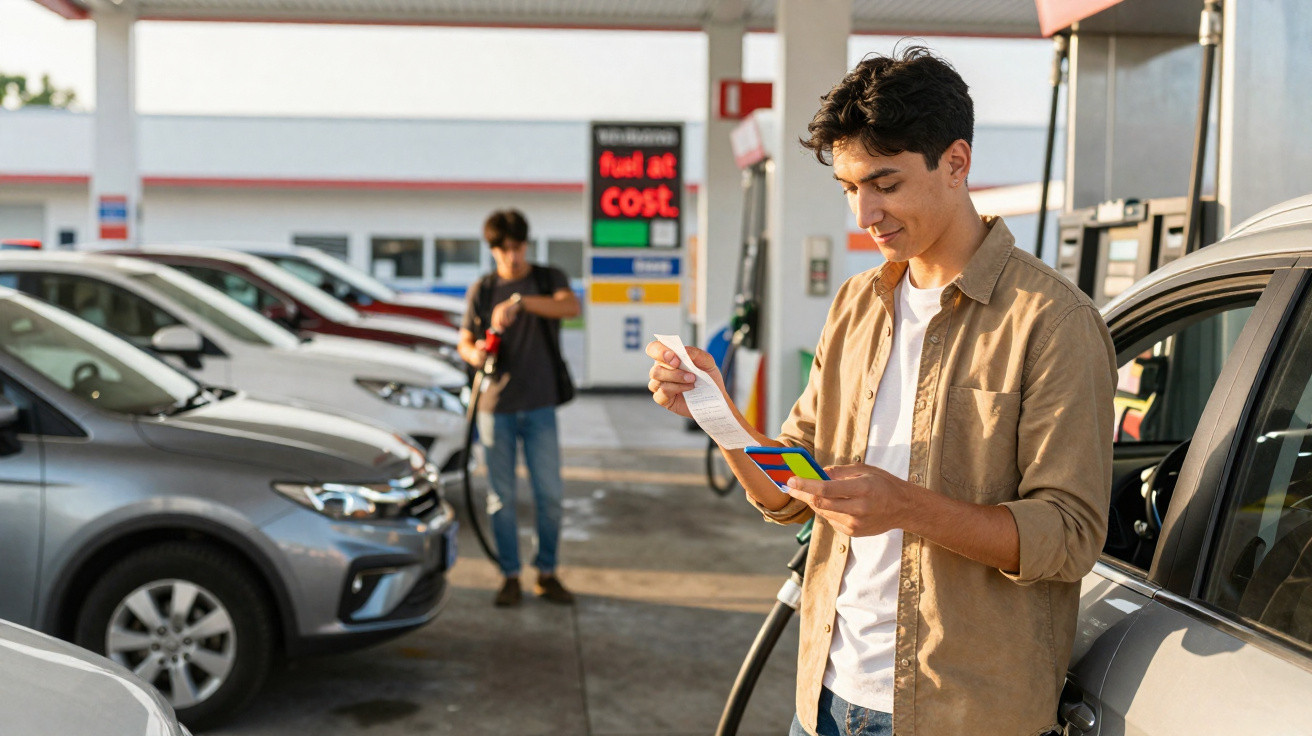
Your neighbours may already be boasting about paying less per litre. The catch is that not every forecourt takes part, the deal may not apply at all times, and drivers do not all qualify in the same way.
I arrived at an Intermarché filling station shortly after dawn on a bitter Saturday, with everyone’s breath visible in the air. Cars were queued around the kerb, their hazard lights pulsing slowly. Drivers stood beside their vehicles, exchanging advice as though sharing a useful route through traffic: part rumour, part practical guide.
At one pump, a driver celebrated as the displayed price fell. A couple of lanes away, a woman stared at her receipt and silently said, “It didn’t work.” There was that familiar unease of somebody quickly calculating the figures in their mind. The lower price existed, but it was not available on equal terms for everyone.
The answer is more obvious than it first appears.
Why your neighbours are paying less at Intermarché
Intermarché does not operate a single nationwide promotion; instead, it is a collection of local choices. In certain areas, the retailer sells fuel “at cost” for a day or two, cutting the pump price by a clearly visible 8 to 20 cents per litre. Elsewhere, the reduction is credited to your loyalty account rather than deducted on the display. Both can be good value, but only one delivers the saving immediately.
Drivers tell variations of the same tale. Thomas, who lives just beyond the ring road, saved almost €9 when he topped up his diesel during a straightforward cost-price weekend at his local store. On the same day, a colleague in another part of town also filled up at the same chain, only to find that her promotion was loyalty credit to appear on her next grocery receipt. Same name above the forecourt, different result. One customer drives away delighted, while the other has to wait for the benefit.
The explanation is basic economics shaped by local tactics. Fuel generates customer visits rather than substantial profit, and Intermarché allows store managers some freedom to select the approach that suits their local area. Wholesale costs change every day, while taxes are set but differ between fuel types. E10, SP95, SP98 and diesel each have their own margin. A large number of stores exclude E85, LPG and AdBlue. What appears to be one promotion is actually a regional patchwork created by local managers.
How to avoid missing the Intermarché offer
Before joining a queue, check the terms. Use the Intermarché app or website to find your forecourt’s banner, which should list participating sites along with the precise dates and times. Read the small print on the leaflet or visit the store’s Facebook page. Some deals impose a limit per transaction, commonly 30 to 50 litres, and may finish before the shop closes. Filling up early in the morning or later in the evening can help you avoid the crowds and the possibility of empty pumps.
Take your loyalty card with you, even where the signs advertise “at cost”. Some forecourts scan cards to monitor volumes, while others use cashback when they cannot change the pump price quickly enough. Do not assume that every fuel grade is covered. SP98 is often omitted, and some offers restrict larger vehicles. Most people have experienced the nozzle stopping at 49.78 litres, only to discover that the limit was not merely hearsay. In truth, hardly anyone reads every line of a promotional leaflet while standing in a car park.
It is rather like trying to catch a train on a flexible timetable: you can make the journey, but only if you check the departure board.
“It’s the only time my tank feels lighter on my wallet than on the scale,” said Claire, 38, who drove ten minutes past her usual station because her village store wasn’t participating this time.
- Find out whether your site offers “at cost” fuel or “cashback on card”. The timing and customer experience are different.
- Verify the fuel types covered. E10 and diesel are frequently included, whereas E85 and LPG are often left out.
- Check the litre limit and operating times. Queues often build during the day’s first two hours.
- Keep your loyalty card to hand. With cashback, the credit is added to your grocery savings pot.
- During particularly busy weekends, monitor stock through Google Maps’ “Popular times” feature and local Facebook posts.
The weekend effect - and what it reveals about how we fill up today
An Intermarché weekend price cut is not simply a lower figure on the sign; it has become a ritual. While waiting, people chat, share tips and compare receipts as runners might compare split times after a race. A neighbour’s saving becomes the standard against which you measure your own. Missing a deal can feel like a small mistake that you are determined not to repeat.
It also demonstrates that the nature of the saving matters. An immediate reduction of 12 cents per litre is instantly reassuring. Cashback feels less definite, rather like a promise for later. Both reduce the overall cost, although they are not equally visible. How people feel at the pump matters almost as much as the calculation.
There is another factor: expectation. We want influence over something that seldom seems within our control. Energy costs have become seasonal. You spot the signals, decide when to fill up and tell your friends. The discount may be the headline, but the habit it encourages is the real story.
Most people discover this only after doing it once: the cheapest litre is the one that suits your routine without causing trouble. If your nearby Intermarché is offering fuel “at cost” and you can get there early, it is an obvious choice. If the deal is cashback and you need groceries anyway, the saving still ends up in your shopping basket. If neither applies, spending 30 minutes in a queue on the other side of town may cancel out the benefit in time and stress. You can choose which game to play.
| Key point | Detail | Why it matters to the reader |
|---|---|---|
| Offer type | “At cost” at the pump versus cashback on the loyalty card | Understand whether the discount is immediate or added later to your grocery savings pot |
| Timing and limits | Restricted dates and hours; usual limits of 30–50 L per transaction | Choose the best time to avoid queues and avoid reaching the limit during a fill |
| Eligibility and fuels | Participation differs by forecourt; E10 and diesel are common, while E85 and LPG are often excluded | Prevent surprises at the nozzle and select the appropriate pump |











Comments
No comments yet. Be the first to comment!
Leave a Comment