You know the scene all too well: it is 6.37pm, you are in the kitchen looking at a miserable frozen block of mince on the worktop, and you are wondering how this has happened again. This week, you had vowed to be more organised and defrost food “properly”, like those irritatingly prepared people on Instagram. Instead, you are hungry and exhausted, prodding a rock-hard chicken breast with a fingernail while trying to negotiate with the laws of physics. Your hand drifts towards the microwave, where the defrost button seems to flash at you like the terrible choice you are already preparing to make.
You reassure yourself that it will be all right: you have used it before and nobody has died. The microwave starts humming, the plate rotates, and soon the meat’s edges are becoming grey and depressing while its centre remains frozen. Between impatience and guilt, a small fear appears: am I about to give everybody food poisoning? There is a quicker, safer approach, although most of us were never taught it properly. Once you know it, that defrost button begins to look distinctly villainous.
The romance and rage of the microwave defrost button
The microwave defrost button is presented as a domestic wonder. Press it, wait briefly, and dinner supposedly materialises by magic. The adverts do not show the real outcome: partly cooked edges, tough corners and the slight smell of overdone chicken skin hanging in the kitchen. Somewhere, a microwave is beeping accusingly at a neglected pork chop that has gone from “defrost” to “rubber” over three loud intervals.
We are drawn to the button because it appears to solve poor planning for us. It suggests that we can take food from freezer to frying pan in ten minutes without any downside. That is the deception. Defrost settings fire energy waves into food unevenly, leaving some areas frozen while others enter a warm, hazardous temperature range where bacteria can happily multiply.
Food scientists use a thoroughly unromantic term for this risky range: the “temperature danger zone”, roughly 5°C to 60°C. At these temperatures, bacteria including salmonella and E. coli can double in number in as little as 20 minutes. If a microwave starts gently cooking the outside of your chicken while its middle is still icy, the exterior is sitting in that danger zone while you act as though it is not. It may seem innocent, but it is not.
Why the middle is still frozen when the outside is sad and grey
Microwaves work by stimulating water molecules. It sounds impressive, yet in reality it means they target the parts of food able to absorb those waves fastest. Thick, compact frozen meat does not handle this well. The edges begin thawing first, the corners steam, and the centre remains stubbornly Arctic. The result is an odd terrain of meat: warm patches, hot spots and an icy core.
As soon as the outer part of that chicken reaches a vaguely warm temperature, bacteria become active again. Freezing never truly removed them; they were merely dozing in the freezer like miniature villains in a Marvel film. Of course, the meat must still be cooked completely, and high temperatures kill most common pathogens. The problem is that, when the surface has spent long enough in the danger zone, certain bacteria can produce toxins that heat does not reliably eliminate. You cannot taste those toxins, but your gut certainly can detect them.
The most troubling part is how it affects our behaviour. Meat defrosted in a microwave can look “sort of cooked” around the edges, encouraging people to be less careful. You might give it a speedy fry that is not quite long enough because it already appears done. Or perhaps somebody cuts into it, says, “Ah, it’s almost there,” and rushes those final few minutes. We are only human, and hunger makes us take shortcuts. The defrost button makes that particularly easy.
The fridge method we all pretend to use (but rarely do)
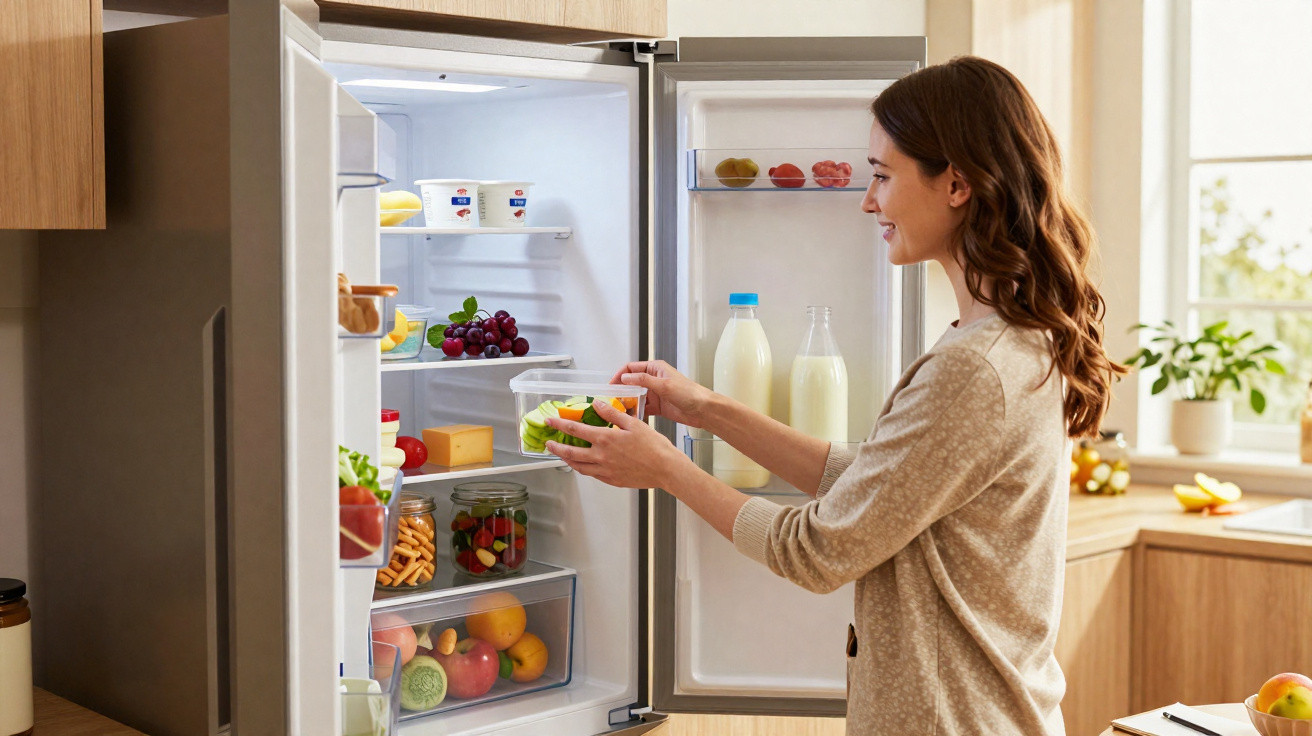
Ask any food safety specialist how meat should be thawed and you will hear the same answer repeatedly: “Defrost it in the fridge.” Naturally, they are correct. A fridge maintains a pleasantly low temperature, allowing meat to thaw gradually without giving bacteria the warm, welcoming window they enjoy. In an ideal world, each of us would transfer tomorrow’s chicken from freezer to fridge at breakfast, with a halo gently shining above our heads.
In reality, hardly anybody manages it every single day. Life is chaotic. Plans alter without warning, children reveal that they have invited two ravenous friends over, or you arrive home late and look at a frosty packet of sausages as though it has personally betrayed you. Fridge thawing is the safest standard: slow, dependable and wildly impractical for people who cannot remember where they left their keys, never mind what they might want to eat on Thursday.
It can also feel a little dispiriting. Food thawed in the fridge requires you to plan 12 to 24 hours ahead and become the sort of adult whose diary is more than meetings and alarms blurred together. On some days, that is manageable. Far more often, you open the fridge, find nothing prepared for cooking and quietly resent the optimism you felt in the supermarket aisle.
The quiet guilt of good intentions
Everyone knows an “organised food person” online. They have labelled freezer containers, weekly meal plans and attractive overhead photographs of mince in little glass dishes. They never forget to thaw anything. Presumably, they also fold their washing on the day they do it. For everyone else, defrosting meat is an exercise in damage limitation: how can this become safely edible before somebody starts eating cereal instead?
That is when the low-level shame starts. You remember the advice about using the fridge, ignore it amid the pressure of the day, and turn the microwave defrost button into a guilty secret. You watch the plate turning, knowing that this is not ideal but unsure what alternative you have. Yet there is a route between virtuous fridge thawing and frantic microwave use. It is not glamorous, and it requires a sink plus some patience. But it works.
Cold water: the unsexy hero of fast defrosting
Cold-water thawing does not sound thrilling. It can seem almost laughably simple, like advice from your gran that surely cannot beat modern technology. However, ask people who study food safety in laboratories rather than merely on TikTok, and cold water is their preferred rapid option by a considerable distance. It is fast enough for real life, gentle enough to keep meat in the safe range and surprisingly satisfying once it becomes routine.
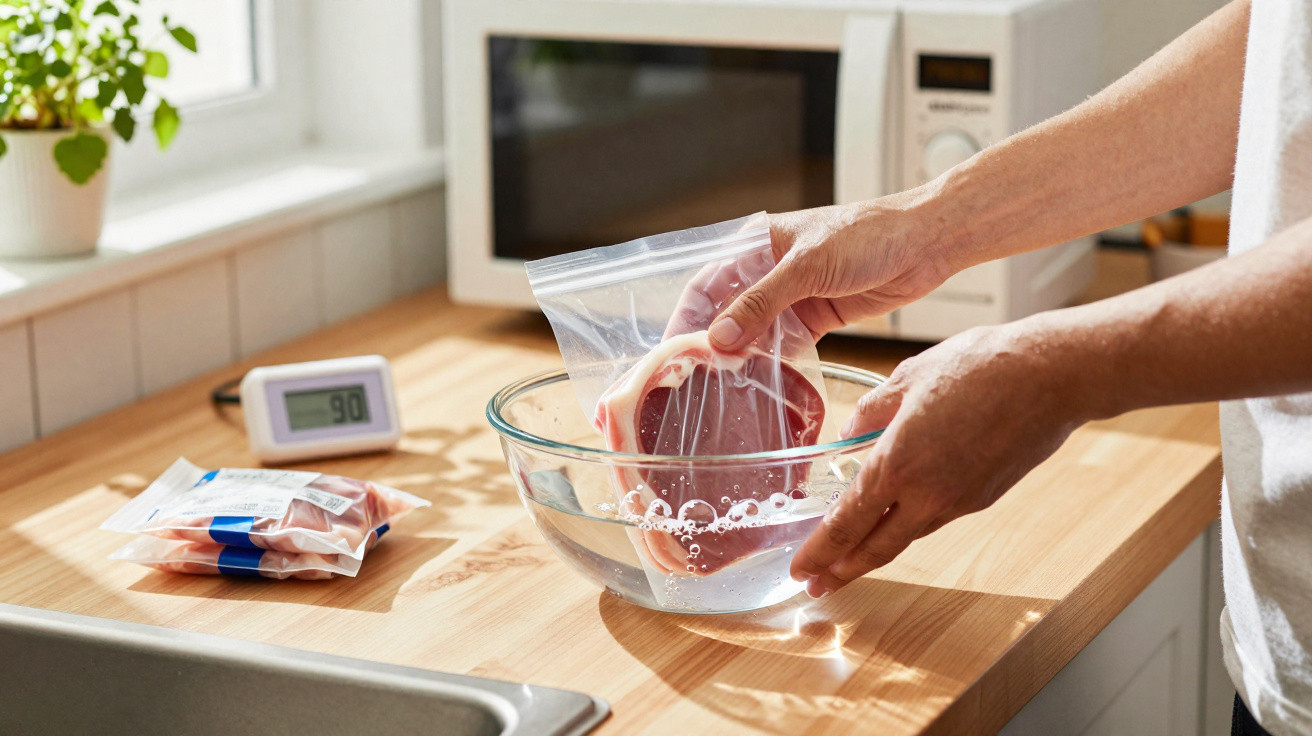
The method itself is simple: leave the meat in a leak-proof bag, immerse it in cold tap water and replace the water every 30 minutes to keep it cold. Water transfers heat far more effectively than air, including the cold air inside a fridge. Consequently, a chicken breast that could sit on a fridge shelf for a day can go from frozen to ready for cooking in roughly an hour under the tap. Smaller portions thaw even more rapidly. A packet of mince may be ready in 30–40 minutes, about as long as it takes to empty the washing machine and argue about the television remote.
Why cold water beats the microwave at its own game
This approach keeps the meat’s outer surface below the danger zone for far longer. Instead of bombarding the food in unpredictable bursts from the outside, the water removes the chill evenly. There are no grey, cooked edges and no unsettling hot spots. Instead, the temperature shifts steadily from rock-solid to flexible and ready for the pan. When you press the packet lightly with a fingertip, you can feel it give just enough.
Although it may seem counterintuitive, the water must be cold rather than warm. Warm or hot water would thaw the exterior too rapidly, pushing it directly into bacteria’s preferred spa-like temperature while the middle stays frozen. Cold tap water offers speed without that dangerous diversion. Every impatient instinct may tell you otherwise, but the cold is helping you.
There is also something reassuringly calm about the process. You fill the sink, lower in the bagged meat, and hear the water slap softly against the bowl. Every 30 minutes, you empty it and refill it from the tap; the sound is a small prompt that you are handling it properly. There is no aggressive hum and no frantic beeping, only water quietly doing what science says it does best.
How to actually do it, without turning your kitchen into a swamp
Cold-water defrosting is straightforward, though several details cannot be ignored. The meat needs to be inside a sealed, leak-proof bag. If its supermarket packaging is not waterproof, place it in a freezer bag or zip-lock bag before submerging it. You do not want raw meat juices escaping into the water, and you certainly do not want them reaching the sink, your hands or anything else you may neglect to wash thoroughly.
Choose either a large bowl or a clean sink, ensuring the meat remains completely under water. If it floats upwards like an obstinate iceberg, hold it down with a plate. Replace the water every half hour so that it stays cold. This is not needless fussing: fresh cold water prevents temperatures from creeping up as the meat warms, reducing the time its exterior spends flirting with the danger zone.
When the meat has thawed, cook it immediately. Do not think, “I’ll just leave it on the side while I scroll on my phone for 40 minutes.” You have sped through the safe stage, so it now requires a proper hot finish. The oven, frying pan or grill is where genuine safety takes place, as the internal temperature eventually rises enough to destroy bacteria that survived the cold.
A rough guide that actually fits real evenings
A stopwatch is unnecessary; you only need a general idea of the timing. Smaller cuts, such as chicken fillets, boneless pork steaks or mince in 500g packs, generally thaw in cold water within 30–60 minutes. More substantial pieces, or portions of around 1kg, can need up to two hours. Large joints and whole chickens are the main nuisance: they may still require several hours, and are sometimes better suited to that slow, saintly fridge treatment when you can manage it.
If you tend to forget items left in the sink, set a phone timer for every 30-minute water change. The aim is not flawless organisation; it is simply to prevent the water becoming tepid and sluggish. Make it a background task while you deal with ordinary life: supervising homework, having a shower or enduring three rounds of “where are my football boots?”. By the time you remember dinner, the meat will be pan-ready rather than still brooding in the freezer.
The emotional side of “doing food safely”
Food safety guidance often arrives with a heavy thump. It can feel like yet another responsibility adults must perform perfectly, alongside sorting recycling correctly and answering emails within an acceptably respectable period. In truth, most of us work on a sliding scale of “good enough”, particularly when we are feeding people after a long Tuesday. That is exactly why the microwave defrost button is so tempting: it plays to our wish that one press can make a problem vanish.
Cold-water thawing has none of that appliance magic. It resembles watching paint dry, though in a curiously soothing way. Rather than simply trusting that a machine has done the job properly, you take part in the process. You feel the packet softening, replace the water and judge when it is ready. That brings a modest feeling of control, particularly when modern life so often means responding to notifications.
Most of us have experienced the moment of serving a meal while privately wondering: “Did I rush that chicken?” That faint worry can ruin the first mouthful. Proper cooking combined with cold-water thawing helps to quieten it. You might still scorch the onions or make the rice too soft, but at least you are not taking part in bacterial roulette.
So, should you break up with the defrost button?
Nobody is going to enter your kitchen and seize your microwave. There will be genuine emergencies when the defrost button seems like the sole option, and many of us have spent years thawing food questionably without suffering more than a mildly dodgy stomach. Even so, once you understand how uneven the odds may be, it is difficult to ignore them. That unremarkable little button is not simply lazy; it carries risks that may not become obvious until later.
The fridge will always be the calm, sensible partner: dependable, predictable and slightly dull. Cold water is the resourceful friend who arrives when you are in difficulty, offers a practical fix and does not judge. The microwave defrost function? It is the charming ex who messages at midnight: exciting, convenient and not especially good for you over time. You can still talk, but it is probably unwise to move them back in.
The next time you find yourself facing a frozen block of dinner and automatically reaching for the keypad, stop briefly. Fill the sink, seal the bag and allow cold water to do its quiet job. The meat will thaw, the risk will reduce, and you will avoid grey, half-cooked edges with a faint scent of regret. Your future self, and everyone at the table, will feel the difference.




Comments
No comments yet. Be the first to comment!
Leave a Comment