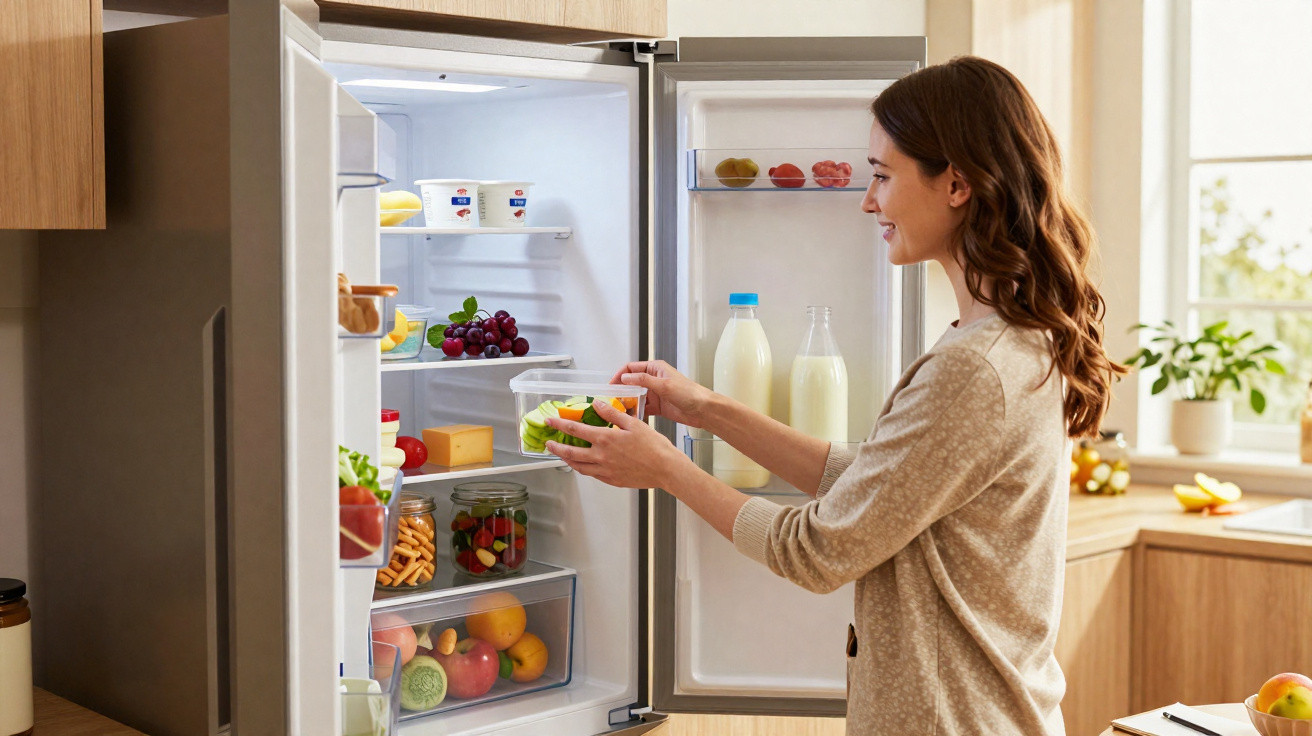
You open the fridge and a wave of cold air escapes - followed by a half-open jar of salsa tipping onto its side. A bag of spinach is edging its way off a stack of yoghurts. A sticky lemon, with nowhere to go, rolls about on the shelf. You stand there searching for the item you bought three days ago, which has somehow vanished into the frozen depths. The milk sits behind the leftovers. The leftovers sit behind the condiments. Somewhere at the back, a forgotten science experiment is quietly growing fur.
Then somebody calls from another room: “Did we run out of cheese?”
You look once more, feel overwhelmed, and realise you have no idea what is actually in your own fridge.
One straightforward zoning trick can completely change that.
The hidden chaos behind your fridge door
Most fridges are not messy from the start. Disorder builds up bit by bit: one hurried food shop, one late-night meal when everything is pushed onto the first available shelf, one lunchbox container that never returns to where it belongs. Before long, opening the door means facing visual clutter rather than food. Your brain gives up. You shut the door and order a takeaway.
We tend to assume this means we are disorganised. More often, the fridge simply is not arranged around the way we really live.
Imagine a Sunday evening. Someone feels motivated and does a big food shop. For roughly ten minutes, the fridge looks perfect: fresh berries, leafy greens and yoghurts standing in neat little rows. By Wednesday, the strawberries have travelled to the back. The herbs are hidden beneath leftovers. That container of “healthy lunch prep”? It is tucked behind a jar of sauce. You take whatever you can spot within three seconds and forget everything else.
Food-waste figures can seem distant until you remember that your own floppy cucumbers liquefying in the vegetable drawer are part of them.
This happens for a reason. The layout of your fridge does not reflect the way your mind looks for food. You do not think, “top shelf, middle, back left”. You think, “I want something quick, something sweet, something for breakfast”. Without a clear zone for each of those situations, your hand reaches for whatever is nearest. Some foods are therefore eaten first every time, while others are overlooked completely. The layout determines what you notice, and what you notice determines what you eat.
That is why the “zone trick” can feel almost unfairly effective once you test it.
The fridge zone trick that works in everyday life
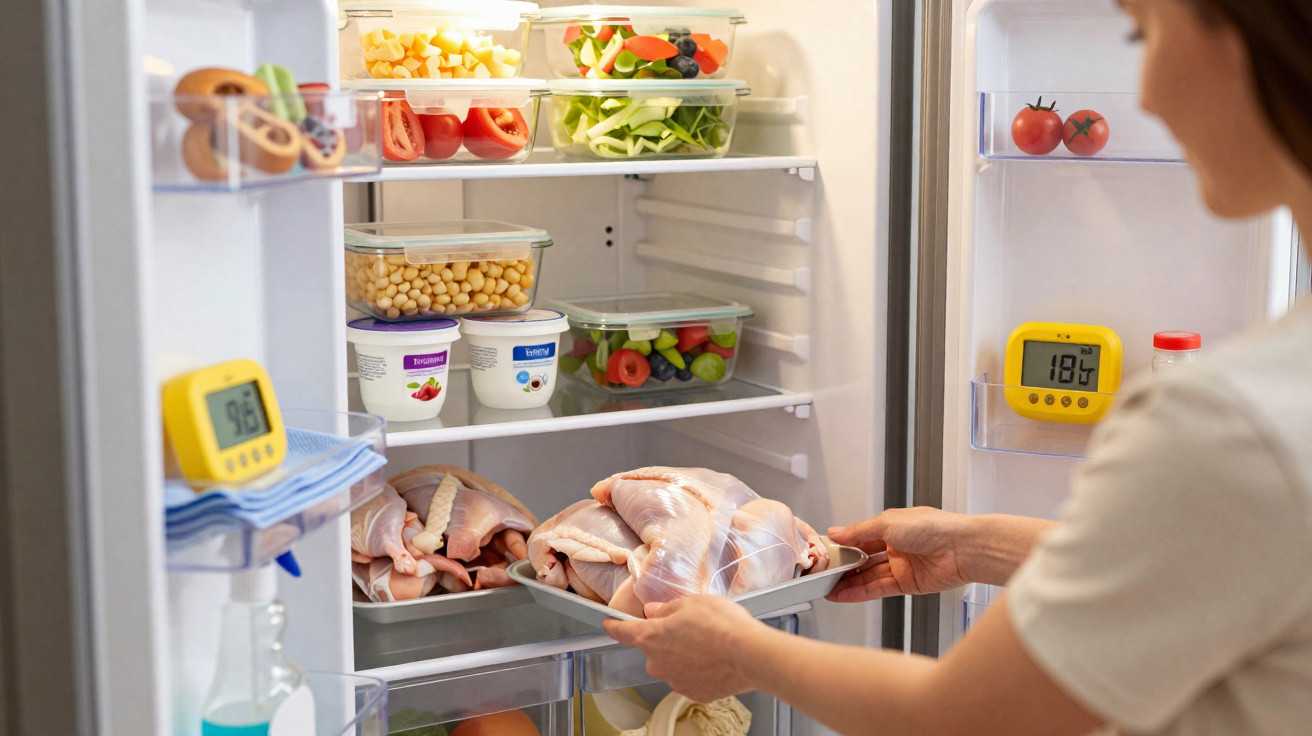
The principle is simple: organise the fridge according to use rather than food type. Forget a “dairy shelf” or “leftovers shelf”; think in terms of a “breakfast zone”, “snack zone” and “cook-tonight zone”. Give every shelf, or even half a shelf, a purpose. That is all it takes.
Begin with three or four zones that you use every day. For many households, these are:
- A grab-and-go snack zone
- A breakfast zone
- A cooking zone for foods that need using soon
- A leftovers and ready-to-eat zone
Once a zone has a name, anything that does not suit it should either go into a different zone or should not be kept in the fridge at all.
Consider the snack zone. Place it at your children’s eye level if you have children, or at your own eye level if working from home makes you stress-snack. Fill it with yoghurts, hummus, washed grapes in a clear container, cheese sticks, chopped vegetables and that chocolate bar you are supposedly rationing. All at once, the question changes from “What do we have?” to “What do I fancy from this box?”
One mother I spoke with found that simply putting snacks into one bin halved the daily “What can I have?” questions. Her children understood the zone sooner than the adults.
Zoning succeeds because it works with your habits instead of your Pinterest ideal. A cooking zone in the middle of the fridge, for instance, becomes a place for chicken that needs using, opened stock, chopped onions and that half-tin of tomatoes. At 7 p.m., when you are tired, you open the door and receive a quiet message: “Use this before it dies.”
Realistically, nobody maintains this perfectly every day. Some evenings, the takeaway container will be shoved wherever there is room. That is fine. Zones still help even when the system is only partly maintained. The visual map remains familiar, so your brain does not have to work as hard to locate proper food.
How to create easy fridge zones without becoming a fridge police officer
Begin with a reset rather than an intense clear-out. Remove anything that is clearly out of date, quickly wipe the shelves, then choose your key zones based on your life this month - not the life you wish you had. If you never eat breakfast at home, there is little point in assigning space to a breakfast zone. If you work from home and snack throughout the day, give that zone prime shelf space.
Use inexpensive clear bins, or reused plastic containers, to create invisible boundaries. One bin equals one zone. Mark the front with masking tape and a pen. It does not need to be stylish; it only needs to be truthful.
There is one major pitfall: becoming too specific too quickly. Setting up a “sauce zone”, “cheese zone”, “jar zone” and “children’s snack zone” on the first day may feel satisfying, but your future self will ignore half of them the first time they are hungry and exhausted. Keep the categories broad at first. Give them room to develop. Later, if one zone is constantly overflowing, you can divide it into two.
Be kind to yourself, too. This is not a personality assessment or a moral grade. It is a practical tool. If your “healthy snack bin” gradually becomes a “random things I might eat someday bin”, treat that as information rather than failure. Rename the zone to fit your actual life instead of trying to force your actual life to fit the label.
Sometimes the simplest shift is just deciding that the center shelf belongs to “Now” and the bottom shelf belongs to “Later”. One organizer told me: “When people stop fighting their habits and start designing around them, their fridge finally becomes a helper, not a guilt machine.”
- Eye level = priority zone
Place the food you want to eat more often directly in your line of sight. This could be prepared vegetables, leftovers or proper meals rather than condiments. - Door = “tolerant of temperature swings” zone
Keep sauces, dressings and drinks here. Avoid storing milk, which goes off quickly, or eggs, which prefer a stable temperature. - Bottom back = long-stay zone
This area suits robust items: pickles, jars and foods that do not need to be displayed front and centre. - Drawers = produce by visibility, not rules
If fruit always disappears from the drawer, make one drawer a clear “fruit first” box and deliberately leave it half empty. - One “guilt-free chaos” corner
Set aside one tiny no-rules space for awkward items such as half a lemon, a leftover lime or stray sauce sachets. Contained chaos is better than uncontrolled chaos.
Living with zones rather than battling your fridge
It is striking how quickly a zoned fridge influences behaviour. People begin eating what they can see. That single cucumber finally makes it into a salad because it is not concealed behind a jar. Leftovers no longer quietly expire because they always sit on the same shelf, in the same place, as though they are raising a hand to say, “Eat me first.” You waste less food, feel less guilt and no longer need to take a full mental stocktake whenever you open the door.
The fridge turns into a quiet visual to-do list instead of a chilled junk drawer.
You may find that your zones change with the seasons. In winter, the “soup and batch-cook” zone may need more room. During summer, the “cold snacks and drinks” zone might take over. That is its advantage: the structure stays in place while the contents change. The masking-tape labels can shift as your routine shifts. There is no flawless arrangement, only one that makes this evening easier than the previous one.
When somebody asks, “Where’s the yoghurt?” you do not need to respond. They already know where the yoghurt belongs.
Perhaps that is the real aim: not an Instagram-perfect fridge, but one that quietly understands how you live and gently encourages you to use what is already there. A few zones, a few bins and a small set of rules that you are allowed to break on difficult days. You close the door feeling a little calmer and more aware of what is waiting inside.
The chaos never disappears entirely; it simply becomes contained. That small change can transform the feel of your whole kitchen.
| Key point | Detail | Value for the reader |
|---|---|---|
| Use “zones by use” | Arrange shelves around situations - breakfast, snacks, cook-tonight and leftovers - rather than rigid food categories | Speeds up decisions and makes food easier to find in everyday life |
| Claim eye-level space | Keep the foods you want eaten first on the most visible shelf | Cuts waste and makes healthy or planned meals more likely to be used |
| Start simple, not perfect | Start with 3–4 broad zones, then change labels as your habits become clear | Reduces pressure and makes the system easier to sustain after the first weekend reset |






Comments
No comments yet. Be the first to comment!
Leave a Comment