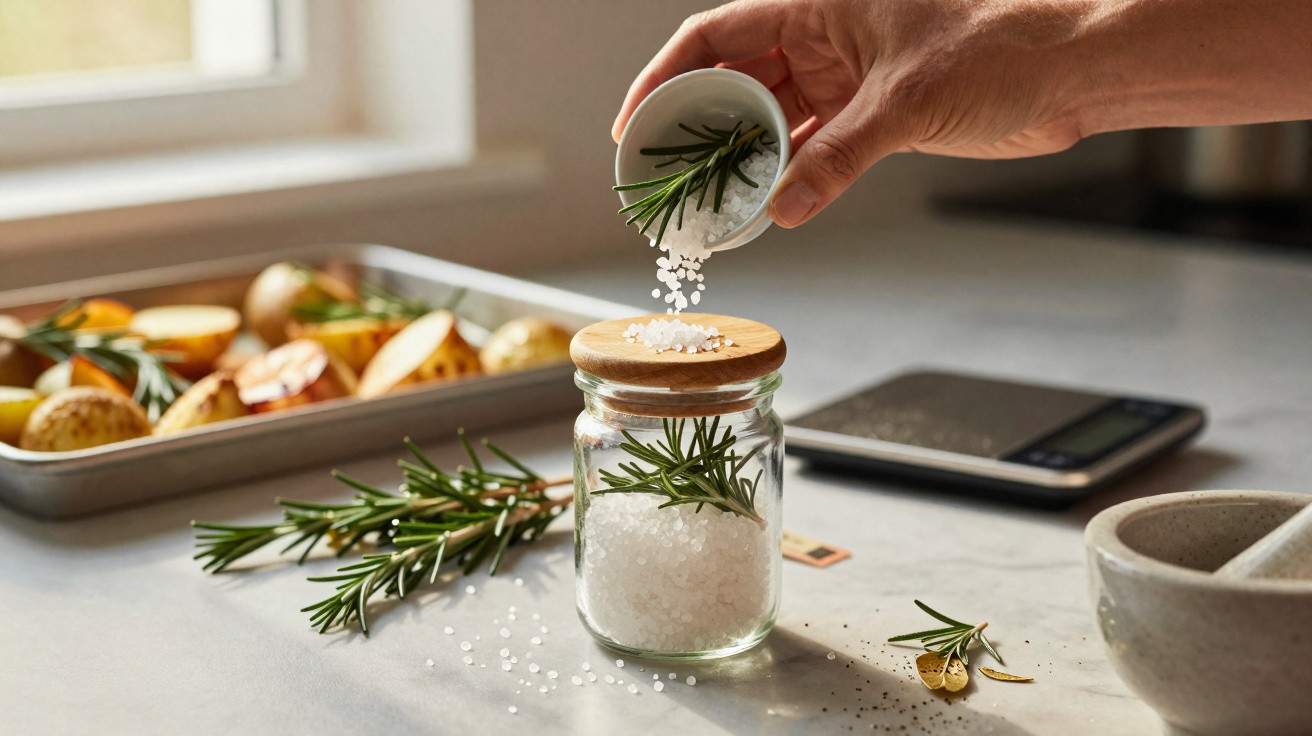
It flashed in the light whenever somebody passed by, like a cooking-show prop that had somehow found its way into an ordinary kitchen. The sort of thing that seems to say: you could cook like this too.
I saw a friend unscrew the lid, take a perfumed pinch and scatter it over potatoes sizzling in the pan without a glance. There was no weighing or hesitation, only the assurance that came from one uncomplicated blend. Across Instagram, versions of the same jar have attracted millions of views, styled in reused bottles with old-fashioned labels.
What those clips leave out is what happens after filming stops: the jar left untouched for weeks, the kitchen warming up, the rosemary slowly and almost imperceptibly changing. Is this neat little idea brilliant, or are we dressing up a food-safety issue in an attractive jar?
Why rosemary and coarse salt are suddenly everywhere
Step into a fashionable kitchen at the moment and it is easy to spot: a weighty glass jar holding large sea-salt crystals and twisting, dark-green rosemary sprigs, resembling a miniature underwater woodland. Beside the uninspiring cardboard carton of table salt tucked in the cupboard, it feels handmade and faintly luxurious. One look suggests its owner reads recipes in bed and has at least one cast-iron pan.
Its appeal also lies in its apparent ease. You cook, reach for the jar and season your food - job done. There is no searching through the spice cupboard or rinsing herbs at the last minute. Rosemary adds a Mediterranean note, while coarse salt keeps it rooted in everyday cooking. It is attractive, useful and ever so slightly performative: precisely the sort of item that earns a social-media close-up.
Browse TikTok or Instagram Reels and the same ritual appears repeatedly. Someone pulls rosemary leaves from a sprig; they drop like confetti into a bowl of salt; a dreamy soundtrack plays and perhaps a handwritten label appears. Some creators describe their “homemade gourmet salt” as though it bridges the gap between hectic weekday evenings and restaurant-standard meals. Others say almost nothing, simply shaking it over focaccia, roast chicken or grilled vegetables until not owning a jar yourself seems faintly absurd.
Underneath the styling is a genuine impulse. We are tired, and we want shortcuts that feel indulgent rather than second-best. Keeping rosemary and coarse salt together promises an ideal combination of convenience and enjoyment: one movement that improves almost anything. The issue is whether that shortcut follows fundamental food-safety principles, or whether the internet has quietly popularised a fresh-herb storage method that would concern a food scientist.
How to make rosemary salt safely and usefully
If rosemary salt appeals to you, the safest approach begins before the jar reaches the worktop. Choose entirely dry rosemary: either shop-bought dried leaves or fresh rosemary dehydrated until it breaks crisply between your fingers. Moisture sealed in the jar is what can turn an appealing trend into a possible science experiment.
Lay the rosemary on a baking tray and dry it in a low oven at around 80–90°C for 60–90 minutes, turning it once or twice. Prop the oven door slightly open with a wooden spoon so that steam can escape. Once the leaves are dry and brittle, gently crush them in your fingers and combine them with coarse salt at approximately one part rosemary to four or five parts salt.
Transfer the mixture to a properly clean, dry jar. That means washed, rinsed and completely air-dried - not merely wiped with a damp cloth. Add a date label, then keep it somewhere cool and shaded, away from the hot area beside the hob where oils can become rancid more quickly. Used as a seasoning rather than a decorative accessory, rosemary salt can retain its fragrance for months without becoming unpleasant.
The usual error is rushing straight to the attractive stage. People pack fresh, still-moist sprigs into salt, tighten the lid and expect the crystals to preserve everything by themselves. Salt is effective, but it is not a time machine. Moisture from the rosemary, particularly near the stem, can remain trapped and form small pockets that are more welcoming to microbes than might be expected.
On a hectic weekday evening, the hazard is not obvious. You simply take the jar and sprinkle. Problems emerge later, when the rosemary becomes darker, the aroma moves from pine-like to faintly musty, or the leaves gather into small wet clumps. On a warm, humid kitchen shelf, that is a warning sign; in a cool, dry location, it is more of a caution. Either way, the clean, vivid flavour you wanted is no longer there.
Let’s be honest: nobody really does this every day. No home cook studies herb salt under a microscope or records jar temperatures. The safest simple rule is this: if you can see moisture, find soft stems or notice cloudiness in the glass, the show is over. Throw it away, make another batch and use dried rosemary from the outset. Your future self - and your stomach - will quietly appreciate the slightly less glamorous choice.
“Salt is not a magic force field,” says one food microbiologist I spoke to. “It slows some things down, sure. But if you trap fresh plant material with water activity inside an enclosed space, you’re not preserving. You’re just delaying the problem and making it less obvious.”
That may sound dramatic until you consider how these jars are normally handled. We reach in with fingers that are slightly damp while cooking, leave the lid off beside steaming pans and forget when the mixture was made. Yet the emotional appeal is powerful: after a difficult day, a fragrant pinch of rosemary salt can feel like a small act of kindness. On a solitary evening, it quietly says, “this meal matters”. During a busy Sunday lunch, it is the jar passed around the table just before the roast is ready.
- Use only dried rosemary, or dehydrate fresh sprigs fully before combining them.
- Store the jar away from heat, steam and direct sunlight.
- Date every batch and make a fresh one every 2–3 months for the best flavour.
Balancing trend, pleasure and food safety in one small jar
At one level, the rosemary-and-salt jar is not truly about seasoning. It represents the idea of a calmer, more purposeful kitchen, where flavour is always within reach and dinner never feels hurried. We like objects that project capability, telling visitors “I cook” before a plate even reaches the table. For something made with a handful of sprigs and a scoop of salt, the little jar carries considerable emotional weight.
But science does not vanish merely because the glass looks good on camera. Salt can lower water activity and slow bacterial growth, but it does not sterilise fresh herbs or make careless storage harmless. Follow that principle and the idea becomes genuinely smart: dehydrate first, mix afterwards, then store it properly. Ignore it and it is another instance of appearance defeating basic common sense.
In practical terms, the decision is made each time you fill the jar. You can fully embrace the shortcut by pushing fresh rosemary into coarse salt and hoping it works out, or guide the trend towards something more sensible. Dry the herbs, keep the container away from warmth and smell the mixture occasionally. If you show friends the trick, show them the unglamorous part as well.
There is an odd reassurance in accepting that even straightforward things bring a small element of risk. We keep garlic in oil, ferment vegetables on worktops and eat street food whose origins we cannot fully trace. Rosemary salt belongs somewhere on that same scale, only in a Pinterest-friendly disguise. Some people will read this and throw away their jars; others will adjust their methods and continue using it with greater care.
Perhaps the real value is not the jar but the pause it creates: the moment when you consider what you are eating, how it is stored and which food trends you welcome into your kitchen. Rosemary leaves pressed against the glass become less of a prop and more of a quiet prompt: flavour is chemistry, not merely decoration. In the small gap between “looks good” and “is safe”, each of us decides where to draw the line.
| Key point | Details | Why it matters to readers |
|---|---|---|
| Use dried, not fresh, rosemary | Dry rosemary in a low oven at 80–90°C until the leaves are brittle, or buy ready-dried herbs. Mix only when no visible moisture remains. | This lowers the chance of microbial growth in the jar and produces a steadier, more concentrated flavour over time. |
| Salt-to-rosemary ratio | A useful proportion is 1 part crushed dried rosemary to 4–5 parts coarse salt by volume. Begin with small batches totalling 100–150 g. | Excess rosemary can taste medicinal and overpower food; a balanced blend remains flexible for everyday cooking. |
| Storage time and conditions | Keep the jar somewhere cool, dry and shaded, away from hob heat and dishwasher steam. For the best aroma, use within 2–3 months. | Heat, light and humidity diminish herb oils and may cause clumping or unpleasant smells, changing a “hack” into wasted ingredients. |











Comments
No comments yet. Be the first to comment!
Leave a Comment