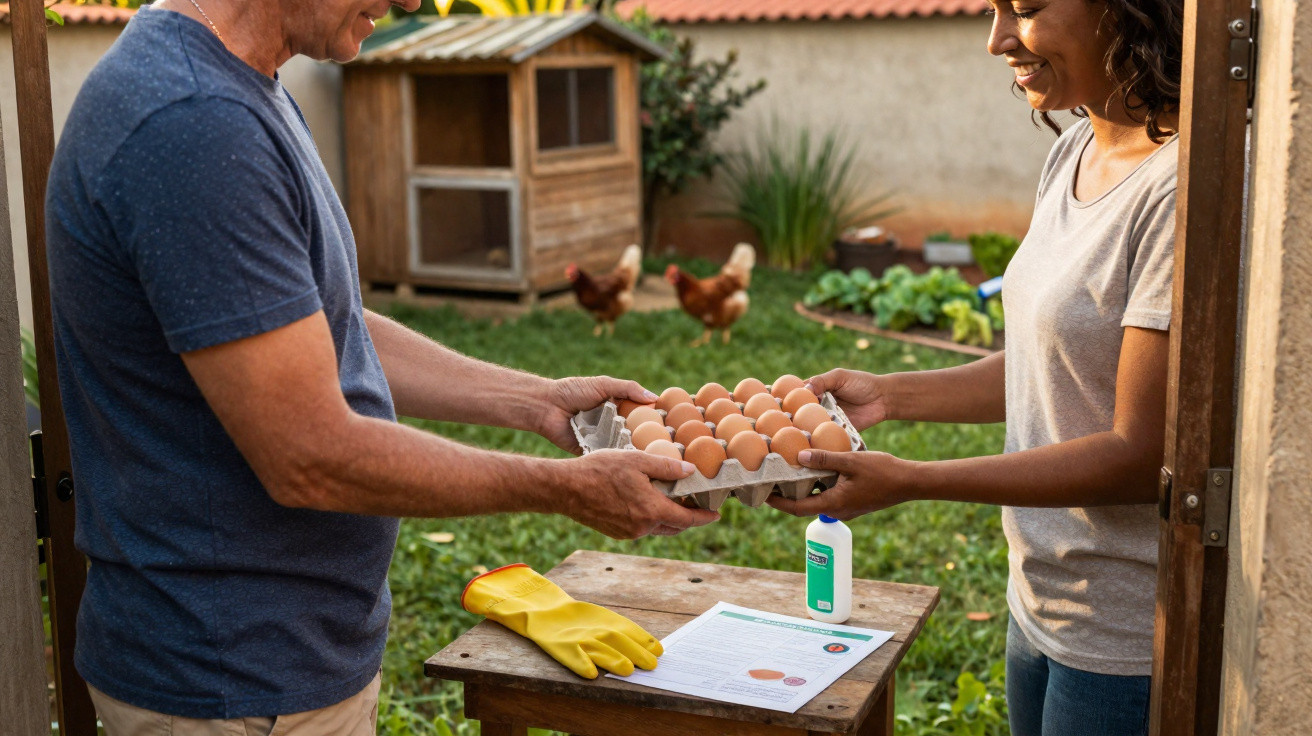
Keeping hens at home may sound delightful and economical, but that surplus basket of eggs can soon become a legal problem.
In France and across much of Europe, growing numbers of households are keeping chickens in their gardens to enjoy fresh eggs and greater self-sufficiency. However, once there are enough eggs for the daily omelette, it can be tempting to sell a few boxes to neighbours, colleagues or friends. What looks like an innocent “side hustle” may clash directly with food-safety requirements, tax rules and local regulations.
Why backyard hens are becoming so popular
Keeping poultry at home has become far more widespread in recent years. A 2020 IFOP survey estimated that about 5% of French households had a chicken coop: approximately 1.3 million installations, ranging from simple shelters to stylish designer hen houses.
A number of factors are behind this rise:
- Higher supermarket prices encouraging households to reduce food costs
- Worries about processed foods and lengthy supply chains
- Nostalgia for grandparents’ rural way of life
- A wish to reduce waste by giving leftover food to hens
Part of the attraction lies in a chicken’s efficiency. One hen can consume up to 200 kilos of scraps and feed each year, converting it into eggs and manure. For many city-based families, a coop offers a small personal response to inflation and food scandals.
Backyard hens promise cheap, traceable eggs and a sense of control - but selling those eggs triggers a different set of rules entirely.
Can you sell eggs from your own hens?
This is the issue that surprises many first-time hen keepers. A productive laying hen delivers around one egg per day. With three or four birds, the fridge can quickly fill up. Neighbours may then ask to buy a box, making a sale seem tempting.
Legally, however, that informal transaction is often where difficulties start.
The short answer: in most cases, private individuals are not allowed to sell eggs from their backyard hens as if they were a farm.
In France, as in many EU states, only registered farmers and approved operators have full permission to market eggs from their flocks. They must be listed on professional registers, maintain official documentation and meet a lengthy set of food-safety requirements.
Private hen keepers, on the other hand, are generally expected to use the eggs within their own household or give them away informally. You may give your neighbour a box as a present or exchange it for a jar of jam, provided there is no organised commercial activity.
When does a “favour” become a business?
The uncertain area concerns small payments. Some people attempt to “just cover the feed costs” by charging a few euros. In legal terms, though, selling a food product can mean you are viewed as a producer placing goods on the market. That changes the situation completely.
Authorities consider:
- How regularly sales take place, whether occasional or repeated
- The number of eggs being sold
- Whether the eggs are advertised or sold from a stall, online or in person
- Whether any profit is made, even a small amount
When it starts to look like a genuine activity rather than occasional cost-sharing among friends, agricultural and food-business rules may apply.
Backyard hen eggs are tightly regulated products
Eggs may appear straightforward, but they are classified as sensitive food products. If handled incorrectly, they can carry salmonella and other bacteria. As a result, most European regulations require rigorous traceability from the laying hen through to the breakfast plate.
Commercial eggs must be graded, stamped and packed by approved centres, with clear codes showing how and where they were produced.
In France, the Ministry of Agriculture states that eggs sold to the public must be:
- Sorted and graded by quality and weight
- Stamped with a producer code and farming method, such as free-range
- Packed by an authorised packing centre that is subject to regular inspections
Rules may be somewhat less demanding for small direct-to-consumer activities, such as farmers selling at the farm gate or at local markets. A formal declaration of the activity may often be sufficient instead of full packing-centre approval. Nevertheless, the producer must be identifiable, traceability must be maintained and hygiene standards must be observed.
Why this matters for your small coop
Even two or three hens at the end of your garden produce a food item that may be eaten raw or only lightly cooked. A health outbreak linked to home-produced eggs could have serious consequences both for public health and for you legally.
Food-safety inspectors, local authorities and sometimes tax officials may become involved if neighbours complain, illnesses are reported, or your “informal” sales become apparent on social media.
Rules for keeping hens at home
The sale of eggs is not the only issue: putting a chicken coop on your property can itself bring obligations. Many towns cap the number of animals allowed, impose minimum distances from neighbouring homes, and set requirements relating to noise, smells and waste.
Before buying your first hen house, local authorities recommend contacting the town hall to check zoning and animal‑keeping bylaws.
In built-up urban locations, some councils limit poultry keeping to reduce nuisance and disease risks. Regulations in rural villages are often less restrictive, but they still apply. Ignoring them can lead to fines, particularly if neighbours report early-morning crowing or flies.
What about selling homegrown vegetables?
Vegetables are treated somewhat differently. In many countries, people may sell produce grown in their gardens, subject to conditions that are generally less strict than those applying to eggs or meat.
In France, for example, a “Sunday gardener” may sell surplus tomatoes or courgettes if hygiene requirements, local market rules and, where applicable, basic registration as a small agricultural producer are followed. Authorities may require evidence that prohibited pesticides have not been used and that the operation remains limited in scale.
| Product | Typical status for individuals | Main conditions |
|---|---|---|
| Backyard eggs | Consumption or gifts only | No regular commercial sales without registration and traceability |
| Garden vegetables | Often sellable in small volumes | Respect hygiene, local rules, possible registration as micro-producer |
What could happen if you sell eggs?
The most serious possibility is a food-poisoning incident connected to your eggs. Should neighbours become unwell and doctors report the case, investigators may examine how the eggs were handled, stored and dated. Having no records can work against you.
Even where nobody falls ill, tax authorities may treat repeated egg sales as undeclared earnings. In many jurisdictions, even modest income has to be declared, especially when payments are regular rather than symbolic. Local councils may also fine people for unlicensed street trading or for operating a business from a residential address.
The friendly carton left on a doorstep with a price scribbled on the lid can, on paper, tick every box of an undeclared food business.
Practical situations faced by backyard owners
Suppose you keep six hens that are laying well. They could produce up to 40 eggs weekly. Your household eats 15, you give away 10, and you sell the other 15 to three neighbours each week, throughout the year, at €3 per dozen. You have then created a micro-business with regular, identifiable income.
Go further by advertising in local Facebook groups, taking cash and bank transfers, and delivering boxes. If the activity comes to the attention of the authorities, it could attract scrutiny from both food-safety officials and tax inspectors.
The legal exposure increases again if you sell at a local market without registration, alongside farmers who have paid for inspections and a market pitch.
How to remain on the safe side
For people who like the idea of backyard hens but not the paperwork, the lowest-risk approach is simple:
- Keep egg production in line with your household’s requirements
- Give excess eggs to neighbours and friends free of charge, or through informal swaps
- Do not establish regular, organised sales at fixed prices
- Store and label eggs carefully even when gifting them, including the laying date
- Check local requirements before starting anything that resembles a business
If you truly wish to sell eggs as a source of income, you need to approach it as a small farmer would. This will usually involve registering as an agricultural producer or micro-enterprise, declaring the activity, and seeking guidance from the local agricultural office or chamber of commerce.
Key terms and nuances to understand
Two legal concepts frequently arise in this discussion: “traceability” and “placing on the market”. Traceability means being able to follow a product back to where it came from, including the farm, flock and batch. This is the reason commercially sold eggs have a code stamped onto the shell.
“Placing on the market” has a wider meaning than many expect. It can include selling, but it may also cover giving away food as part of a promotion or another service. If your eggs are offered outside your private circle in a structured manner, you could fall within that definition.
Backyard poultry can still be a very effective way to reduce food waste, cut household bills and feel more resilient during an uncertain economic period. The legal boundary is crossed not by the first egg, but by the first genuine move into trading. Understanding where that limit lies in your country or region allows you to enjoy keeping hens without unwelcome consequences.














Comments
No comments yet. Be the first to comment!
Leave a Comment