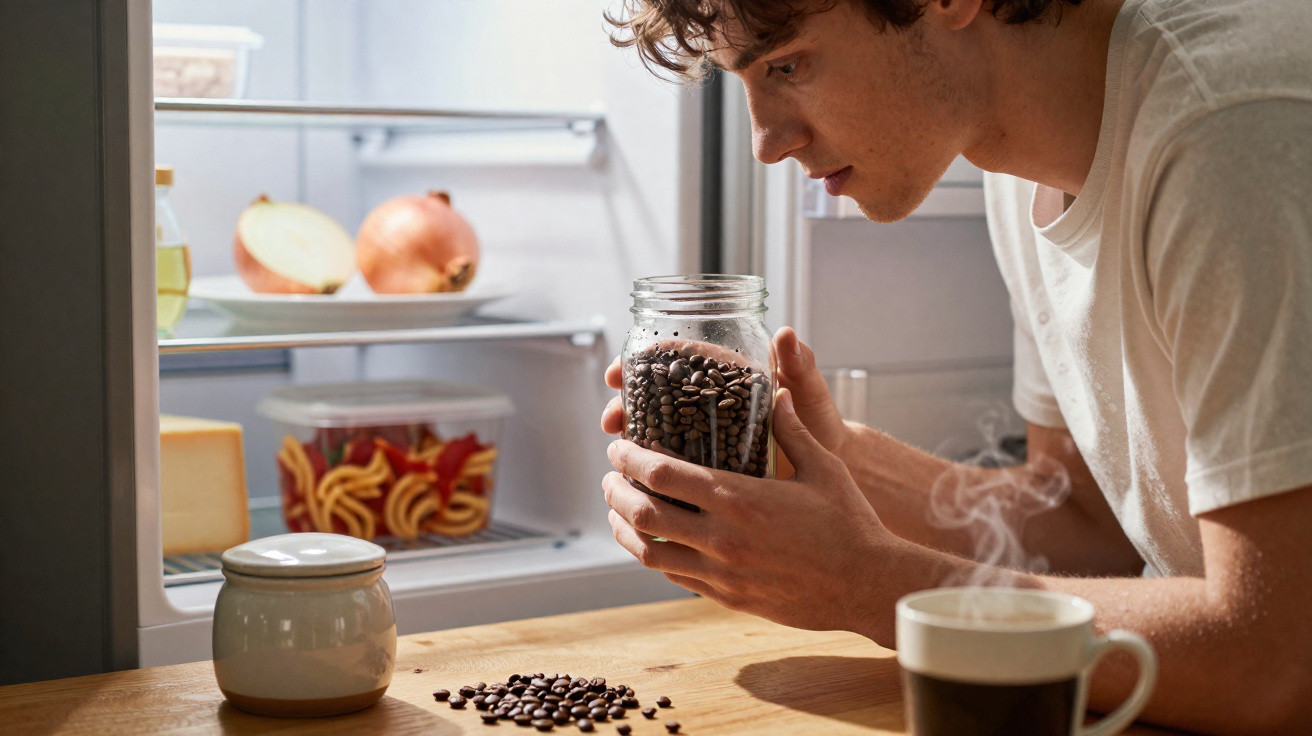
Anyone who appreciates good coffee pays attention to the beans, grinder and machine. Yet one frequently overlooked factor can quietly spoil the result: storage. The refrigerator is often seen as a safe place to preserve flavour, but it is commonly where coffee loses its characteristic aroma and taste most quickly.
Why your coffee suddenly tastes bitter
Bitter, dull-tasting coffee is rarely a coincidence. It is usually caused by several mistakes together: unsuitable storage, moisture, fluctuating temperatures, and often coffee that is too old or ground incorrectly. In this, the refrigerator is a key factor – as a problem rather than a solution.
Coffee is extremely sensitive to air, moisture, odours and temperature changes – all of which are abundant in the refrigerator.
Coffee beans and ground coffee have a porous structure. Their countless tiny cavities and large surface area create an intense aroma, but they also turn coffee into a sponge for whatever is present nearby. In the refrigerator, this mainly means:
- strong cheese and cured-meat smells
- moisture on walls and inside containers
- continual temperature changes whenever the door is opened
The result is that foreign odours settle into the coffee while delicate aromas escape. Coffee that still smells promising in the bag can taste flat and slightly harsh in the cup. Many people interpret this as “strong” or “full-bodied”, when it is usually a tired, unbalanced flavour with bitter notes.
Refrigerator: the three biggest traps for coffee aroma
1. Foreign odours creep into the beans
Cheese, cold cuts, herbs, fresh food and sauces often sit right beside the coffee packet in the refrigerator. The aromas from these foods can migrate into grounds and beans, even through many types of packaging. In the cup, this can appear as dull, faintly “spiced” or even cheesy undertones that add to the bitterness.
2. Aromas disappear faster than expected
A low temperature offers only limited protection. Chemical degradation does slow down, but air and moisture still continually reach the coffee. Both speed up the loss of volatile aroma compounds – the very substances responsible for fruity, nutty or chocolatey notes. If only roasting flavours and bitter compounds remain, coffee tastes harsh and one-dimensional.
3. Condensation makes coffee damp
Every time the packet is removed from the refrigerator, it may experience a temperature change of more than 15 degrees. Condensation immediately forms on its cold surface and can penetrate the beans and grounds. Damp coffee not only loses aroma; it also becomes more prone to clumping and off-flavours – even genuine mould.
As soon as coffee becomes damp, its aroma turns: first flat, then musty, and finally undrinkable.
What coffee manufacturers actually recommend
The advice from across the industry is revealing. Manufacturers agree on one point: oxygen and moisture are coffee’s greatest enemies.
- Some producers accept refrigerator storage only in rigorously airtight containers and when the coffee is not taken out frequently.
- Others recommend keeping it at room temperature, provided the contents of a tin are used within a few days.
- For longer storage, chilling is sometimes recommended after all – but always with the instruction to let the coffee return to room temperature before brewing.
One principle runs through every piece of guidance: no oxygen, no moisture and no strong odours. That combination is seldom achieved in an ordinary household refrigerator.
Mould risk: when coffee can make you ill
Many people regard coffee as a dry, safe product. However, mould can develop in damp surroundings – especially when it is stored in a refrigerator or freezer and repeatedly exposed to temperature changes. Condensation inside the container and organic material create ideal conditions for fungal spores.
Mould on coffee can produce what are known as mycotoxins. These mould toxins are considered concerning even in small quantities. Possible effects include:
- gastrointestinal complaints
- headaches and feeling unwell
- an additional burden on the liver and immune system with long-term intake
As soon as coffee smells musty, shows visible mould or feels damp, it belongs in the bin – not in the machine. “Brewing it away” does not work here.
Freezer: a useful trick or another risk?
Many coffee enthusiasts keep larger supplies in the freezer. The thinking is that cold slows the loss of aroma. This is partly true, but it also introduces fresh problems. Condensation forms again during defrosting, while odours from fish, garlic or ready meals can circulate in the freezer too.
Freezing works particularly well when:
- the coffee is vacuum-sealed,
- the packet is opened as rarely as possible,
- only small portions are individually packed.
For everyday beans that are used daily, however, the freezer is hardly suitable. Constantly taking the packet in and out increases moisture inside it, once again raising the risk of off-flavours and mould.
The better solution: a cupboard instead of the refrigerator
Anyone wishing to avoid bitter coffee should follow a straightforward storage rule: cool, dry, dark and airtight. A normal food cupboard or pantry provides ideal conditions.
The best place for coffee is in a closed cupboard, away from the hob, dishwasher and direct light – not in the refrigerator door.
How to store coffee correctly
- Protected from light: Opaque tins, or the original packaging placed inside a tin, shield coffee from UV rays that destroy delicate aroma compounds.
- Airtight: A container with a tightly fitting lid keeps oxygen out and noticeably slows oxidation and aroma loss.
- Dry and moderately cool: A steady 15 to 20 degrees is ideal, without major temperature fluctuations – so choose a pantry rather than a windowsill above a radiator.
A practical approach is as follows: keep the original packet closed, then after opening squeeze it to leave as little air inside as possible and place it in an additional aroma-preserving tin. The packet and container then act together as a kind of protective shield.
How long does coffee really stay good?
Every packet has a best-before date. For good flavour, however, the period after opening matters more:
| Coffee type | Opened packet, stored correctly |
|---|---|
| whole beans | approx. 4–6 weeks with strong aroma |
| ground coffee | noticeably declining after approx. 2–3 weeks |
| pre-brewed instant coffee | stable for several months, but less complex |
Those who value flavour are better off buying smaller amounts more often than leaving large stock packs for months. More importantly, grind only shortly before brewing – this significantly reduces bitterness and brings more sweetness and fruitiness to the cup.
Practical tips to prevent bitterness in the cup
Alongside storage, preparation and water quality also affect flavour. Here are a few quick adjustments you can make:
- do not grind too finely, as this extracts more bitter compounds
- keep brewing water at around 92–96 degrees rather than pouring it on boiling
- rinse filters with hot water before brewing to prevent a papery taste
- do not use an over-stored bean blend – ideally, the roast should not date back many months
If you keep getting bitter results despite good beans, reconsider the storage location first. Often, it is enough to move the coffee packet from the refrigerator to a cool cupboard and use a tightly sealing tin. Within just a few days, the coffee can taste rounder, clearer and less harsh.
Regular coffee drinkers in particular benefit from some structure: keep beans for the next two weeks in a tin in the cupboard, and store larger supplies as airtight and cool as possible, but without constant temperature changes. This keeps your favourite coffee enjoyable for longer instead of turning it into a bitter disappointment.










Comments
No comments yet. Be the first to comment!
Leave a Comment