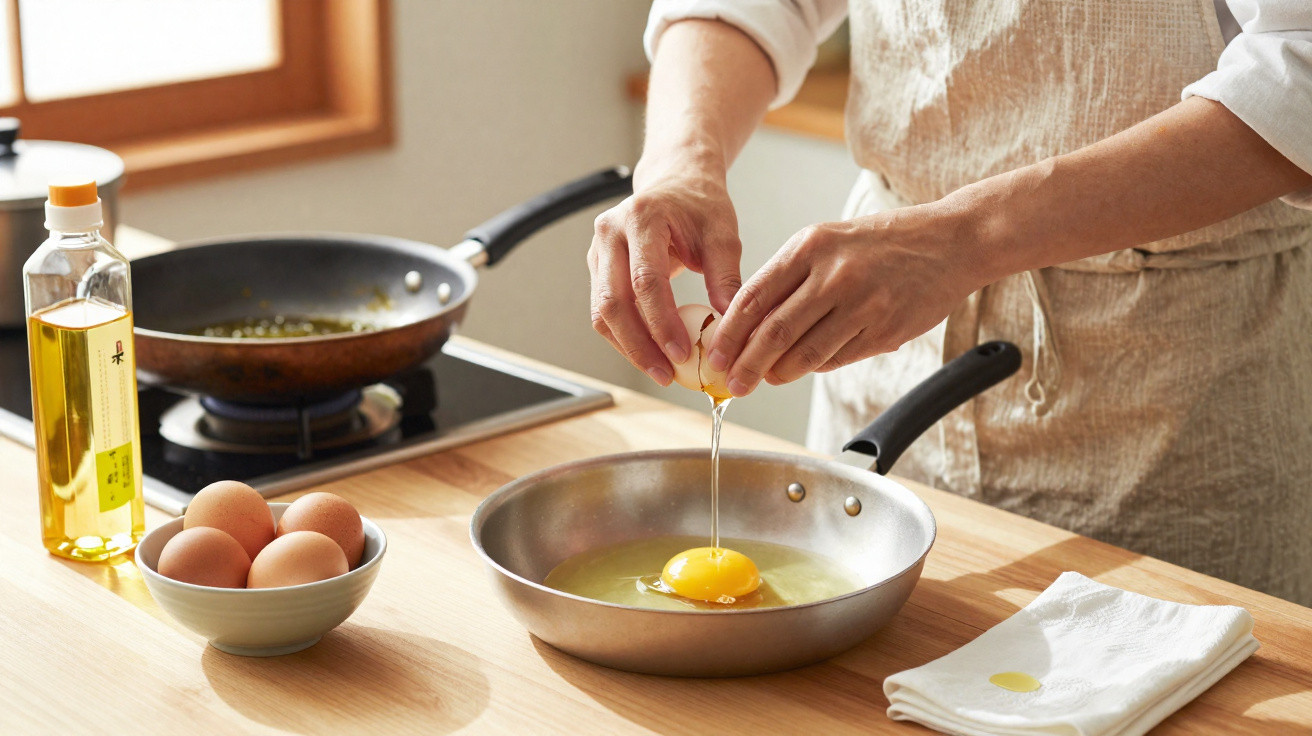
The pan was already smoking when the dispute began.
In a tiny Tokyo kitchen, a young line cook eased a glossy egg into a pan carrying barely any oil, and the chef observing him visibly recoiled. There was no fierce sizzling or violent bubbling, only a quiet murmur of heat. The egg settled into a flawless, quivering oval, with a porcelain-like shine. No scorched spots. No oily ring. Simply… calm.
Two metres away, another cook was preparing it “the classic way”, flooding his pan with a golden pool of frying oil. It was the same egg at the same temperature, yet the outcome was completely different. Oil snapped and spat, the edges became ragged, and the kitchen filled with the familiar aroma of frying.
The Japanese technique was nearly soundless.
The traditional approach sounded like a battle.
Someone murmured, partly in jest and partly in anger: “So we’ve been wasting money and health for nothing?”
No one laughed.
Why a quiet Japanese egg is creating noisy enemies in Western kitchens
In commercial kitchens, a fried egg is much like a handshake: straightforward, quick and meant to be impossible to get wrong.
For years, the instruction has been unchanged - add a generous splash of oil, turn up the heat, wait for the loud sizzle, and serve. The more intensely it crackles, the more confident the cook feels. That noise has convinced generations of chefs that they were doing it “right.”
Then videos from Japan began appearing, showing cooks using hardly any oil.
A teaspoon spread into a fine layer, reduced heat, a lid for a few seconds, and an egg that looks as though it belongs in a studio photograph. The white is silky, the yolk remains beautifully runny, there is no brown crust and no greasy finish. The clips went viral for one obvious reason.
The eggs appeared… cleaner.
Far too clean for old-school pride.
One Tokyo home cook shared a close-up demonstration: an egg straight from the fridge, a non-stick pan and merely a trace of neutral oil. She tipped the pan to distribute it, before wiping away the extra with folded kitchen paper until only a shine remained.
She slipped the egg onto this almost dry surface, cooked it slowly beneath a glass lid, and produced an egg that was bright, delicate and remarkably light.
Within a few weeks, the viewing figures had reached millions. Food bloggers from LA to London began trying the “minimal oil Japanese egg”, setting it against the heavy-fry approach. Some calculated fat absorption, others timed the cooking, while a few even weighed the oil before and afterwards. The results were unforgiving.
One blogger calculated that her classic diner-style eggs used up to five times more oil than necessary.
Extend that across weeks, months and years, and the waste seemed huge.
The more closely people examined the issue, the more peculiar the old reasoning became. Why were we adding large quantities of oil to a food that does not naturally require it? Eggs already contain plenty of fat and protein. They need only sufficient lubrication to release neatly from the pan, along with a steady temperature that allows them to set gently. Most of the surplus oil ends up on the plate, in the pan or inside us.
The Japanese method reveals this quietly: much of the oil used for a “normal” fried egg is not there for cooking, but for routine. It is about spectacle, noise and speed during a busy service. It is also about flavour - though sometimes that means more “greasy spoon” than careful cooking. A quieter egg, gently cooked with only a hint of fat, poses a direct question to every professional kitchen.
Are we cooking this way because it is better, or because it is what we were taught?
The Japanese low-oil egg trick, step by step
At its heart, the technique is almost frustratingly easy.
Choose a quality non-stick or well-seasoned pan, place it over a medium-low heat, and ignore the instinct to pour in lots of oil. Add only a teaspoon of neutral oil or light olive oil instead, then tilt the pan so the surface is coated. If you can see a pool of oil, you have already used too much.
Break the egg into a small bowl before cooking it.
That gives you control - rather than hitting a hot pan with an eggshell at 7 a.m. Carefully slide the egg into the lightly oiled pan rather than dropping it in from above. The pan should receive it quietly, not burst into noise. When the white begins changing from transparent to milky, cover the pan briefly with a lid to create a little steam.
Keep it covered for 30–60 seconds, and look for a slight wobble in the yolk.
That is the indication that it is ready.
When people attempt this for the first time, they often become anxious. The impulse to raise the heat and pursue that diner-style sizzle can be powerful. We have all experienced that point when breakfast feels like a race against time. But rush this egg and you lose the qualities that make the trick distinctive: a creamy white, tidy edges and an almost weightless texture in the mouth.
The first common error is too much heat, too quickly. The white blisters, the edges become aggressively crisp, and you think, “See? I do need more oil.”
The second is using a cheap, scratched pan. Without a reliable cooking surface, even excellent technique will lead to sticking and tearing. This trick is less about magic and more about respecting heat and surface.
Once you settle into the gentler pace, something changes.
The egg no longer feels like a disposable item and begins to seem deliberate.
In kitchens that have discreetly embraced this approach, the discussions have become unexpectedly emotional. One London chef told me, on condition of anonymity, that his team strongly resisted when he first moved to minimal oil for staff meals.
“Fried eggs are sacred for us,” he said. “They’re hangover food, comfort food, shift food. When I cut the oil, some of my cooks swore it tasted ‘less real.’
But after a month, we noticed people felt less heavy, less sluggish after family meal. That’s when I realized how much unnecessary fat we were normalizing on a plate as small as a single egg.”
He began recording the figures and gave his team three stark conclusions:
- They were saving litres of frying oil every month from eggs alone.
- The eggs looked more appealing on plates, particularly in photographs and on social media.
- A few regular customers quietly asked: “What did you change? I feel lighter after breakfast here now.”
One bluntly honest line remained with us during our conversation: most of us fry like we’re still cooking in the 1980s.
What this “egg scandal” really reveals about how we cook
At a deeper level, this is not simply an egg-cooking trick. It is a small culinary revolt against pure habit. The Japanese method does not criticise fat or flavour - it merely exposes the laziness behind “more is better”, particularly in hectic settings. It demonstrates how much of our cooking culture relies on sound, speed and performance instead of quiet precision.
Some chefs are angry because the arithmetic is uncomfortable.
If a small adjustment to heat and oil lowers costs, cuts waste and creates a cleaner result, what else on their menu has been made excessive by tradition? How many deep-fat fryers run all day to achieve textures that might be possible with less force and less surplus?
For home cooks, the issue is gentler but no less meaningful.
What if breakfast could provide comfort without leaving a coating of tiredness in your mouth?
| Key point | Detail | Value for the reader |
|---|---|---|
| Minimal oil is enough | Japanese-style eggs use a thin film, not a puddle, of oil | Spend less on oil and eat lighter without giving up flavour |
| Control beats brute heat | Medium-low heat and a short lid-on finish | Get tender whites and runny yolks instead of greasy, crispy edges |
| Habits can be challenged | Old frying methods often reflect tradition, not necessity | Feel freer to question and improve everyday cooking routines |
FAQ:
- Question 1 Is this Japanese egg method really healthier than classic frying?
- Question 2 Do I absolutely need a non-stick pan for this trick to work?
- Question 3 Can I use butter instead of oil with the same technique?
- Question 4 Will my eggs still taste rich without all that frying oil?
- Question 5 Is this method practical if I’m cooking for a big family or brunch crowd?





Comments
No comments yet. Be the first to comment!
Leave a Comment