The salt shaker lands on the table with a faint but defiant thud.
You tip it over your plate and give it a gentle tap, followed by a firmer one. Still nothing. Inside, the salt has become a humid, clumped-up block just as you are looking at a perfectly cooked plate of chips that is about to be sadly underseasoned.
You unscrew the top, prod inside with a knife and shake it upside down as though it has personally wronged you. A few tiny grains emerge reluctantly. Everything else remains trapped in a compacted mass that you cannot see but can certainly sense.
Then somebody at the table casually says, “Just put some rice in it.”
It sounds faintly ridiculous: a childhood remedy, a kitchen legend, the sort of thing your gran might mention while drying her hands on a tea towel. Yet, when you give it a go, the result is quietly pleasing.
The rice never comes into contact with your meal. Still, it makes all the difference.
Why salt clumps… and how a handful of rice quietly fixes it
Anyone living in a damp place will recognise the sound of a blocked salt shaker. What should be a light rattle becomes a flat, heavy knock. The issue is not the shaker, the salt brand or holes that are supposedly “too small”. It is moisture in the air creeping into the salt and transforming free-flowing crystals into sticky lumps.
Salt behaves a little like a sociable person at a packed party. The more water molecules that turn up, the more readily it clings to them. Soon, instead of a pourable flow, you are left with one dense clump. That is why your salt can act like damp sand on rainy days or after the kettle has been constantly boiling.
Rice enters the picture like the friend who silently opens a window.
In a small Brighton café kitchen, staff once got through salt shakers as quickly as napkins. They would knock them on the stainless-steel worktop, remove their lids and jab at the contents with cocktail sticks. During busy service, the same complaint could always be heard: “The salt’s blocked again, can we get a new one?”
One afternoon, after visiting her grandmother in Portugal, the manager returned and tipped a teaspoon of uncooked rice into every shaker. The team laughed, rolled their eyes and got on with their work. Two weeks later, not a single shaker had needed replacing.
The cooks insisted that the salt seemed drier. Customers never noticed the rice itself. What they did notice was something different: their food was seasoned consistently, even when the weather shifted from blazing sunshine to that persistent, grey coastal mist.
The rice had simply worked away unseen, much like a backstage technician during a theatre performance.
The reasoning behind this modest habit is straightforward. Salt draws moisture from the atmosphere. When humidity is high, it dissolves just enough for the crystals to stick together and form lumps. Rice grains work as miniature sponges, absorbing the excess moisture before the salt can take it in.
Rice consists largely of starch, and starch readily takes on water. Nestled between the salt crystals, the grains create dry gaps while soaking up droplets that would otherwise join the salt into clumps. You are not “flavouring” the salt with rice; you are shielding it from the air.
As it takes in humidity, the rice becomes slightly harder, and that is perfectly fine. Meanwhile, the salt remains loose, dry and easy to shake out. It is a low-tech, app-free, gadget-free answer to an issue you may have spent years making more complicated than it needs to be.
How to use rice in your salt shaker without creating a mess
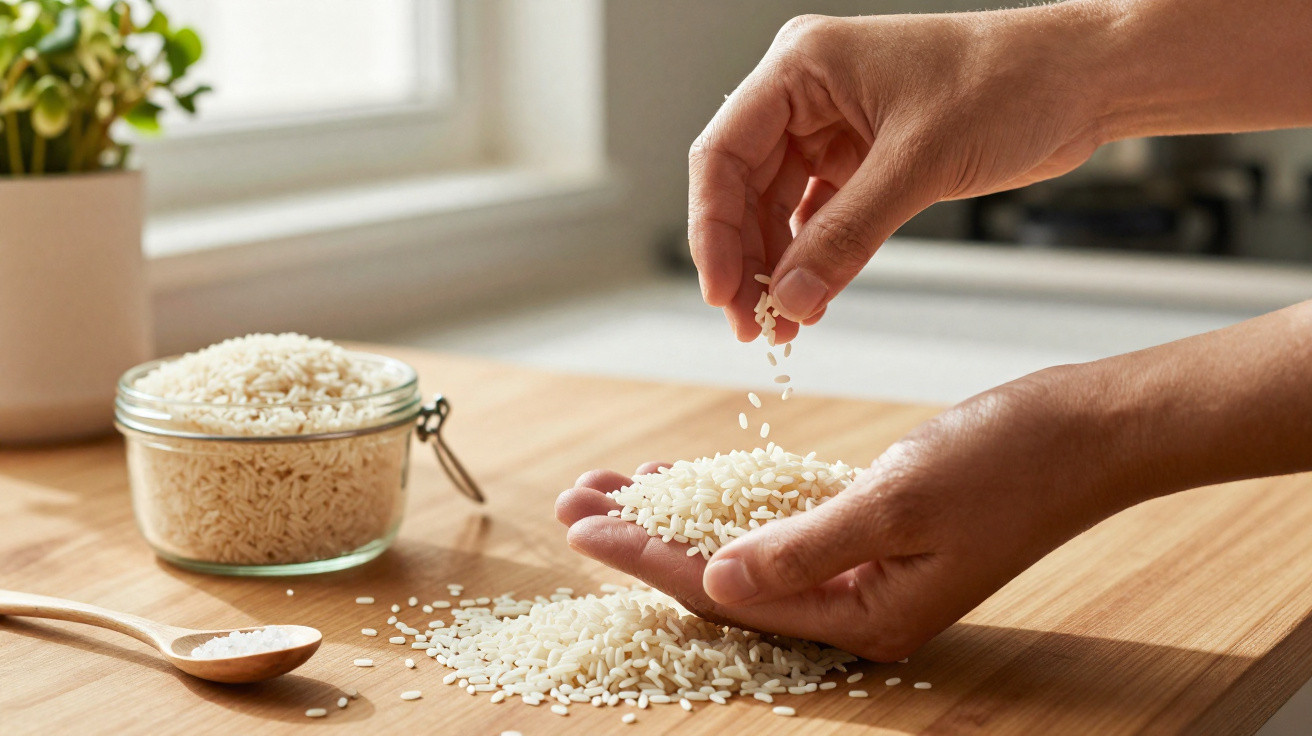
The method is almost absurdly easy. Open your salt shaker and add a modest pinch of uncooked rice. Around half a teaspoon is sufficient for a standard table shaker. Fill the remaining space with salt, shake it gently and put the lid back on.
No special rice is required. Ordinary white rice is the best choice because its grains are small and discreet. They either settle at the base or mix among the salt, mostly out of sight. When you shake the shaker, the salt continues to pass through the holes while the weightier rice generally stays put.
The first difference you may notice is the noise: a fresh, dry rattle rather than a dull thud.
There are, naturally, a few ways to get it wrong. Add too much rice and it becomes irritating, knocking about like a maraca and occasionally attempting to slip through the holes. Choose grains that are too large and they may obstruct the openings instead of preventing a blockage.
Then there is the more chaotic approach: using flavoured rice, cooked rice or even broken grains left over from last night’s meal. Let’s be honest: nobody really does this every day, but we have all seen a misused “tip” end badly.
If rice in a shaker seems odd or untidy to you, you are certainly not the only one. There is a certain reassurance in remembering that this is not a social-media trick invented in recent years. It is a long-standing shared custom, passed through family kitchens well before smartphones existed.
“My grandmother kept rice in every salt cellar,” an elderly neighbour once told me. “We didn’t call it a trick. It was just what you did if you didn’t want your salt to sulk.”
These inherited little habits offer a quiet kind of comfort. We devote so much time to pursuing clever gadgets and ideal storage containers that a teaspoon of rice can feel almost defiant. It is fast, inexpensive and does not mean reorganising the whole pantry on a Sunday afternoon.
- Use plain white rice – brown or sticky rice usually contains more oil and may not remain as neutral.
- Begin with a small pinch rather than a handful, adding more only if your kitchen is particularly humid.
- Replace the rice every few months when it becomes discoloured or overly hard.
- Use the same method in sugar jars, spice blends or travel salt tins.
- Keep shakers away from steam coming from pans, kettles or dishwashers.
A small trick that reveals a lot about life in our kitchens
There is something almost gentle about these modest, handed-down solutions. A pinch of rice in a salt shaker does more than save dinner from blandness. It carries a slight echo of every kitchen where people quietly refused to accept clumpy salt as unavoidable.
In some respects, this trick is the opposite of overthinking. There is no need for a dehumidifier, an expensive new grinder or a stainless-steel “moisture control system”. All you need is a dry cupboard, a bag of rice and thirty seconds. In return, your salt simply… works, evening after evening.
We often judge cooking by recipes and techniques, but it is these small actions and barely discussed routines that truly influence how a kitchen feels. Rice in a salt shaker is one of those unobtrusive details that only becomes noticeable when it is absent. Its purpose is to keep things running smoothly, not to attract attention.
If this has made you want to inspect your own salt shaker, you are not alone. You may discover nothing except salt. You may spot a few yellowed rice grains that you had forgotten about. Or perhaps you will suddenly feel like opening the cupboard, taking out the rice bag and making your next meal a little easier without explaining why to anyone.
| Key point | Detail | Benefit for the reader |
|---|---|---|
| Rice absorbs moisture | Starchy grains behave like tiny sponges inside the shaker | Keeps salt loose, allowing it to pour freely even in humid weather |
| Only a small amount is needed | About half a teaspoon for a standard table shaker | Prevents mess, has no effect on flavour and is easy to try straight away |
| Old-fashioned trick, modern benefit | A traditional family habit that still works in modern kitchens | Feels genuine, inexpensive and easy to share with friends or family |











Comments
No comments yet. Be the first to comment!
Leave a Comment