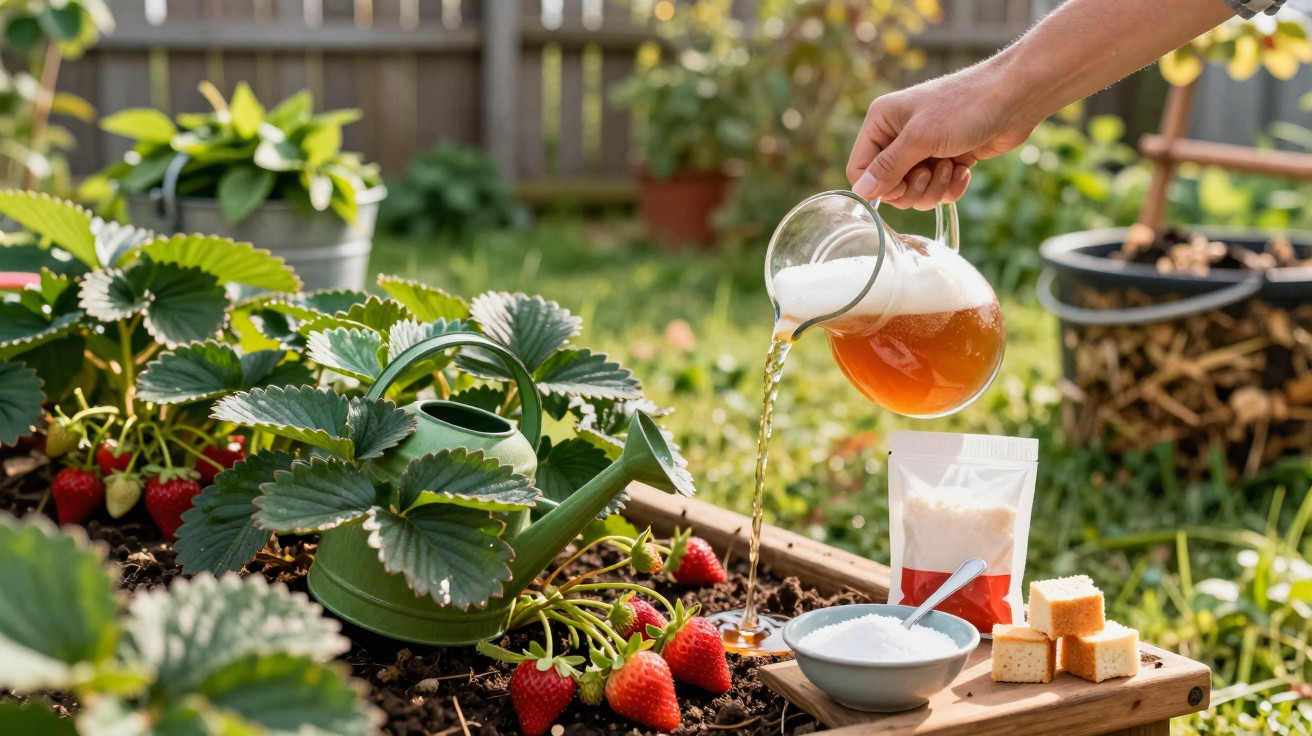
With a simple home-made remedy of yeast and sugar, strawberry plants can be encouraged to produce noticeably larger, juicier fruit. This practical trick has a sound basis in soil science and takes only a few minutes to prepare – without expensive specialist fertilisers from the garden centre.
The simple yeast fertiliser recipe for XXL strawberries
At the heart of the method is a home-made liquid fertiliser designed primarily to support soil microorganisms and root growth. Most people will already have the ingredients at home:
- 50 grams of fresh yeast (or 1 teaspoon of dried yeast)
- 1 litre of lukewarm water
- 1 tablespoon of sugar
Prepare the fertiliser as follows:
- Dissolve the yeast in the lukewarm water.
- Stir in the sugar until it has dissolved completely.
- Leave the mixture in a bowl or bottle at room temperature for 24 hours so that it can ferment.
- Once fermented, dilute it with water at a ratio of 1:5 (one part yeast mixture to five parts water).
- Apply around half a litre of this solution around the root area of each strawberry plant.
This yeast-and-sugar mixture acts as an energy boost for soil life and roots – plants reward it with vigorous growth and larger fruit.
It is particularly worthwhile to use it at the start of the growing period and shortly before flowering. The mixture should not be used more than two to three times per season, so that the nutrient balance in the soil remains stable.
Why yeast gives strawberries such a strong boost
Yeast is more than simply a raising agent for baking: it contains living microorganisms as well as many nutrients. Among other things, it provides:
- B vitamins
- Proteins
- Nitrogen
- Phosphorus
- Potassium
These are precisely the substances plants need to build leaves, form flowers and develop fruit. Sugar has a different function in this recipe: it provides an easily accessible energy source for beneficial soil bacteria and fungi. As these tiny organisms become more active, they break down organic matter faster and release nutrients that strawberries can use immediately.
The more alive the soil is, the better the nutrient cycle works – and the more vigorously strawberries grow, even without harsh chemicals.
Soil scientists have stressed for years that an intact soil microbiome is almost as important as a healthy human gut. The yeast-and-sugar mixture works as a short but intensive “kick-start” for this underground network.
Four natural alternatives for gardeners who like to experiment
Anyone who does not want to rely on yeast alone can use other natural liquid fertilisers as well, either alongside it or alternately. Here are several tried-and-tested options.
Old bread as a source of nutrients
Stale bread does not have to go in the bin. It can form the basis of a mild liquid fertiliser:
- Put old bread in a bucket and cover it with water.
- Leave it for one week, until it develops a distinctly fermented smell.
- Dilute with water at a ratio of 1:10 before use.
The mixture mainly supplies carbohydrates and a small amount of nitrogen, making it suitable for slightly depleted beds.
Nettle feed: a classic choice
Nettles provide a free source of fertiliser:
- Roughly chop fresh nettles and place them in a bucket.
- Top up with water and leave for 1–2 weeks, stirring occasionally.
- When bubbling subsides, dilute at a ratio of 1:20 with water and apply to the plants.
This feed contains plenty of nitrogen as well as trace elements, making it ideal for strong leaf and root growth before flowering.
Using sour milk leftovers in compost
Sour milk or leftover yoghurt can be mixed into compost. This creates a fertiliser rich in lime and calcium. Calcium reinforces cell walls and helps prevent soft, watery tissue – an advantage when aiming for firm strawberry fruit.
Use chicken manure only when heavily diluted
Anyone who keeps chickens has access to a highly concentrated fertiliser. Strong dilution is essential:
- Dilute chicken droppings with water at a ratio of 1:10.
- Apply it only before flowering, so that plants do not put all their energy into leafy growth.
Its high nitrogen content does stimulate growth, but excessive amounts can burn the roots. A careful touch is essential here.
Creating ideal conditions for giant strawberries
Even the best fertiliser has limits if the site and general care are unsuitable. Several basics determine whether the result is a success or failure:
| Factor | Recommendation |
|---|---|
| Sunlight | 6–8 hours of direct sunshine each day |
| Watering | Keep evenly moist; avoid waterlogging |
| Soil pH | 5.5–6.8, slightly acidic to mildly neutral |
| Plant spacing | 30–45 centimetres between plants |
Sunny positions encourage sugar production in the fruit. Planting too closely together often results in fungal diseases and small berries because there is not enough air circulation or light. A good mulch layer of straw or grass cuttings is also important: it retains moisture in the soil and stops fruit from lying in mud and rotting.
Common mistakes that reduce strawberry yields
Many gardeners wonder why their plants fail to produce large fruit despite being fertilised. Straightforward causes are often to blame:
- Too much nitrogen: Lush foliage develops, but there are few flowers.
- Old plants: After three to four years, productivity declines noticeably.
- Incorrect pruning: Runners are left to grow unchecked and drain the plant’s energy.
- Constantly wet soil: This encourages fungi and weakens the root system.
Anyone using the yeast recipe should incorporate it into an overall care plan: rejuvenate the plants at the right time, remove unnecessary runners and choose a site that dries quickly after rain.
How often yeast fertiliser is useful
Dosage throughout the season is another important consideration. A practical tip from allotment gardens is that three applications are usually more than enough:
- First application shortly after new growth appears in spring
- Second application just before flowering begins
- Third application after the main harvest, to strengthen plants for the following year
Between these applications, normal watering with rainwater or tap water is sufficient. Working compost into the soil as well creates a long-lasting nutrient base, with yeast fertiliser acting as an additional boost.
Risks and limits of this home-made remedy
Useful as the recipe is, it cannot replace essential soil care. It cannot magically fix heavily compacted ground, persistent waterlogging or an extremely unsuitable pH level. In very heavy soils, adding sand or coarse compost is worthwhile, as this allows roots to grow downwards more easily.
There is another consideration for anyone growing strawberries in pots or on a balcony: over-fertilising must be avoided. The volume of compost in containers is limited, so salts accumulate more quickly. In this case, a more weakly diluted yeast solution once or twice per season is often enough.
Practical combinations for the maximum harvest
In everyday gardening, it makes sense to combine methods. Many experienced gardeners use a little compost in spring, mulch with straw and then apply the yeast recipe as a starting signal for the growing season. During dry spells, they are more likely to use nettle feed to keep plants resilient.
Variety selection is another important factor. Early, mid-season and late varieties respond differently to nutrient applications. Keeping notes on variety, position, fertilising and yield makes it clear after one or two years which combination really produces the largest strawberries in your own garden.












Comments
No comments yet. Be the first to comment!
Leave a Comment