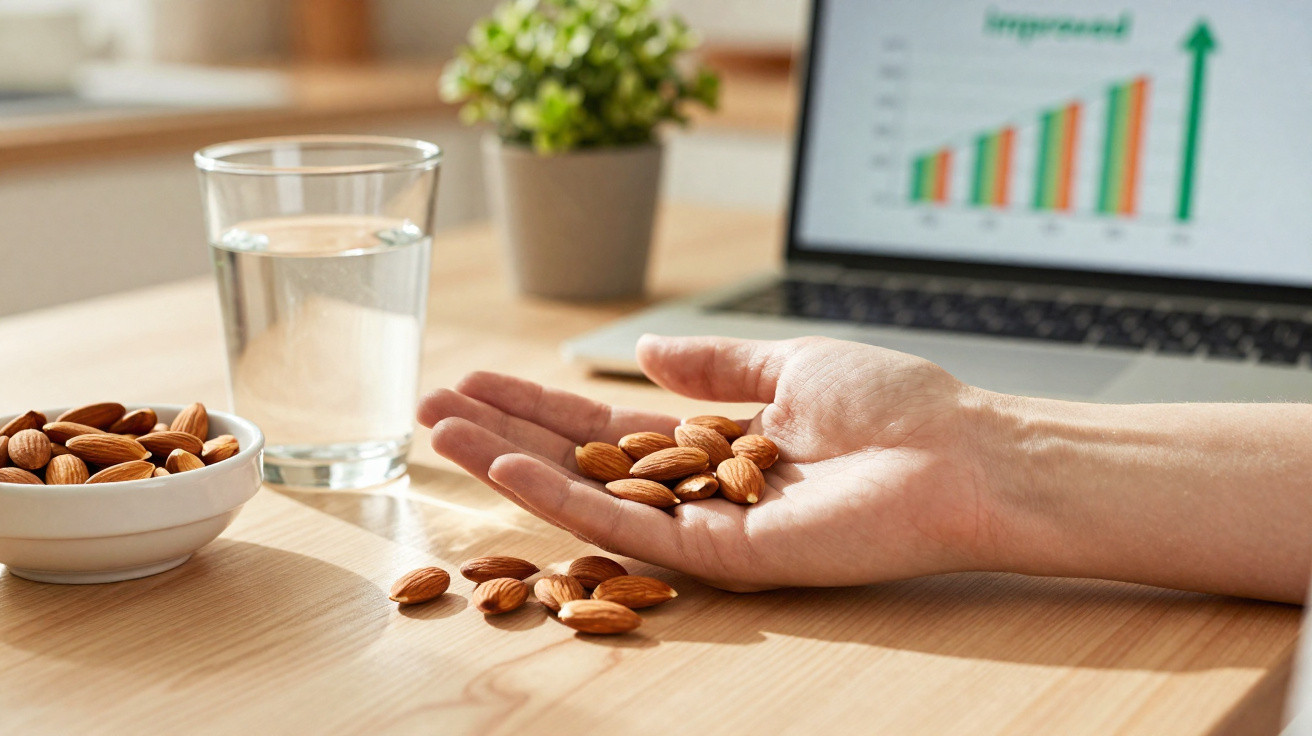
The man in the grey jumper is sitting at the kitchen table, his laptop still open and his vacant eyes fixed on the screen. Beside the keyboard sits an opened bag of crisps: half empty, half a source of guilt. The evening news is playing in the background, where a doctor is talking about heart attacks, cholesterol and a “silent danger”. He stuffs a few more crisps into his mouth, hits mute and sighs.
Two weeks later, a glass container sits in that same spot, carefully filled with almonds. The stress level is unchanged, as is the job, but the hand movement is different: instead of reaching for crisps, he now reaches for nuts. It seems like an insignificant, almost laughably small change.
Yet blood test results can sometimes tell a remarkable story.
What a handful of almonds does to your cholesterol
We all know the moment: a blood test, followed by a conversation at the GP surgery and a doctor’s slightly stern, slightly worried expression. “Your LDL is a little high,” she says. “You should take action.” At once, we picture strict diets, dry rice cakes and discouraging lists of forbidden foods.
In reality, it can be far less dramatic. It may simply mean adjusting one small part of everyday life. For example, eating a handful of almonds each day. No fuss, no kitchen scales, just a regular snack ritual.
Many people think of almonds as “quite nice, but dangerously high in calories”. What is less often considered are the straightforward figures. Several studies found that people with raised cholesterol who ate almonds regularly reduced their “bad” LDL cholesterol by a noticeable amount – often by 5 to 10 per cent. It may not sound like much, but at the level of the arteries, it is significant.
Take the 45-year-old office administrator who tries “that nut thing” to support her sister. Every afternoon at around 4 pm, she has 20 to 25 almonds instead of a chocolate bar. Three months later, she is surprised by her lab results. Her work, family and worries are all the same – but her blood lipid reading suddenly looks a little more favourable.
How can these unassuming kernels influence cholesterol? Part of the answer, ironically, lies in their fat. Almonds contain mostly monounsaturated fats, which compete with LDL cholesterol in the bloodstream. They also provide fibre, which acts like tiny sponges in the gut and binds cholesterol.
They also contain plant compounds such as phytosterols, which compete with our cholesterol in the digestive system. As a result, some fats do not enter the bloodstream at all. The almond is not a magic wand, but it is a quiet ally that works discreetly in the background while we get on with life.
How to make a daily handful of almonds part of your routine
The rule of thumb is remarkably straightforward: around 20 to 30 g of almonds a day, or roughly one small handful. There is no need to weigh them; your own hand is the most convenient measuring tool. If you like, put them in a small container or screw-top jar in the morning and take them to work.
The best time is when you would usually reach for something sweet or very salty: during an afternoon at the office, while relaxing on the sofa in the evening, or after dinner instead of having “just one more little thing”. This makes the snack a swap rather than an extra source of calories.
Let’s be honest: nobody follows this perfectly every day for months, as though they were in a health guide. Sometimes the container stays in the rucksack, sometimes the chocolate bar wins, and sometimes stress takes over the entire snack decision. That is normal; it is not a character flaw.
What matters is not a 100 per cent success rate, but the overall direction. Anyone who chooses almonds on four out of seven days is already treating their body far better than before. A common mistake is eating almonds “on top of” other snacks rather than replacing them, which simply raises calorie intake. Swapping consciously is the better approach.
“If my patients change just one thing about their everyday snacking, I ask them to make it a daily nut moment. Almonds are often the easiest place to start,” says a cardiologist who has supported people with raised cholesterol for years.
- Buy plain almonds – unsalted, unroasted and without a honey or sugar coating.
- Portion them out in advance: put one small handful into a container instead of snacking from the large bag beside your laptop.
- Use almonds as a replacement, not an addition: have them instead of pastries, crisps or a second chocolate bar.
- Allow at least eight to twelve weeks before judging your next cholesterol reading.
- If you have nut allergies or take medication, have a brief word with your doctor before increasing your intake significantly.
What this small snack does for us psychologically
It is not only the biochemical benefits of almonds that are interesting, but also what happens mentally when we introduce such a small ritual into the day. Many people say that their daily handful helps them regain a sense of control. It is not a huge lifestyle transformation, but more like a quiet thought in the background: “I am doing something for myself today.”
That feeling is often the real turning point. When people no longer see themselves as victims of their blood results, but as someone who can actively shape them, they gradually make more small, similar choices in everyday life – and that is where the larger effects develop.
At the same time, such an unremarkable step can relieve pressure. There is no complete nutrition manifesto or strict deprivation, only an upgrade to one moment of the day. The afternoon snack changes from a secret enemy into a reasonably dependable ally.
Many people then notice that their cravings ease a little, because the fat and protein combination in almonds keeps them full for longer. Blood sugar spikes become gentler, and the internal highs and lows less severe. On paper, it is about LDL; in the mind, it is about calm.
There is, however, one truth we may not like to admit: a handful of almonds will not undo decades of neglected eating habits. It is one piece of a puzzle, not the whole picture. Someone who continues to smoke heavily, barely exercises and eats highly processed snacks every day will not see miraculous blood results from nuts alone.
Even so, this one small change can be a realistic starting point, more achievable than saying, “From tomorrow, I will change everything.” It is a quiet door opening. Once someone has seen that a tiny, enjoyable step can produce measurable effects on a lab report, they are more likely to believe in taking other similar steps.
Perhaps wholemeal bread will make it into the trolley on the next shop, perhaps the stairs will occasionally replace the lift, or perhaps the car will be parked a few metres farther away. Somewhere among all of that, the small glass container of almonds remains: unassuming, but consistent.
Many people later say they do not even know exactly when the ritual began. It was simply there one day, like a familiar gesture. Blood values do not respond to grand gestures. They react to what we repeat every day – even something as ordinary as a handful of nuts.
| Key point | Detail | Benefit for the reader |
|---|---|---|
| Almond quantity | Around 20–30 g daily, one small handful, ideally as a snack replacement | Clear, practical guidance without counting or weighing |
| Effect on cholesterol | Moderately lowers LDL, supported by healthy fats, fibre and plant compounds | Explains why this simple snack can genuinely affect blood values |
| Practical approach | Portion in advance, choose plain products and consciously swap them for other snacks | Concrete steps to begin a small, realistic change as soon as tomorrow |

















Comments
No comments yet. Be the first to comment!
Leave a Comment