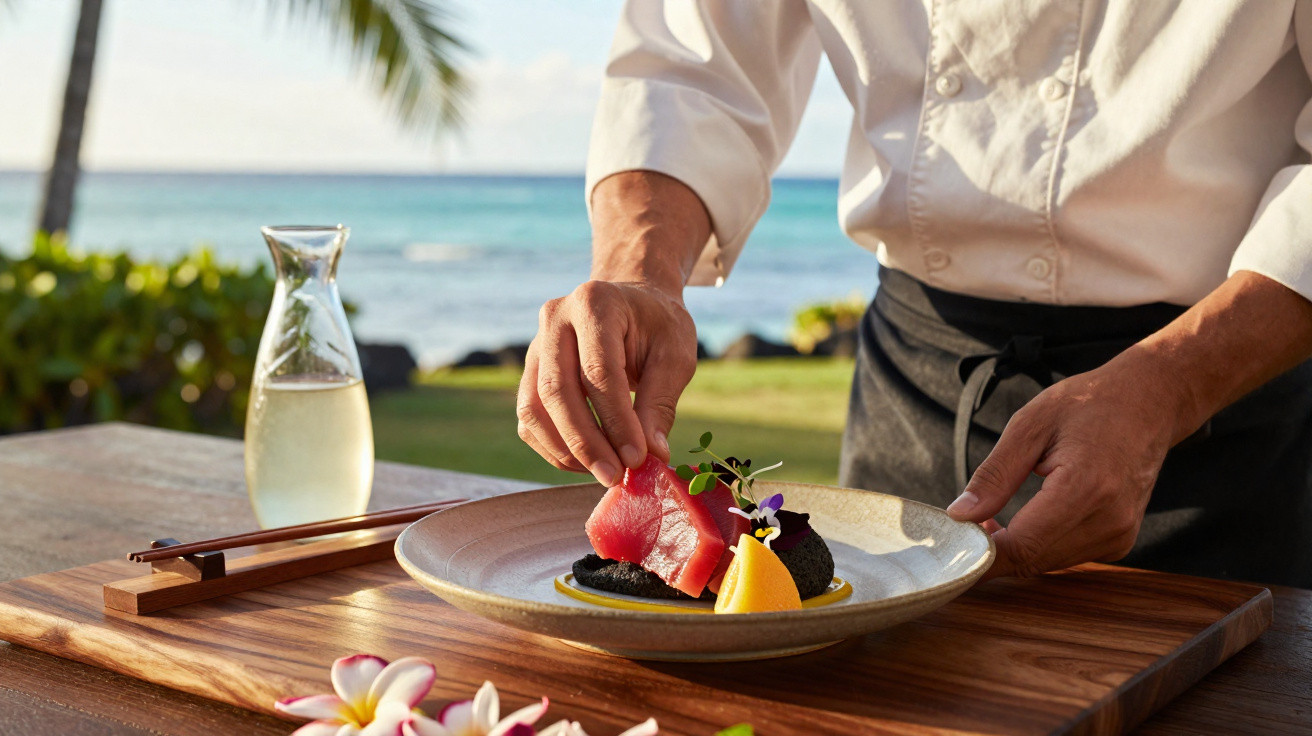
Bordered by lush palms and the golden sand of five crescent beaches, Maui’s Wailea Coast is celebrated for its extraordinary natural scenery and its cluster of luxury resorts.
One is Four Seasons Resort Maui, an extravagant hotel familiar to many from its prominent appearance in the first season of HBO’s The White Lotus.
But the resort’s newest restaurant, Komo, is now drawing the attention, becoming an essential booking not just in Wailea but across the whole island.
Komo at Four Seasons Resort Maui
Since opening in February 2025, Komo has been led by Tokyo-born chef Kiyokuni “Kiyo” Ikeda. Over a 25-year career that includes time at Morimoto, Ikeda has developed a menu defined by exacting technique and an important sense of the unexpected.
Deliveries from Tokyo’s Toyosu Market arrive twice weekly. About half their contents can be anticipated: bluefin tuna, Hokkaido sea urchin, hamachi and Fuji trout. What remains is unknown, including to the chef.
“It might be a highly prized fish like nodoguro or something far more rare and unexpected,” Ikeda tells Food & Wine. “That sense of the unknown ensures that no two visits are ever the same, allowing the menu to evolve naturally with what the ocean provides.”
Guests keen to discover the selection can order the Mystery Box, a 10-piece nigiri set that frequently features unusual catches or seasonal specialities. One recent delivery contained ebisudai, which takes its name from Ebisu, the Japanese god of fishing and one of the Seven Gods of Good Fortune. “I had never even encountered this fish in Japan. Discovering it in our shipment felt like a true gift from the ocean,” Ikeda says.
Japanese seafood and exacting preparation
Whatever fish is delivered is served with little embellishment and prepared simply. Bluefin tuna, for instance, can be ordered raw or dry-aged. In the dry-ageing method, moisture is drawn out as the fish matures. “The umami becomes more concentrated and the texture is refined,” Ikeda says. “Placing a piece of aged tuna next to fresh tuna allows diners to immediately taste the difference. It's the same fish, but the precision in timing and technique unlocks something completely different.”
Beyond occasional Hawaiian seafood, including Kona abalone and Diamond Head shrimp, most fish is flown in from Japan. There, cold water and strong currents create distinctive qualities in its fat, flavour and texture. “The same species can taste and feel very different depending on where it's raised,” Ikeda explains.
Many of Komo’s craft-brewed sakes are also imported directly from Japan and cannot be found elsewhere on Maui. Ikeda additionally creates his own soy sauce blend: aged, regular and tamari sauces combined with house-made dashi broth. The result has a subtle complexity that amplifies the inherent umami of the rice as well as the fish.
Wasabi is another point of difference. It can be grated tableside on genuine sharkskin, producing a smooth paste with more pronounced aromas, unlike the green dollops found at most sushi bars.
“We source fresh wasabi roots from Shizuoka where the water and soil conditions produce optimal quality,” Ikeda says. “Grating on sharkskin creates a fine, even texture and brings out a delicate, complex flavor, while the gentle heat enhances the taste of the fish without overpowering it.”
Hawaiian ingredients and island-inspired design
Although many components come from abroad, other details are deliberately grounded in Hawaiian culture, tradition and community.
The restaurant’s distinctive interior honours the island’s heritage. Its central fountain represents the journey of water from Maui’s mountains to the ocean, while details in marble, lava stone and heavily veined quartzite acknowledge Maui’s volcanic past. Carefully positioned mirrors are intended to catch the golden light of every individual sunset.
Other than the fish, most ingredients are cultivated on farms in Maui, including daikon, onions, cabbage, calamansi, makrut lime, finger lime and oranges. The rice is freshly milled on Oahu by Kubota Rice Industry (Hawaii) Inc. Komo is one of only three restaurants supplied by the producer, and the sole restaurant on Maui to source its rice there.
“Sourcing locally not only ensures the freshest possible ingredients, but also supports the local community,” Ikeda says. “My approach is not to create fusion cuisine but to highlight the natural harmony between Japanese techniques and Hawaiian ingredients.”
Taken as a whole, Ikeda says dining at Komo is an “experience that can't be planned, repeated, or replicated.”












Comments
No comments yet. Be the first to comment!
Leave a Comment