The corridor in a budget hotel smelled… costly. Not luxurious in the way perfume does, and not artificial like a bargain air freshener. It simply had that freshly mopped, faintly soapy scent that somehow makes you believe in the white bedding and even the television remote. As your suitcase wheels cross the tiles, you briefly ask yourself why your own home never keeps this smell for more than ten minutes after you have scrubbed the floor.
At home, lemon and vinegar solutions can leave the kitchen smelling like a salad gone wrong. The fragrance vanishes quickly, or, worse still, hangs around with an odd acidic edge.
Some people have discreetly found another way.
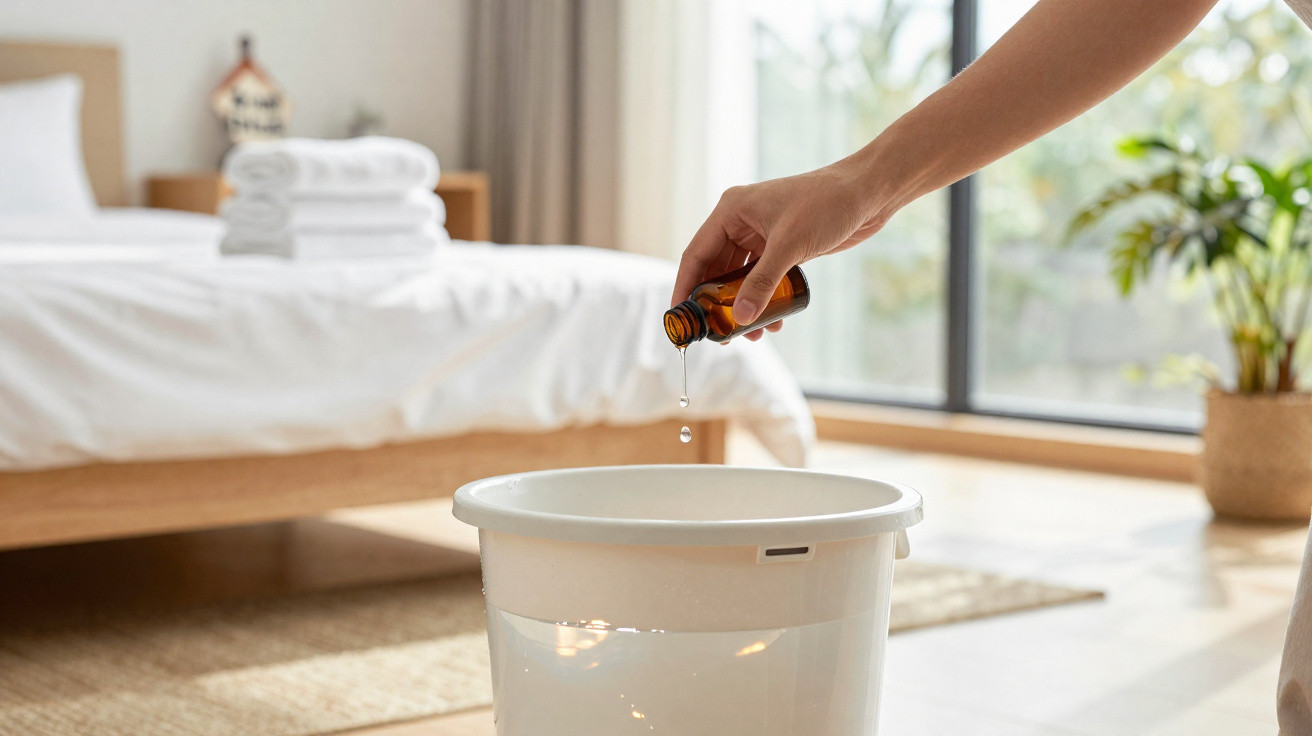
They put only two drops into the mop bucket.
How to get a hotel-clean smell without a salad-like scent
Step into a properly maintained hotel lobby just after the housekeeping team has finished, and you notice that familiar rush of freshness. It is not the aggressive hit of bleach or the sugary, candy-floss aroma of a plug-in diffuser. Instead, it is a lightly powdery clean note that you sense more than consciously register.
That fragrance is not created by rubbing half a lemon along the skirting boards. It does not come from another white-vinegar formula that makes your eyes sting, either. Often, it is the result of something much smaller and subtler added directly to the cleaning routine.
Speak to professional cleaners and a clear pattern emerges. Many quietly put two or three drops of concentrated fragrance oil or laundry scent booster into their mop water. Not a capful or even a splash: genuinely just two drops.
One housekeeper at a mid-range chain hotel admitted that she carries a small bottle of “fresh linen” concentrate in her apron. She dips in a toothpick, taps it into the bucket, swirls the water and, suddenly, the entire corridor carries the scent of freshly laundered sheets. Guests pass through, take one sniff and mentally mark the space as clean. No one suspects such a tiny amount is responsible.
There is straightforward reasoning behind the technique. Floors do more than appear clean: their smell communicates cleanliness too. We are conditioned to link mildly soapy, laundry-style scents with hygiene and tidiness. A gentle fragrance released from warm mop water adheres to tiles and skirting boards far more effectively than lemon or vinegar’s sharp aromas, which disappear quickly.
Vinegar is an excellent degreaser, but it suggests a “kitchen experiment” rather than a “hotel lobby”. The hotel-inspired method keeps cleaning and fragrance as separate jobs. Clean first, then add scent.
Two drops in the mop bucket: the method people use
The central idea is almost ridiculously easy. Fill the bucket with warm water and your usual floor cleaner or a gentle soap. Next, add a maximum of two drops of concentrated fragrance, whether that is an essential-oil blend, floor fragrance oil or a liquid laundry perfume made for dilution.
Move the mop through the water to distribute the fragrance evenly. That is all there is to it. There is no dense perfume in the room and no tacky coating on the tiles, only a faint background aroma that remains for several hours and quietly indicates that somebody has cleaned properly.
Those who advocate this trick often begin after a weekend spent in a friend’s home that smelled impossibly good. They watch their friend mop and see the same bucket and similarly grey water, apart from a tiny brown glass bottle retrieved from the back of a cupboard.
Once home, they try it on a small area of flooring. On the first attempt, they commonly use too much, turning the living room into a perfume counter. By the second attempt, they limit themselves to two drops, and the home suddenly has that peaceful, hotel-like sense of cleanliness. In truth, hardly anyone does it every day. Yet using it once or twice a week, ahead of visitors or following a deep clean, can transform the atmosphere of a room.
The success of the “two drops” approach comes down to concentration and surfaces. Fragrance molecules spread more effectively in warm water before settling lightly on the floor as the water dries. The bucket does not need to smell powerful; what matters is the soft trace left behind.
Use too much and the scent can become stifling, particularly in compact bathrooms and hallways. Use very little, and the brain interprets it as natural cleanliness rather than an attempt to conceal something. Our noses are surprisingly good at spotting when we’re being lied to by fragrance.
What to add to the mop bucket - and what people avoid
The most straightforward option is a laundry fragrance or “scent booster” liquid specifically formulated to be diluted. Add two drops to the mop water, stir briefly and it is ready to use. These products are made to smell of fresh sheets, cotton, or soap, aromas the brain already associates with clean beds and soft towels.
Essential oils offer another option. A traditional hotel-style combination is one drop of lavender with one drop of eucalyptus or tea tree in a neutral cleaner. Lavender softens the more piercing notes, while eucalyptus creates that “spa corridor” impression. Keep in mind that essential oils do not magically disinfect floors; their main purpose is fragrance.
The product people most often regret adding is neat fabric conditioner. It may look clever on TikTok, but it can leave floors a little sticky or streaky. The same is true of inexpensive perfume oils intended for burners, as they may create an oily layer and could mark porous tiles.
People who have tested a few options generally settle on one reliable bottle and use it for months. It is a scent that does not clash with other cleaning products, cause a headache or feel excessively “hotel lobby at 6 am” when they only want to clean the kitchen after dinner.
“I used to drown the house in those plug-in things,” admits Sara, 34, who works night shifts and cleans in the late morning. “Now I just put two drops of a cotton-scented laundry perfume in the mop water. The smell is lighter, it feels like real cleanliness, not like I’m hiding something.”
- Smart scents to try in the bucket
- “Fresh linen” or “cotton” laundry fragrance: the closest match for that hotel-sheet scent.
- Lavender + eucalyptus essential oils: soothing and clean, particularly in bathrooms.
- Neutral floor fragrance concentrate: created to avoid stains and residue.
- Things people often regret using
- Undiluted fabric conditioner: may create streaks plus a waxy, slippery finish.
- Too much essential oil: an overpowering smell and potential irritation for children and pets.
- Strong food-style fragrances (vanilla, cinnamon): lovely in candles, but strange on floors.
- Small habits that make it effective
- Leave a window open for ten minutes while mopping, allowing the fragrance to settle gently.
- If you have delicate wood or stone, test the fragrance in a corner first.
- Use it solely in the final rinse water if you are concerned about products reacting together.
Beyond the bucket: the understated pleasure of a home that “smells clean”
The fascination with the “hotel-clean smell” reveals something about modern life. We clean between meetings, after the children are asleep and before the delivery driver rings the bell. Making the floors genuinely shine is one thing; ensuring the house smells softly fresh without an overpowering wall of chemical perfume is another.
People who have taken up the two-drop method speak less about impressing guests and more about their own experience. There is that small, discreet trail of fragrance in the hallway when you return carrying the shopping, and that gentle feeling of “ah, yes, I did something for this place today”.
For some, it becomes a minor ritual: fill the bucket, add the standard cleaner, pause, then tap in two drops as a final touch. It is not about making a home pretend to be a hotel. It is about borrowing that feeling of calm and order for a few hours.
You may develop your own version: rosemary for a kitchen that always carries the scent of Sunday lunch, a cotton note in the bedroom or virtually no fragrance at all, only the mild neutrality of genuinely clean air. The trick lies in the balance: visible cleanliness, nearly imperceptible scent and the quiet pleasure of walking barefoot across a floor that looks and smells as though somebody cared.
| Key point | Detail | Value for the reader |
|---|---|---|
| Two drops are enough | Add a very small quantity of concentrated fragrance to warm mop water | A simple way to create a hotel-style clean scent without overwhelming perfume |
| Keep cleaning and scenting separate | Clean first with your usual product, then lightly fragrance the rinse water | Improved hygiene and longer-lasting freshness without harsh smells |
| Select suitable products | Choose laundry-style fragrances or diluted essential oils instead of fabric conditioner | Helps prevent residue, streaks and heavy artificial scents at home |
FAQ:
- Question 1 What type of fragrance is safe to put in my mop bucket?
- Question 2 Can essential oils harm my floors or leave them slippery?
- Question 3 Is it safe to combine vinegar, floor cleaner and fragrance in one bucket?
- Question 4 How long does the “hotel-clean” scent normally remain on the floor?
- Question 5 Is this method suitable for homes with pets or young children?









Comments
No comments yet. Be the first to comment!
Leave a Comment