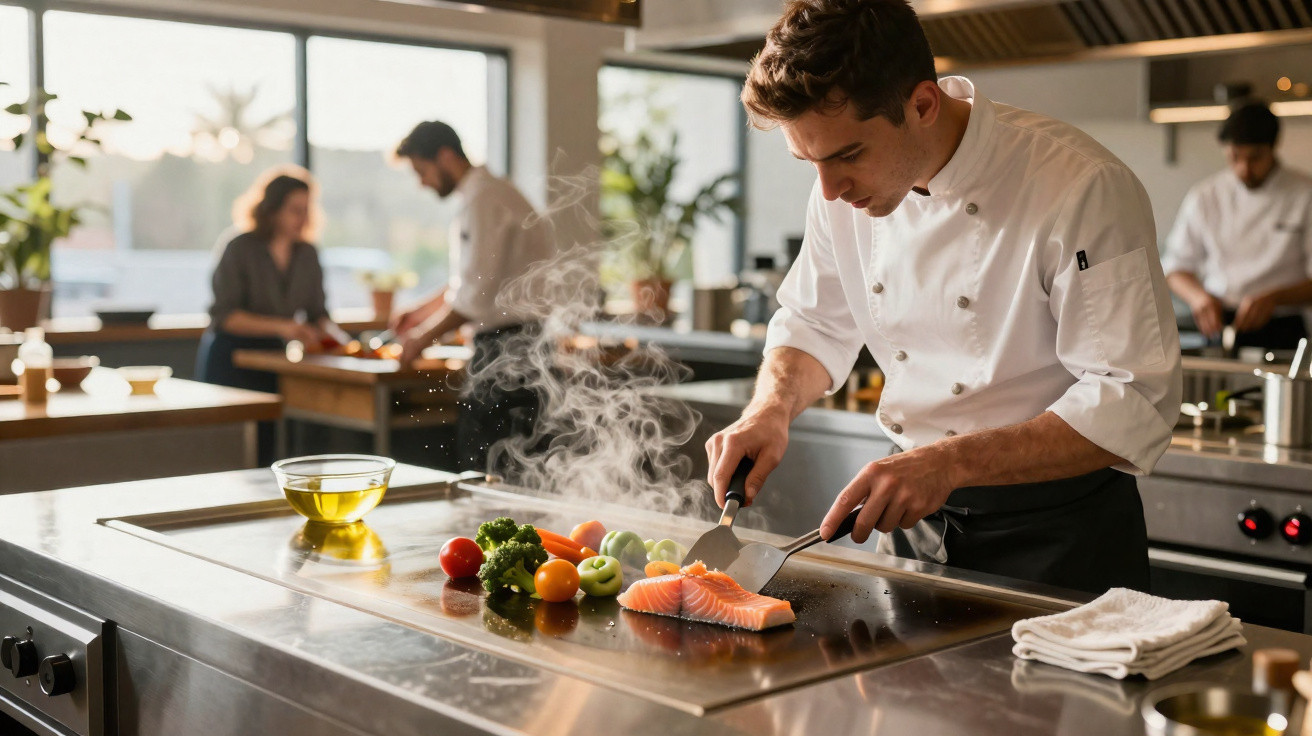
Rather than relying on oil and uneven hot spots, it uses regulated magnetic fields and intelligent sensors to apply uniform heat straight to food. Resembling a cross between a chopping board and a laboratory bench, it could reshape how we sear, sauté and plate dishes.
I encountered it for the first time on a Tuesday morning in a tight test kitchen, complete with worn flooring and a playlist looping early-2000s hits. A chef placed a skin-on salmon fillet on a dark glass plate that emitted the faintest hum. There was no oil and no pan. Within roughly two minutes, the skin crackled, loosened and became the precise shade of a September leaf. He nudged one edge with a palette knife, smiled and murmured, “Listen.” It sounded less like a sizzle and more like a purr. It was as though the usual rules of frying were being rewritten in front of me. He then cooked tomatoes without turning them to mush.
The slab that sizzles without a pan
On a worktop, it resembles a pared-back, thick induction hob: matt, uninterrupted and marked by almost no branding. Chefs use a compact dial to move between areas, while heat spreads over the board as evenly and precisely as a sunrise. Once food touches it, it browns as though the surface knows precisely where each atom belongs. There is barely any smoke, no blast of hot oil against your face, and none of the familiar worry over choosing between a crust and a burn.
One demonstration I watched became a pancake production line, and it was unexpectedly soothing. Twelve rounds of batter were placed down together; their edges set in unison and their centres rose at exactly the right moment. A handheld thermometer showed that the surface stayed within a couple of degrees across an area that would ordinarily contain at least three pan shadows. We have all experienced a breakfast that turns into triage; here, it felt like a symphony rather than a scramble.
Behind this is an interplay of induction coils and a ferromagnetic layer positioned immediately under the glass-ceramic cooking surface. The magnetic field changes direction thousands of times per second, generating heat precisely where it is required. Algorithms send those fields in micro-bursts, ironing out hot spots while continuously returning temperature readings to the controller. The upper layer has a micro-texture and a smooth hydrophilic coating, allowing steam to cushion food before it releases. There is no Teflon to damage and no oil film to control, altering everything from flavour to washing up.
How chefs are learning to “mag-cook”
Temperature comes first. For a tidy sear with neither smoke nor spitting, most proteins benefit from a preheated area at around 180–200°C. A light sprinkling of salt on the surface draws out just enough moisture for the steam-release effect to work, leaving the crisp snap you expect when cutting into the food. With delicate ingredients, lower the setting to 150–160°C and allow a little longer. Think of it as a griddle that can be as restrained as a sous-vide bath or as forceful as a cast-iron frying pan, without the inconsistency between those extremes.
Next comes managing moisture. Dry food with kitchen paper and allow the surface to do its job, particularly when cooking skin-on fish or chicken thighs. Add sugary marinades later rather than earlier, unless you want to caramelise your way into a sticky mess. Avoid overcrowding the slab: uniform heat does not create unlimited release, and food still needs air circulating around it. Be patient before turning food, too; the slab signals readiness by releasing it more easily. Honestly, no one manages that every day.
There is a cadence to it, rather like mastering a new instrument. The first attempts may be inconsistent, but eventually your hands simply learn the timing and the release.
“I used to chase hotspots around pans,” a test-kitchen chef told me. “Now I chase flavor. The surface is the same everywhere, which makes me braver with textures.”
- Reduce the temperature by 10–15°C for thin cuts; increase it for thicker steaks, then finish at a lower setting.
- Oil has become a flavour ingredient rather than insurance against sticking. Brush it on once cooking is finished.
- Eggs and cheese need a cooler area and a lighter touch. Slide rather than scrape.
- Wipe the surface while it is still warm using a damp cloth. Burnt sugar needs a brief steam lift, not vigorous scrubbing.
Why it could change kitchens beyond restaurants
Evenly cooked food has a calmer taste. That is the clearest way to put it. When you are not rushing to prevent one side from scorching, you can focus on seasoning and finishing details, such as a citrus brushing or melting herb butter. The approach is naturally leaner and remarkably dependable, evening after evening. As heat is contained within the surface layer rather than the surrounding air, kitchens also remain cooler-no small blessing during a summer service.
For home cooks, its attraction is almost pleasantly mundane: reduced clutter, tidier worktops and one slab capable of handling pancakes, smash burgers and blistered peppers without changing pans. Parents may appreciate less splatter and fewer flare-ups. Students may welcome a single appliance that does not require a cupboard packed with frying pans. There is certainly a learning curve, but the reward is control. Real control, the kind you feel in your fingertips.
There are compromises. Fat will not render in quite the traditional way, and certain flavours depend on oil singing in a frying pan. Some ingredients still benefit from the depth of a conventional pot or the embrace of a wok. Caramel sauce will challenge your patience. Nobody should claim this is magic: it is a tool rather than a miracle. Yet it removes the least enjoyable aspects of cooking-the hot spots, smoke and fiddly cleaning-and gives you more room to enjoy it.
This is still the beginning, an exciting and untidy stage. Chefs are discreetly trying prototypes during staff meals, taking them to weekend pop-ups and working out how to balance searing with tenderness. Engineers continue refining sensor arrays that adjust heat by pixel rather than by area. It is easy to picture school canteens making crisp-edged toasted cheese sandwiches without an oily haze, or hospital kitchens reaching safe temperatures with less pressure. Picture a midnight snack that does not wake the household. Picture a worktop that knows when to stop.
| Key point | Detail | Why it matters to the reader |
|---|---|---|
| Even heat without oil | Magnetic fields generate uniform warmth through a ferromagnetic layer and intelligent control loops. | More dependable browning, fewer burnt patches and a healthier default. |
| Simplified workflow | One surface manages searing, griddling and gentle cooking modes, with rapid temperature changes. | Fewer pans, less cleaning and quicker weekday cooking. |
| A rewarding learning curve | Moisture control, timing and temperature precision replace oil-based techniques. | Greater control over texture and more confidence across recipes. |
















Comments
No comments yet. Be the first to comment!
Leave a Comment