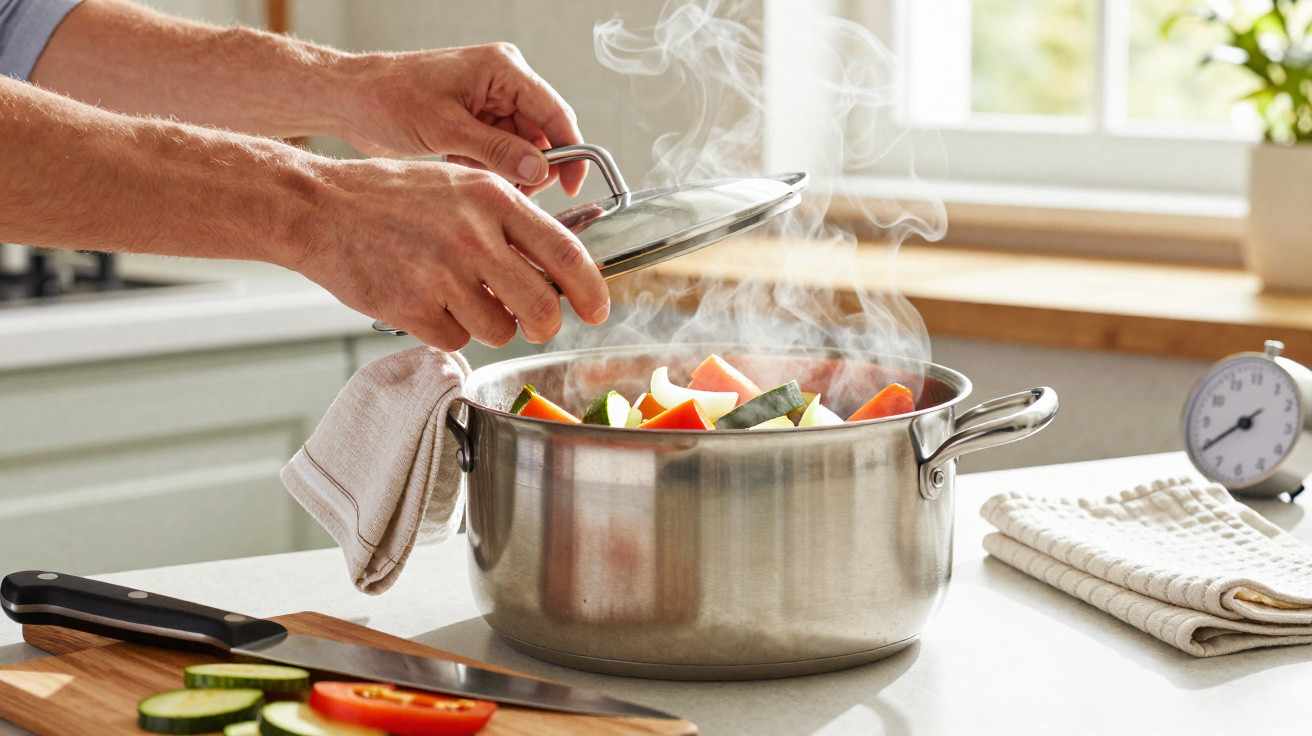
A perfectly ordinary casserole dish, a damp tea towel and a little patience are all you need to cook vegetables full of flavour without water or fat.
Many home cooks assume that waterless, oil-free cooking requires an expensive cast-iron pot with a specialist lid. In reality, the key is not the cookware itself but a physical effect that anyone can use calmly on their hob – even after work.
Gentle cooking without a drop of water: what really makes it work
Cooking without extra water or fat relies on what the food already contains: its natural juices. Vegetables, fruit and fish all naturally hold plenty of moisture. Provided the pot is prepared correctly, this internal liquid is enough to cook everything until tender, succulent and flavoursome.
“The driving force behind this method is not high-tech cookware, but the cycle of steam and condensation inside the pot.”
As the temperature rises, moisture from the ingredients turns into steam. If the lid seals well, the humid air remains inside. When the steam reaches the slightly cooler lid, it forms tiny droplets that fall back onto the food. This creates a kind of automatic rainfall:
- Heat causes moisture to evaporate in the pot
- The steam rises and reaches the lid
- There, it cools, condenses and drips back down
- The food is continually lightly “watered”
This is precisely what stops the ingredients from scorching on the base or drying out. Rather than fierce heat, the food is exposed to steady, moist warmth. This usually happens at around 60 to 80 degrees – considerably gentler than frying or searing in a pan.
Why an ordinary pot is enough – provided it meets two conditions
Cast iron is nice to have, but it is not essential. For everyday use, two things matter: a well-fitting lid and a decent base.
A pot or shallow casserole is ideal if it has:
- a reasonably thick base to distribute heat evenly
- a lid that fits fairly closely
- a hob with precise heat control
The real issue is a lid that lets too much steam escape. When that happens, the evaporation-and-condensation cycle is constantly interrupted. This is exactly where an almost old-fashioned trick proves remarkably effective.
The tea towel trick: making the pot almost airtight
All you need is a clean, slightly damp tea towel. Fold it and place it between the rim of the pot and its lid. The fabric adapts to minor unevenness and seals the gaps. The important points are:
- Dampen the tea towel only lightly, then wring it out thoroughly
- Fold it so that no part hangs over a flame or onto the hob
- Place the lid firmly on top, then avoid lifting it repeatedly
“The tea towel barrier turns an ordinary lid into an almost sealed dome in which the steam can circulate.”
If you own a pot with a very tightly fitting glass lid, you can often do without the tea towel. It is worth trying first, as the original lid is frequently more airtight than expected.
Waterless and fat-free cooking: how to get it right on your first attempt
Spring and summer vegetables work especially well: carrots, leeks, kohlrabi, fennel, courgettes and asparagus. Apples or pears are also suitable for quick compote variations. Here is a straightforward vegetable example for two people:
- 600 g carrots
- 2 leeks
- 1 onion
- 1 pinch of salt
- Pepper
- Fresh herbs (for example parsley or chives)
Preparation: the cutting matters
The size of the pieces determines how quickly their own moisture is released. Oversized pieces take a very long time to heat through, while tiny cubes can break down quickly. A sensible middle ground is:
- Carrots cut into slices or batons
- Leeks cut into rings
- Onion cut into thin half-rings
Put everything loosely into the pot rather than packing it down tightly. A small pinch of salt helps open up the cell structure, allowing the moisture to escape a little faster.
Controlling the heat: build it up, then turn it down
Managing the temperature may seem unremarkable, but it makes all the difference:
- Set the hob to a medium heat and fit the lid, with or without the tea towel.
- Wait a few minutes for steam to develop inside.
- As soon as visible moisture gathers on the lid, lower the heat.
“The aim is a quiet ‘murmur’ inside the pot, not loud sizzling. If it crackles, the hob is usually too hot.”
Now leave the lid closed. Every time it is lifted, steam escapes and the cooking time becomes longer. Smell and appearance offer better guidance: if gently sweet vegetable aromas spread through the kitchen and the lid is lightly misted, the process is working properly.
What happens on the plate: more flavour, a different texture
Anyone used to boiling vegetables in plenty of water will notice quite a change. Because there is barely any liquid sitting in the pot, the flavours stay in the ingredients. Carrots taste more intense, leeks become more savoury and herbs come through more strongly. Less salt is needed, and an additional sauce is rarely necessary.
Cooking time lets you control the texture quite precisely:
| Cooking time (guide) | Result |
|---|---|
| 8–10 minutes | Crisp with a slight bite |
| 12–15 minutes | Tender, but not overcooked |
| 20 minutes and more | Very soft, almost melting |
If desired, fold in a tiny piece of butter or a drop of olive oil right at the end. The flavour then coats the vegetables rather than dispersing through a large volume of water, making it seem more intense even though the amount of fat stays low.
Common mistakes – and how to put them right
Most problems with this technique can be traced back to three causes:
- Leaky lid: Too much steam escapes and the base dries out. Solution: use the tea towel trick or choose a better-fitting lid.
- Heat too high: The sound is more like frying and there may be a slight burnt smell. Solution: turn the hob down earlier; a thick base helps.
- Impatience: The lid is lifted repeatedly, causing the temperature to drop. Solution: trust the smell and condensation rather than looking inside.
“Three keywords sum up the method: keep it sealed, heat gently, be patient.”
How to use the technique for fish, fruit and everyday cooking
It becomes particularly interesting when you try it with fish. Place a piece of salmon or cod on a bed of sliced leek, add a little salt and perhaps a hint of lemon: inside the tightly sealed pot, the fish cooks exceptionally succulent without falling apart. The heat should be set even more gently than for vegetables, and the lid should genuinely remain shut until the estimated cooking time has passed.
The same approach works with fruit. Roughly chopped apples or pears, a little cinnamon and perhaps one tablespoon of water to get things started will quickly make a fruity compote. There is no need to add sugar, because the flavour remains more concentrated.
Anyone who uses this style of cooking regularly soon notices that it saves not just fat but effort too. There is no browning, no rinsing under cold water and hardly any splashing on the hob. Many dishes practically take care of themselves while you get on with something else.
One aspect is often underestimated: the gentle temperature is also kinder to nutrients. Heat-sensitive vitamins in vegetables have a better chance of staying in the pot when the heat is not turned right up and nothing boils vigorously for minutes on end.
The technique is also interesting when combined with other methods. For example, potatoes can be partially cooked conventionally in a small amount of water, then briefly finished in the sealed pot with some herbs to draw in more flavour. Already cooked pulses such as chickpeas or beans can likewise be warmed gently on a bed of vegetables without breaking apart.
In the end, this way of cooking feels less like a diet and more like a kitchen experiment. Many people only realise when tasting it how much natural flavour there is in simple carrots, leeks or a piece of fish when water does not dilute everything and oil does not mask the aroma. Once you have seen how well it works with a simple pot, a damp tea towel and patience, you are likely to think twice next time you look at expensive specialist pots.







Comments
No comments yet. Be the first to comment!
Leave a Comment