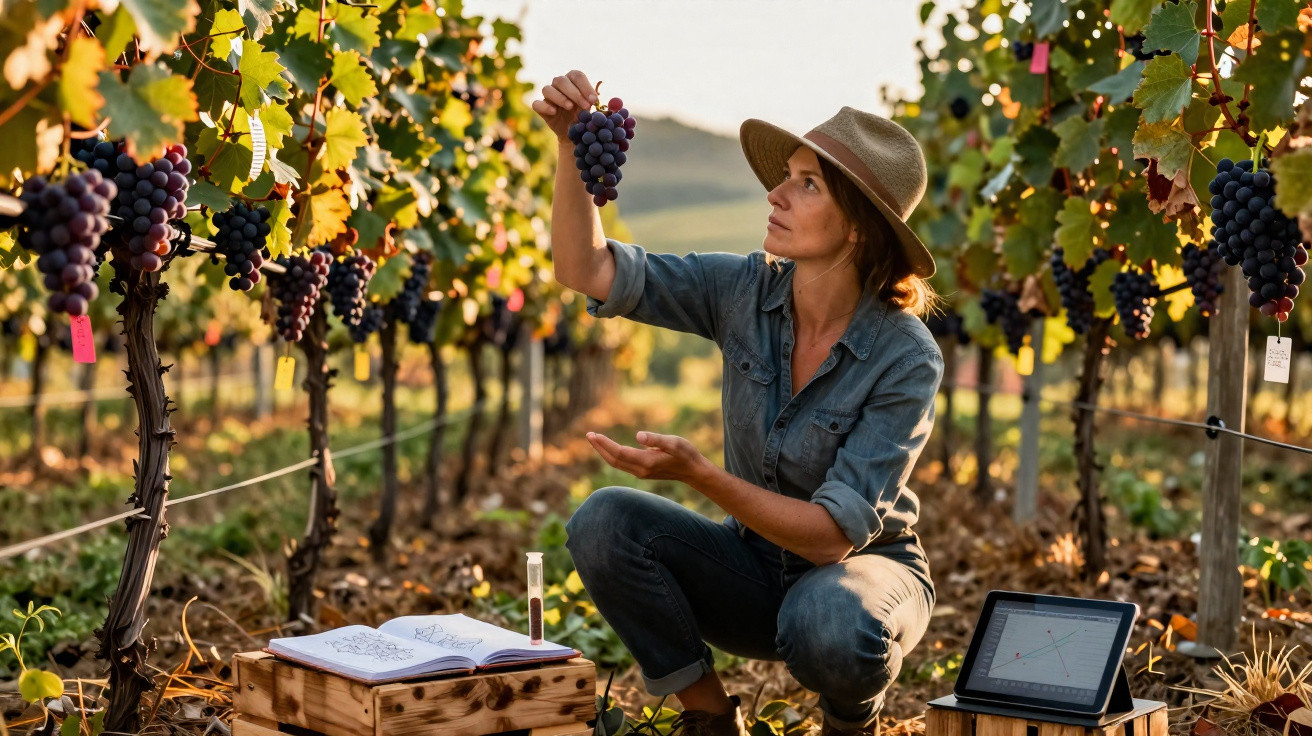
A Burgundian Chardonnay will almost certainly taste unlike a Bulgarian Chardonnay. Climate, soil, and the techniques used to cultivate the vines and make the wine all influence the result - but so does the small number attached to the grape’s name.
That number refers to clones, and there are plenty of them. Thousands of grape varieties are grown around the world, while widely planted grapes such as Chardonnay have dozens of registered forms, known as clones.
Much like shirt numbers in sport, certain clone numbers have become linked with quality. In clone-world terms, Pommard and Dijon clones are the Michael Jordan and LeBron James equivalents.
What are clones and why are they so diverse?
In an era of AI-fuelled unease, clones may sound slightly unsettling. Yet propagating vine clones has been a feature of viticulture for centuries.
Growers notice when particular vines prosper through even severe, difficult conditions as neighbouring vines sag and wither. Some version of massale selection - the longstanding practice of reproducing the strongest and best vines - has existed since winegrowing became a serious pursuit. Vineyards take cuttings from these favoured plants before grafting and planting them.
The approach began to change during the 19th century. German growers started propagating cuttings from promising vines across several generations, confirming that they were sound, healthy and capable of repeatedly producing delicious grapes and wines.
Clonal research was modernised during the 1970s and 1980s, with the introduction of numbered French clones developed in Burgundy alongside the University of Dijon and the Institut National de la Recherche Agronomique (INRA). Universities and research bodies worldwide now maintain and develop clones intended not only to make excellent wine, but also to withstand climate pressures.
Here is what wine enthusiasts should understand about clones - and, where bottles identify them, which ones to look for.
Raising quality in newer wine regions
Cashmere may be luxurious, but it is hardly what you would choose to wear in Tampa during August. Over time, winegrowers - particularly those in emerging regions - can find that the first clones they planted were either poorly suited to their climate or less able to make elegant, complex wine than the choices more readily available today.
At Hermann J. Weimer Vineyard and Winery in New York’s Finger Lakes, co-owner Oskar Bynke says the estate planted the Bordeaux standards 327 and 332 when it started growing Cabernet Franc in 1999.
As its understanding of what the grape could achieve in the Finger Lakes developed, however, the team began searching for other clones.
“Over the last decade or so, we have started working with 214 from the Loire Valley, adding a dimension of darker fruit on the palate,” says Bynke. “Also, clone 623 from Bordeaux, which is less fruit-forward and adds a good contrast. Clone 312 from the Pyrénées offers more acid. And Clone 3 from Italy is a little more subtle, adding a touch of finesse.”
The range of available options has expanded enormously over the past three decades.
“Having a diverse range of clones helps because some are later budding, and others are more vulnerable to disease,” he says. “Hedging your bets means less vintage variation in the wines overall if one performs better one year, and another the next.”
Central Otago in New Zealand released its first commercial Pinot Noir in the late 1980s. Timbo Deaker, viticulturist and operations manager at Viticultura, credits the region’s early and continued success partly to exceptional access to numerous clones.
“Our relationship with Entav [now Entav-Inra, a national agency that develops and certifies clones under France’s Ministry of Agriculture] has meant that we have had the best access to the newest and most diverse range of Pinot Noir clones for a long time,” says Deaker.
The area initially planted dozens of mostly French clones, and most performed well. The notable exceptions were the popular clone 6 and Dijon clones 113 and 114, which delivered disappointing flavours. Their use, though, has since become far more sophisticated.
“We have a saying here that often the Pommard clones provide the skeletal aspects of Pinot, Dijon is the muscle you need to hang off the skeleton, and the Abel clone is the heartbeat that makes the wine come alive,” says Deaker.
Deaker says the team plans to investigate whether individual clones are better matched to particular subregions within Central Otago’s famously varied terroir.
Pursuing a more nuanced expression
Around 550 million Big Macs are sold annually in the US - roughly one every 17 seconds. Yet you may favour a grass-fed smash burger in a gently toasted brioche bun. They are both burgers, but they are far from the same.
Comparable choices between mass-market and highly particular expressions are taking place in vineyards.
At Simpson Family Estates on Michigan’s Leelanau Peninsula, winemaker Drew Perry is increasingly taking a fruit-salad-style approach to clonal planting. The latest additions were intended to bring more finesse to its Pinot Noirs, alongside greater brightness and energy in its Chardonnays.
“Our Pinot vineyards are primarily planted to Dijon clones - 113, 114, 115, 667, and 777,” says Perry. “Our access to 667 and 777 was limited, and the others sometimes lacked color and tannin for a cooler region like ours.”
It now has a warmer plot dedicated to 667, 777 and 828 for still wine. Its original, cooler site is reserved for sparkling wine and rosé, which both call for piercing acidity and lower ripeness.
“We’ve followed a similar path with Chardonnay,” says Perry. “For many years, our vineyards were dominated by clones 76 and 96, and it limited our ability to produce a broader range of styles.”
The estate is now working with a newly planted site featuring clone 809, a Musqué clone that contributes an aromatic element.
“The wines are strikingly different and often capable of re-engaging customers who had written Chardonnay off based on memories of heavily oaked, buttery styles,” says Perry.
At Stoller Family Estate in Oregon’s Willamette Valley, winegrower and vice president of vineyard operations Jason Tosch says Dijon clones form the backbone of its Chardonnay plantings. The team has nevertheless found that a deliberately chosen mix of clones across the valley’s different mesoclimates and microclimates produces a nuanced, reliable wine, including in challenging vintages.
“The Dijon clones tend to ripen slower,” says Tosch. “And while the faster-ripening 548, Mt. Eden, and 809 have unique olfactory and textural characteristics that could make exciting standalone Chardonnay bottlings, when combined with the other Dijon plantings, they add a synergy, which gives our winemaking team greater creative freedom.”
Combating climate chaos
Just as the wine trade’s knowledge of clones and the value of diversity was becoming more developed, the damage wrought by climate change disrupted that progress.
Climate change is accelerating. Since the beginning of the Industrial Age in 1850, temperature has increased by 0.11 degrees Fahrenheit (0.06 degrees Celsius). From 1982 onwards, the pace rose to 0.36 degrees Fahrenheit (0.20 degrees Celsius) each decade. The issue is not simply hotter weather: increasingly severe and prolonged weather “events” continue to increase, with their cost in the US alone exceeding $2.915 trillion between 1980–2024.
Winemakers are therefore selecting clones with climate chaos increasingly at the forefront of their decisions.
Nicole Marchesi, winemaker at Far Niente in Oakville, California, says every decision is guided by a single aim: exceptional wines.
Nicole Marchesi, winemaker at Far Niente
“We’re looking at how we can ensure resilience of Chardonnay, Cabernet Sauvignon, and other varietals, while also amplifying quality. Climate change doesn’t always mean hotter - it means more extreme weather events.”
- Nicole Marchesi, winemaker at Far Niente
The winery has adopted classics including clone 7, alongside 169 and 685. The team also values a proprietary clone propagated by founder Gil Nickel, called Charlemagne. Marchesi says resilient, dependable clones make it possible to take a lighter and more sustainable approach in the vineyard.
“We’re in the midst of a reset in our industry,” says John McCarthy, director of vineyard operations for Far Niente Wine Estate. “For our new plantings, we looked very closely at the soil profiles so we could match each clone with the appropriate rootstock. That way, we built our canopy architecture passively through compatible plant selections, rather than reactive inputs.”
Put simply, stronger clones and rootstocks can mean fewer chemical interventions and healthier natural growth.
At Gamble Estates in Oakville, owner Tom Gamble grows 14 separate clones of Cabernet Sauvignon.
“We replanted some of our Gamble Estates vineyards in Rutherford, and I have started to lean on Clone 4, which thrives in drier environments,” says Gamble.
He is also concentrating on clones 34 and 30, both able to cope with intense sun exposure.
“It’s important to plant with intentionality,” says Gamble. “There are Cabernet Sauvignon clones like 169, which I have planted on Mount Veeder because I think it would accumulate too much sugar down on the valley, where it’s warmer.”
He also prefers clones 8 and 2 for their slow-ripening profile and high acidity, respectively, even as years become warmer.
Assessing the effects of clonal choice
How much difference do clones really make compared with the many other subtleties involved in producing wine?
In the Willamette Valley, David Adelsheim of Adelsheim Vineyard was among the pioneers behind importing Pinot Noir clones from Burgundy.
“Clones are one piece of the puzzle,” says Adelsheim. “They’re important, but not conclusive. You have to think about when you pick, and we found that 95 for Chardonnay, for example, was much riper at the same sugar level as 76. Together, they’re really good.”
The grape variety itself also matters when considering the influence of clonal decisions.
“Pinot Noir is ancient,” he says. “It can be traced to 600 A.D. Chardonnay is much younger, relatively, with roots dating back to the 1500 and 1600s. The differences between clones are much more significant with newer grapes.”
Other producers identify more dramatic outcomes. In South Africa’s Cape Winelands, Bruwer Raats, owner and winemaker at Raats Family Wines, says adjustments to clones have greatly improved wine quality.
“The clones that were selected beginning in the 1950s through the 1980s for Chenin Blanc were aimed at high-volume production, about 30 tons per hectare,” says Raats. “In the late ’90s, and definitely after we started the Chenin Blanc Association in 2000, that changed. We shifted from treating it like a donkey and expecting it to win the Kentucky Derby, to treating it like the thoroughbred it is.”
For his Stellenbosch vineyards, Raats favours clones 24, 220 and 1064 for their reduced yields, greater acidity at higher ripeness and remarkable complexity.
“The penny dropped in the U.S. when they realized that our unoaked Chenin Blanc offered incredible bang for the buck,” says Raats. “The difference was so obvious, and we started getting scores above 90 around 2008.”
While seeking high-quality old-vine Chenin, Raats travelled across the country looking for low-yielding vines.
“I finally found the mother block for the Montpellier clone Chenin, which was imported in the 1960s and largely abandoned because it was so low yielding,” he says. “I called the vineyard owner in the Nuy Valley the next day, and he said, ‘You better come here quick because we’re ripping it out.’ We went the next day and took cuttings, with bulldozers ripping out vines next to us.”
Raats has since planted Montpellier in further vineyards and is pleased by both its performance and the fact that he has protected a fragment of South Africa’s winegrowing heritage.
“It’s absolutely fantastic,” says Raats. “So concentrated. And it flourishes in our conditions, which are increasingly challenging.”
Choosing a particular clone will not invariably determine whether a wine succeeds or fails. But especially in the face of climate change, it can provide the extra advantage that distinguishes a good wine from a great one.













Comments
No comments yet. Be the first to comment!
Leave a Comment