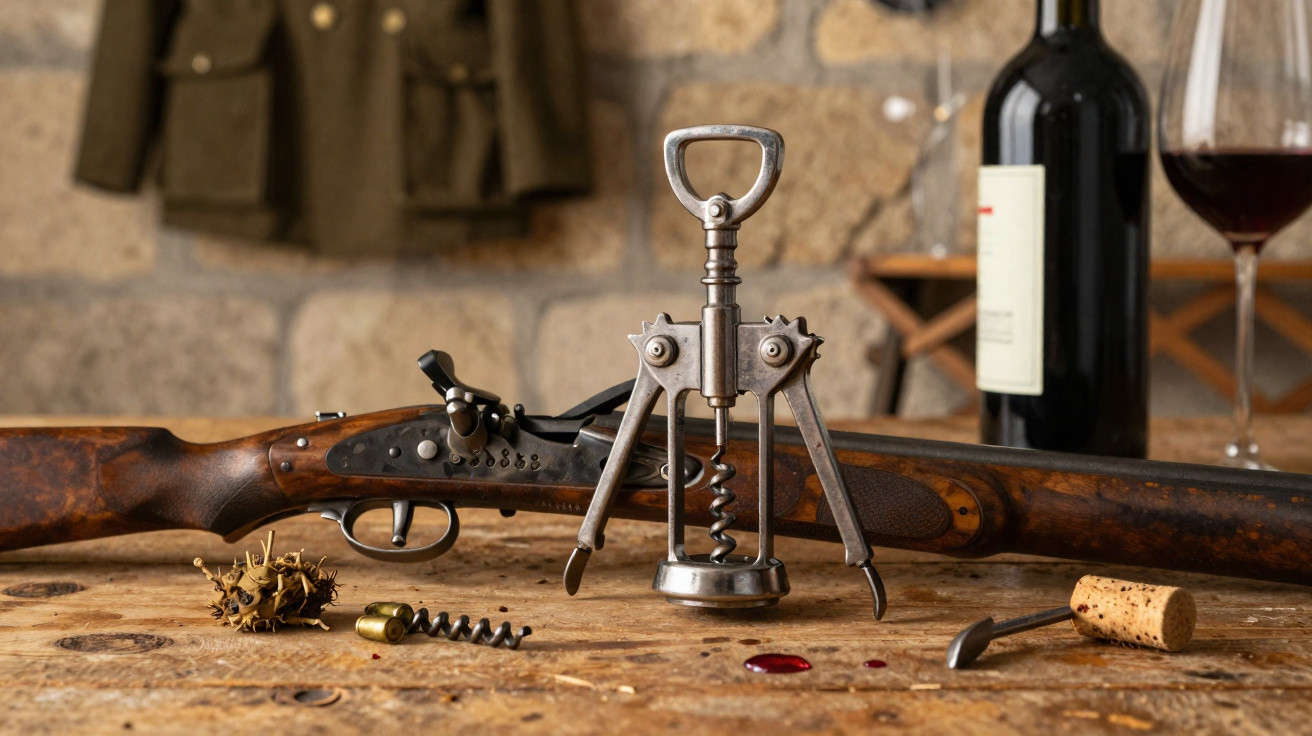
If you sometimes struggle to open a bottle of wine with your corkscrew, remember that soldiers originally used this sort of tool to stop their weapons from exploding in their faces. It may help put things in perspective.
Are you a fan of good wine? You almost certainly have one, perhaps several, corkscrews lying in your kitchen drawers. Even if you do not drink wine, there is still a good chance you own this remarkably useful tool, given that France has been renowned for its wine since Roman times. As George Bernard Shaw wrote in his 1924 play Saint Joan, “Ordinary wine, the drinking water of the French people”, highlighting how wine once held a central place in people’s diets, being safer to drink and more calorific than the stagnant water found in wells and rivers.
Yet enjoying this prized drink first required removing the cork sealing the bottle. To do that neatly, people devised the corkscrew: a mechanically simple yet ingenious instrument that was born not in a dusty cellar or vineyard, but on the battlefield.
From musket barrel to bottle neck
The corkscrew’s story is one of repurposing, as it was not designed for wine in the first place. From the 1630s onwards, European soldiers and hunters used a small metal spiral attached to the end of a rod to remove unused charges or gunpowder residue trapped at the bottom of their muskets, a rudimentary forerunner of the rifle. In France, this small implement was known as a wadding extractor, while English speakers called it a “gun worm”.
Wine bottles, corks and long-term storage
As the historian Paul Lukacs explains in Inventing Wine, glass bottles were originally merely serving decanters: wine was drawn straight from a barrel into a bottle to be taken to the table. At that point, the cork stopper was simply a peg left protruding so that it could be pulled out by hand.
The difficulty emerged later, when people began trying to keep wine for longer periods between 1680 and 1720. To ensure a perfect seal, the cork had to be pushed flush with the bottle neck, leaving it fully inserted rather than sticking out. As a result, fingers could no longer reach it. According to journalist George M. Taber, before the corkscrew existed, there were only two very poor ways to remove it: push the cork down into the bottle, or snap off the neck using red-hot tongs.
Wine drinkers eventually realised that the wadding extractor could grip cork just as effectively, without breaking the bottle’s glass. This cleaning tool was therefore adapted into what early English literary sources first referred to in 1681 as a “bottlescrew”, or, rather awkwardly, a “bottle screw”.
The mechanical evolution of the corkscrew
Once it had been adopted, the “bottlescrew” underwent continual refinement, although it was still regarded as an unofficial emergency tool. It was not until 1795 that the English Reverend Samuel Henshall registered the first official corkscrew patent. His invention was the “Henshall button”: a small horizontal metal disc fitted at the base of the worm. It was a modest but significant breakthrough, as it stopped the spiral from travelling too far and tearing the cork, while also providing a point of support for turning the cork and loosening it from the glass through simple rotation.
Opening a bottle still required considerable strength, however. The action placed heavy demands on the wrist and arm because no extra mechanism helped to reduce the effort or improve pulling power.
Fortunately, in 1882, German inventor Carl Wienke transformed corkscrew ergonomics when he patented the first folding lever model: the famous waiter’s friend, which remains widely used today. Its hinged arm rested against the edge of the bottle neck, multiplying the force transferred to the cork.
The modern corkscrew spiral
Since then, engineers have kept refining the worm, the spiral component, so that it grips more effectively without weakening the cork. Modern corkscrew designs now favour what is known as an “open-centre” spiral.
Unlike the early solid worms, which behaved like wood screws by piercing and forcing apart the cork material, the modern spiral coils around a hollow core. It can therefore pass smoothly through the cork without crushing it or pushing it towards the sides of the bottle neck. To improve matters further, these worms are often coated in Teflon, reducing friction for scalpel-like penetration.
Three centuries after leaving the battlefield for our kitchens, the old wadding extractor has more than earned its status as an essential kitchen accessory. It is a small piece of history you can share to impress people at a gathering, or recall the next time you are battling with a particularly stubborn cork. Keep your dignity and hold your wrist steady: after all, you are handling a greatly improved piece of artillery. Cheers! A word of warning: as everyone knows, excessive alcohol consumption is dangerous to health. Drink sensibly, because unlike muskets, wine should not go to your head too often.
















Comments
No comments yet. Be the first to comment!
Leave a Comment