As most food writers approach the publication of their first cookbook, they are usually celebrating, sharing countless recipes with followers and preparing to sign hundreds of copies at their publisher’s offices. For Ilhan Mohamed Abdi, though, the lead-up to her debut collection, The Ramadan Kitchen, has also meant undergoing surgery - brain surgery, in fact. “So if I am a bit slow on some of the questions, please bear with me,” she says softly. Yet even major surgery has not dimmed her joy at becoming a cookbook author. “I’m very excited, nervous at the same time, but very excited,” she says enthusiastically.
Ilhan Mohamed Abdi and The Ramadan Cookbook
You may already know the London-based 36-year-old from Instagram, where she has 265k followers. It was on the platform, especially during lockdown, that The Ramadan Cookbook began to take shape. “I started a Ramadan series online, just live on Instagram, and I’d post to tell everyone, ‘This is what we’re going to cook. These are the ingredients and kitchen utensils you’re going to need. Join me at six o’clock.’ And I’d get hundreds of people come on these lives. It was fantastic,” she recalls.
What struck a chord in particular was that “I would actually show people I was being serious when I said something takes 15 minutes.” “Like my Somali rice is 15 minutes, one of my most popular recipes, and once they’d seen me actually cook it in front of them online, they’d realise, it really does take 15 minutes, and it really is beginner friendly,” she explains.
For a time, she considered producing a cookbook focused on quick recipes rather than Ramadan. Her followers are still urging her to write a bread book too - Paul Hollywood, be warned - as Mohamed Abdi’s dinner rolls and kimis, flaky flatbreads, deserve to become kitchen staples.
Somali and Egyptian flavours for modern cooks
Before entering the food world, Mohamed Abdi worked in the demanding corporate sector, first at Goldman Sachs and later at Amazon. So how would the mother of one describe her cooking? “A lot of it comes from my own culture, my own heritage. It’s influenced heavily by that. So the foods I grew up with,” she says. “It’s Somali flavours. It’s Arab flavours. My heritage is Somalian Egyptian, so a lot of the flavours come from there. But at the same time, my mother was in the kitchen quite a lot, so cooking her meals would take hours, and I don’t think that’s a fit for the modern cook, so I just adapted those [recipes] to fit the modern cook essentially.”
She spent many hours watching her mother make remarkable food - “I absolutely loved it. I didn’t bore of it at all,” - and, decades on, a comparable scene is playing out in her own kitchen. Mohamed Abdi has dedicated the book to her daughter, Amaana, who has influenced her approach by inspiring more efficient shortcuts as well as ways to include a toddler in the cooking. “I want to preserve memories that I had growing up, the same recipes,” she says. “Ramadan comes every single year. It’ll come every single year until the end of time, and so it’s a book that will grow with her and her children, potentially.”
Ramadan meals, from suhoor to iftar
This year, Ramadan - the month of fasting observed by Muslims around the world - runs from the evening of Tuesday, February 17 until Wednesday, March 18. “For me, it’s a month that brings me back to my faith, routine and family. We spend a lot more time, not just with my own immediate family, but my extended family,” she says with reverence. “When I was in Somalia a lot [when I was younger] I would feel it around me everywhere, but in England or London, you don’t, so Ramadan for me was that one thing that was always constant every single year, no matter where I was. Now, as a mother, I’m trying to create that same sense for my child – comfort and memory.”
The book is arranged in two principal parts: suhoor, the pre-dawn meal eaten before fasting begins, and iftar, the evening meal. Suhoor recipes include Mohamed Abdi’s indulgent-sounding croissant bread pudding and date shake, although she says, “I’ll often just have a cup of water and a few dates, or I’ll have a really small sandwich or bagel, or even egg bites”. For iftar and breaking the fast, she offers chicken shawarma, oxtail stew, lamb chops, macaroni and even a sheet-pan pizza scattered with pepperoni.
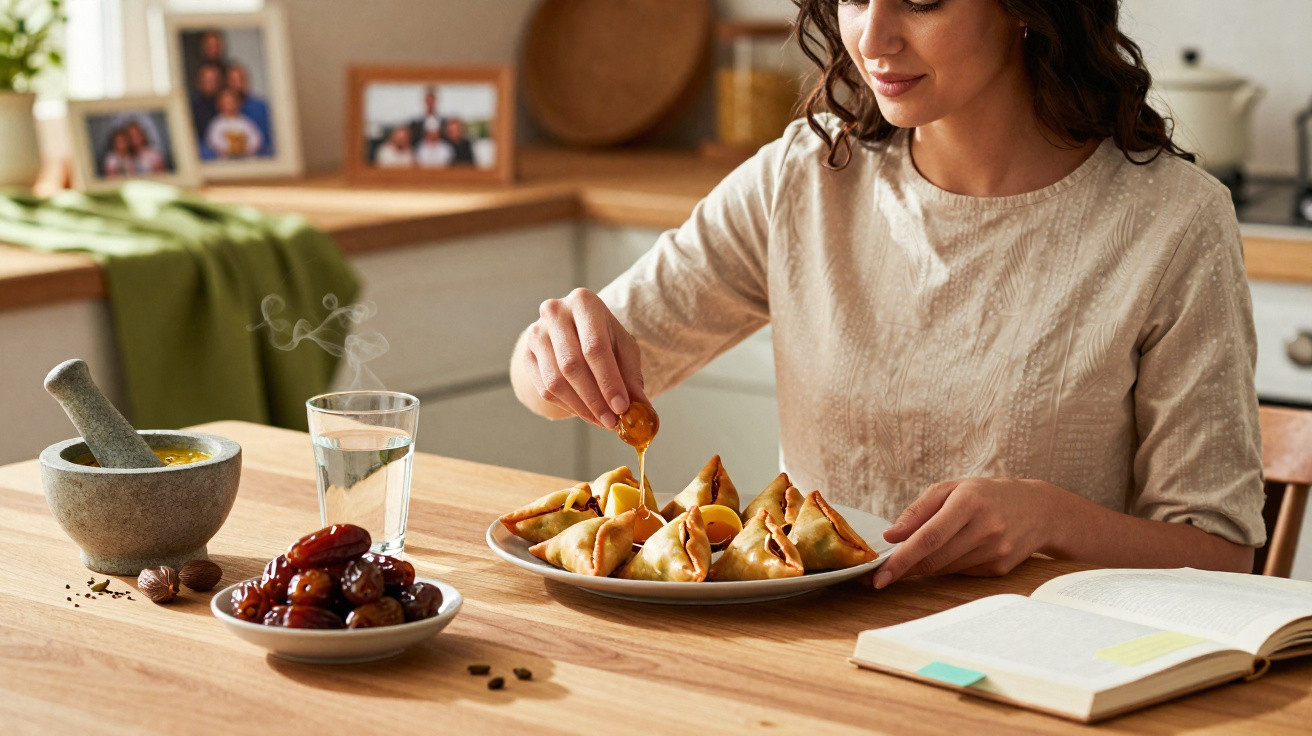
“The book is absolutely for everyone,” she says, stressing that it is not solely for people observing Ramadan. For anyone who does not observe but wants an introduction to the holy month, Mohamed Abdi recommends her samosas and fried doughballs soaked in syrup. “I have such strong memories of these, they’d be the first thing on the table along with samosas throughout the entire of Ramadan.”
“I want people to feel confident when they try these dishes, and I want [them to experience] a sense of comfort,” she adds. “I also want people to walk away with a better understanding of the Somalian Egyptian cuisine I’ve grown up with.” At the very start of the book’s development, she recalls telling her editor that “there are so many more Muslims in the world than, let’s say, vegetarians and vegans, but there are so many vegetarian and vegan books, which are fantastic,” she says, but “why aren’t there more books like [The Ramadan Cookbook]? I think it’s really important. I think it’s changing, but very slowly.” Perhaps Mohamed Abdi has helped to set that change in motion.








Comments
No comments yet. Be the first to comment!
Leave a Comment