A wooden chopping board can last for decades, provided it is not treated as nothing more than a thick plate. It takes everything in its stride: evening vegetables, Sunday bread and impromptu meals. Yet one poor habit, repeated two or three times, can be enough to create a crack that will never close.
There is often a particularly frustrating moment: you take your lovely board from the cupboard, the one that has already seen hundreds of dinners, and notice a dark line running across it. It was not there the day before, or perhaps you simply had not spotted it. The wood suddenly appears delicate, even temperamental, despite looking so sturdy on the worktop. In truth, a board responds to moisture, heat and time, much like an antique piece of furniture that has decided to take part in every meal. With proper care, it can retain its patina for twenty years, sometimes far longer. You simply need to know what it truly needs.
Wood does not like extremes, even in an ordinary kitchen
A beech, oak, maple or walnut board is never entirely still. Its fibres swell slightly after taking in water from a tomato, lemon juice or washing-up moisture, then contract when it dries too quickly. This constant movement causes warping, raised edges and those familiar splits. We all know the moment when a board is placed beside the sink “just to dry”. The risk begins if it is left pressed against a heat source or lying in a puddle.
In a family kitchen, a board used every day may take several hundred knife blows each week. Marks are not necessarily a problem: they show that it is being used, while a wooden board also has the benefit of being kinder to knife edges. The real warning sign is a crack that opens through the full thickness, usually near a corner or along a glued joint. A board left to soak for thirty minutes after a meal and then dried on a radiator can split within days. The wood has no time to adjust.
The most damaging mistake remains putting it in the dishwasher. Heat, water spray and abrupt drying make a formidable combination for wood fibres. A board may look undamaged when it comes out of the machine, only to warp or crack after several cycles. Wood withstands use, not climatic shocks. The same principle applies to the microwave, dishwasher and a windowsill in full sun. A board does not need to be handled like a precious object, but it deserves better than a forced soak.
Simple wooden chopping board care that truly makes a difference
After every use, wash the board with warm water, a soft sponge, a little washing-up liquid and a quick rinse. There is no need to saturate it: the aim is to remove food residue, not to soak the wood. Dry it straight away with a clean tea towel, then stand it upright on its edge so that air can circulate on both sides. This prevents one side from drying more quickly than the other and causing the wood to cup. Let us be honest: hardly anyone does this every day. However, this small habit soon becomes automatic.
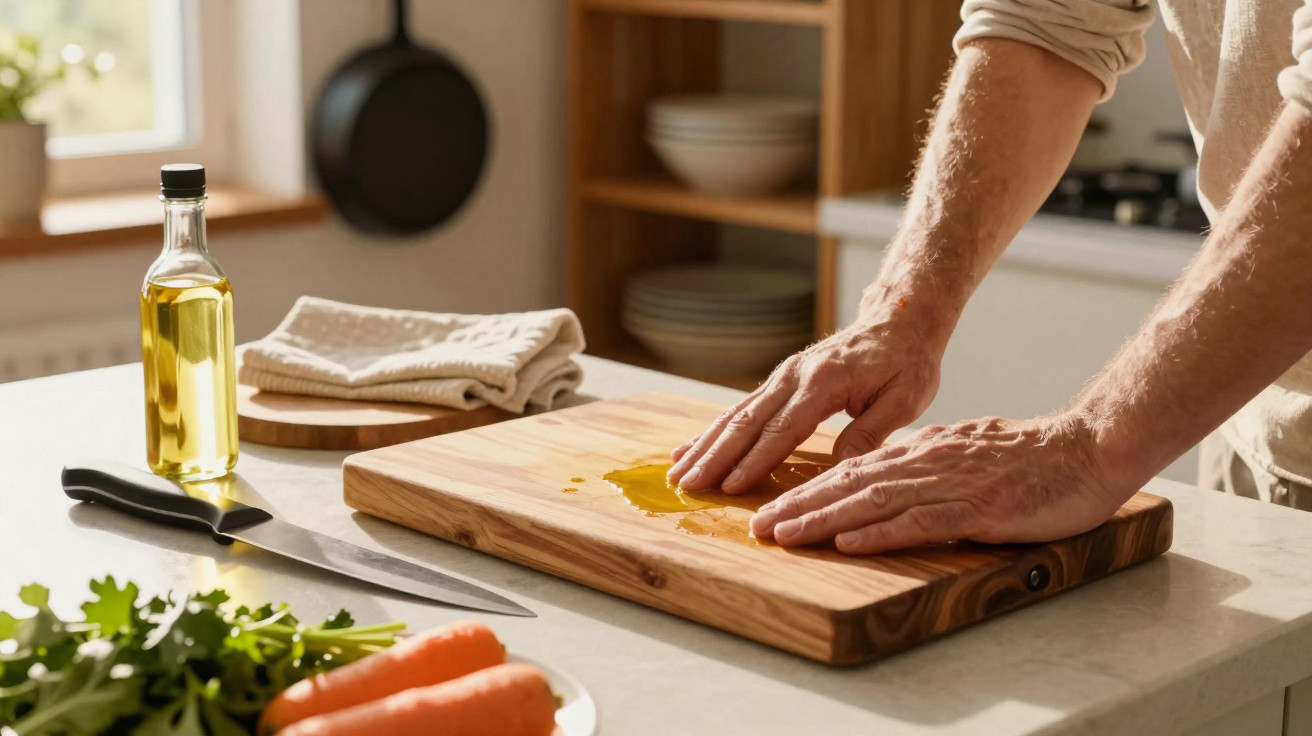
For a heavily used board, apply a light coat of food-grade mineral oil once a month; for more occasional use, every two to three months is sufficient. Grapeseed oil, olive oil and sunflower oil should be avoided, as they eventually turn rancid and may leave a lingering smell. Pour on a few drops, spread them using a lint-free cloth, paying particular attention to the edges and knife-marked areas, then leave the oil to soak in overnight. In the morning, wipe away any excess. The wood will regain a richer colour and discreet protection.
For extra protection, a balm made from mineral oil and beeswax forms a longer-lasting barrier. It is especially useful in winter, when indoor air becomes dry. A well-conditioned board absorbs less water, making it less likely to warp. A cabinetmaker often sums it up like this:
“A board does not need much care, only regular care without rough treatment.”
- Clean promptly after use, without prolonged soaking;
- Dry it upright rather than leaving it flat against the sink;
- Oil it whenever the wood looks pale, rough or thirsty;
- Keep the board away from the dishwasher and intense heat.
An old board also reflects the way you cook
A board that lasts twenty years is not necessarily one that still looks new. It may show carrot marks, a small cut left by an over-enthusiastic knife, or perhaps a lighter patch after vigorous cleaning. These signs are not flaws: they create its patina. If a garlic or onion smell lingers, a mixture of coarse salt and half a lemon can freshen the surface before a brief rinse and thorough drying. For more stubborn stains, gentle sanding with fine paper will often give it a new lease of life.
The choice of board matters too. Thick models made from dense wood with sound glued joints generally stand up to the years better than lightweight, cheaply sold versions. An end-grain wooden chopping board, identifiable by the small squares of visible fibre on its surface, is often gentler on blades and highly robust, although it requires a little more care. An edge-grain board remains an excellent everyday kitchen companion. Above all, the right model is the one you want to use and then put away properly.
There is something rather reassuring about objects that grow old with us. A casserole dish, a knife or a table can be passed on; a chopping board can be too, if it has been treated with respect. Before replacing it at the first sign of warping or marking, it is worth taking a closer look: is it genuinely cracked, or merely dried out? A little oil, time and a few gentler habits can sometimes save this quiet companion. The next time it is brought out to slice freshly baked bread, it may almost look new.
| Key point | Detail | Added value for the reader |
|---|---|---|
| Avoid the dishwasher | Heat and rapid drying cause the wood fibres to move. | Greatly reduces the risk of cracking and warping. |
| Dry on its edge | Air can circulate over both sides after washing. | Prevents the board from warping over time. |
| Oil regularly | Use food-grade mineral oil, then wipe away the excess. | Protects the wood from water, stains and drying out. |











Comments
No comments yet. Be the first to comment!
Leave a Comment