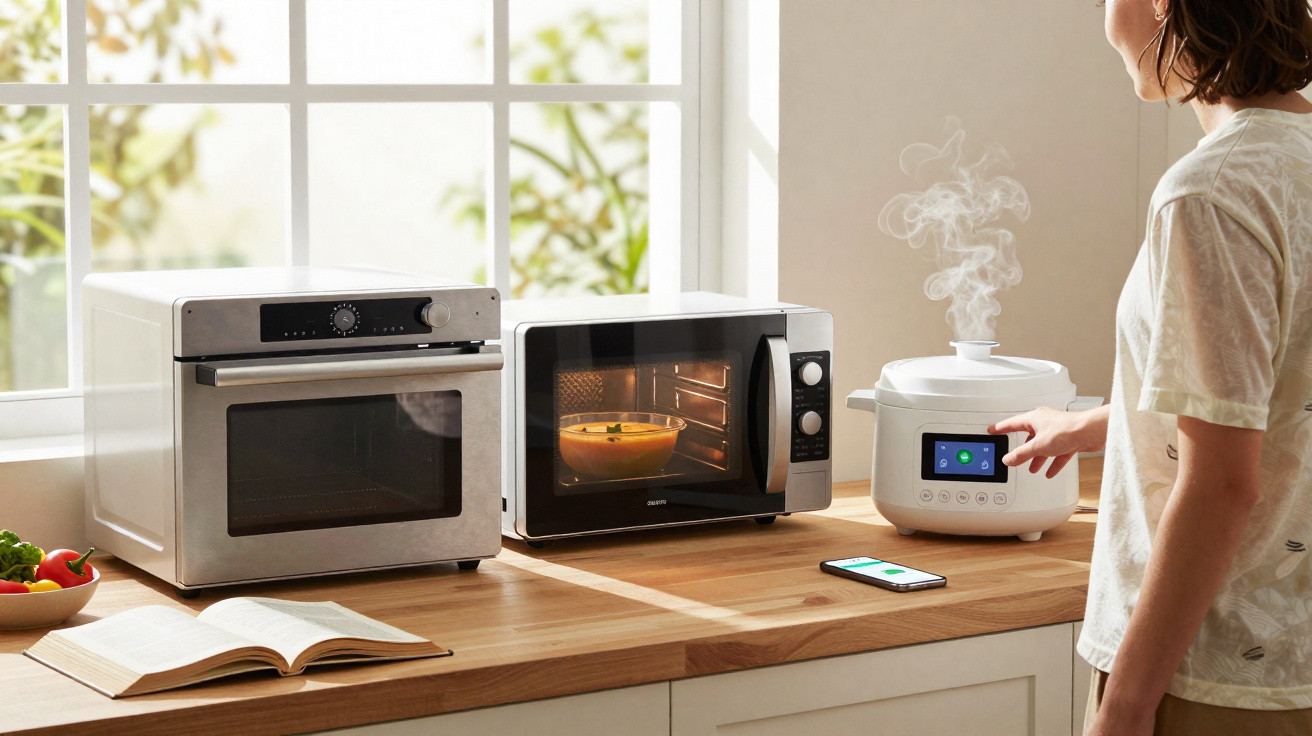
In France and the Czech Republic alike, cooking habits are changing as more versatile appliances arrive in kitchens.
Published on 14 May 2025, the source article examines the growing interest in several appliances that can reheat, cook and brown food. It refers in particular to practices seen in the Czech Republic, where some households are choosing options other than the microwave.
An appliance still found in many kitchens
For many households, the microwave remains the obvious choice. It can quickly heat a ready-made meal, defrost certain foods and prepare straightforward recipes. Its compact footprint and ease of use account for its lasting place on kitchen worktops.
Its origins date back to 1947, although it became widespread in private homes much later. Early models took up a great deal of space. Today’s appliances are considerably more compact, and some offer grill, defrosting or automatic cooking settings.
A microwave warms food using non-ionising electromagnetic waves. When an appliance is in good working order and used in line with its instructions, these waves do not alter the DNA of either food or the people using it. Discussions about this appliance remain common, even though its operation is subject to safety standards and checks.
The real shift is not simply about reheating speed: it is about seeking appliances able to carry out more tasks within one kitchen.
The convection oven, an option for better browning
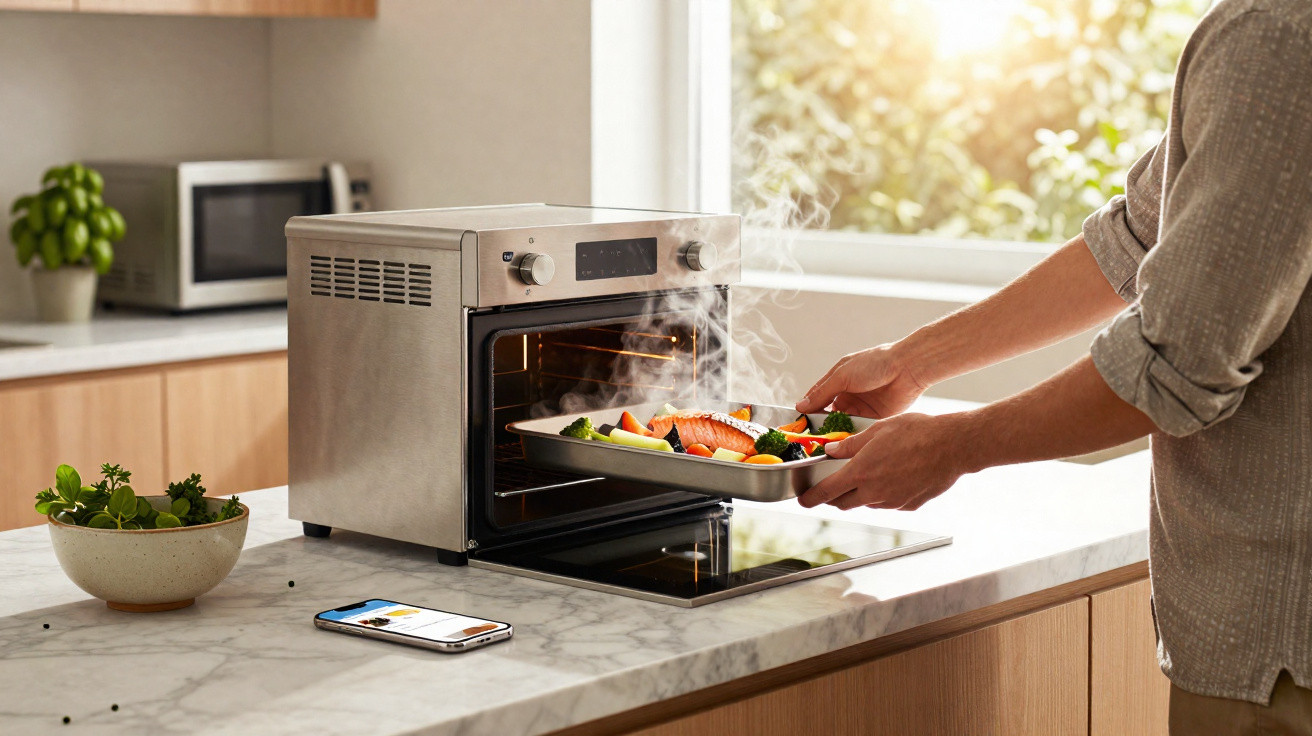
One of the alternatives highlighted by the source article is the fan-assisted convection oven. Its operating principle is straightforward: a fan circulates hot air around the cavity. This movement is intended to distribute heat more evenly around the food.
This type of oven meets needs that a microwave does not always address. In particular, it can help create a crispier finish on certain dishes. Gratins, roasted vegetables, pastries and cuts of meat can therefore achieve results closer to those from a conventional oven.
Different uses for different meals
A convection oven does not necessarily replace a microwave for every task. Heating a mug of drink or a small serving of soup is generally quicker in a microwave. However, when a meal needs reheating while retaining a browned or crisp texture, a fan-assisted oven may be the more suitable option.
- A microwave prioritises speed for small portions.
- A convection oven provides more even cooking.
- Hot-air circulation encourages the browning of certain foods.
- The choice depends on the size of the dish and the desired result.
The source article also suggests that these appliances can retain the flavours of prepared dishes. In practice, results depend mainly on the recipe, cooking time, chosen temperature and the amount of water in the food.
The smart multicooker is gaining ground
The other appliance brought to the fore is the smart multicooker. This term describes equipment combining several preparation methods: slow cooking, steaming, simmering, keeping food warm and, depending on the model, pressure cooking or an air-frying function.
Its appeal lies in its versatility. While a microwave is mainly used for reheating or defrosting, a multicooker can prepare an entire meal. It can be used for soup, a slow-cooked dish, rice, steamed vegetables or recipes requiring long cooking times.
A multicooker does not meet the same need as a microwave: its main purpose is to bring several cooking methods together in a single appliance.
This distinction is crucial before making a purchase. Someone who only wants to heat up lunch leftovers will not necessarily gain an immediate benefit from replacing their microwave. Conversely, a household that cooks regularly and lacks the space for multiple appliances may regard it as a practical option.
Energy consumption should be assessed according to actual use
The source article presents these appliances as solutions capable of saving energy. That claim needs qualification: consumption varies according to the appliance’s power, how long it is used, the quantity of food cooked and the programme selected.
A small-capacity appliance may prevent the need to heat a large oven for a limited serving. On the other hand, long cooking in a multicooker or fan-assisted oven uses electricity throughout the cooking period. Comparing energy labels, reading the instructions and matching the appliance to the meal size remain the most practical ways to reduce costs.
What role do these appliances have in France?
In France, the microwave remains a common appliance, but kitchens also contain fan ovens, steam cookers, multicookers and hot-air cooking appliances. None of these appliances performs exactly the same role.
The decision often comes down to household habits. For meals prepared in advance, the microwave retains a speed advantage. To cook complete dishes, a multicooker can avoid the need to take out several saucepans. To restore crispness to a pizza, vegetables or a gratin, a convection oven will often be the more appropriate choice.
Maintenance must also be considered. Food splashes inside a microwave need regular cleaning. A convection oven, meanwhile, requires its rack, tray and cavity to be cleaned. With a multicooker, particular care is needed for the seal, lid and inner pot to prevent lingering odours.
The microwave will not disappear overnight
The source article considers that these newer appliances may gradually change habits. This trend appears to be driven primarily by the search for versatility. Consumers sometimes want equipment that does more than reheat food, allowing them to cook, simmer, grill or retain a pleasant texture as well.
Even so, the microwave remains hard to replace for certain everyday tasks. Quickly heating leftovers, melting butter or defrosting an ingredient are uses for which it remains convenient. The appliances mentioned therefore do not necessarily signal its disappearance; instead, they offer different ways to organise meals and kitchen space.










Comments
No comments yet. Be the first to comment!
Leave a Comment