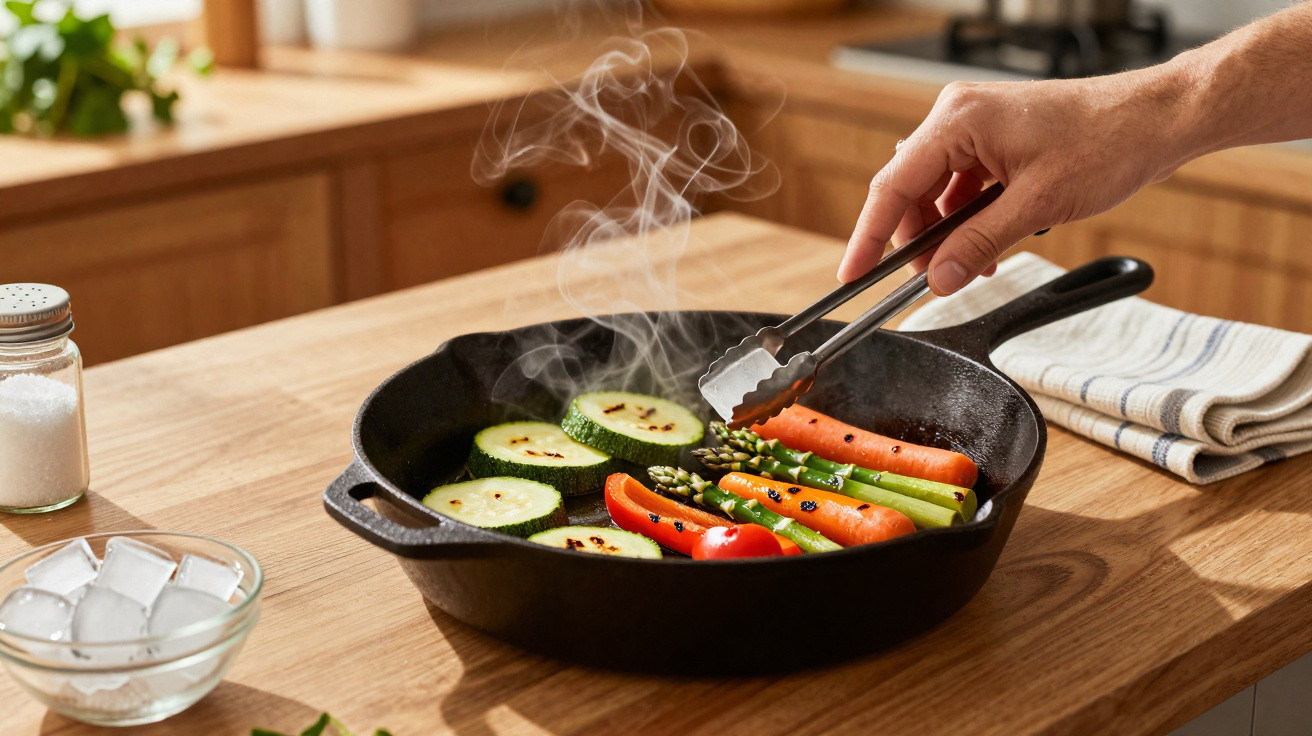
An ice cube in a hot frying pan may sound unusual before grilling vegetables, yet the brief thermal shock can help even out the heat across the cooking surface. Used with a suitable pan and careful attention to steam, this method can produce vegetables that are browned outside, tender inside, and free from patches that are burnt in one area and undercooked in another.
Why rub ice over the frying pan before adding vegetables?
As the ice meets the heated pan, it turns to vapour almost at once, spreading steam across the surface. This short contact may help reduce uneven hot spots, which often occur when a pan becomes hotter in the centre than around its edges.
Once the steam has cleared, the frying pan remains hot and ready for the olive oil and vegetables. The idea is not to cool the pan down, but to condition the metal so the vegetables grill more evenly from their first contact with the surface.
Which frying pans work best for this technique?
This approach works particularly well with cast-iron and stainless-steel frying pans, as both materials store heat and cope better with sudden temperature changes. Their cooking surfaces stay hot even after their brief contact with the ice.
- Cast iron holds its heat for longer and encourages deeper browning.
- Stainless steel heats effectively and allows vegetables to be grilled over a medium-high heat.
- Thick-based non-stick pans require care and should only be used occasionally.
- Thin or scratched non-stick pans should be avoided for this trick.
How can you use the ice cube without getting burned?
Steam rises quickly and can scald your hands, face or forearm if the ice is handled carelessly. For that reason, hold the cube with kitchen tongs or a holder, rather than touching it directly with your fingers.
- Heat the frying pan over a medium-high heat for 2 to 3 minutes.
- Grip the ice cube securely with tongs.
- Move the ice around in quick, circular motions.
- Do not leave the cube sitting in one spot in the pan.
- Wait for the steam to subside before adding olive oil and vegetables.
Which vegetables are best with the ice cube in a hot frying pan?
Firmer vegetables with a lower water content generally react best to the thermal shock. Courgette, aubergine, thinly sliced carrot, asparagus, peppers and thoroughly dried mushrooms develop a browned surface without breaking down as quickly.
Tomatoes, cucumber and very wet vegetables release too much liquid, which can reduce the frying pan's temperature. To prevent this, dry the vegetables with kitchen paper before grilling and cut them into similarly sized pieces.
How do you achieve a crisp exterior and tender centre?
After using the ice, add only a little olive oil and arrange the vegetables in a single layer. If the frying pan is overcrowded, the vegetables give off excessive steam, cook rather than brown, and lose the characteristic grilled texture.
The ideal result is reached when the outside develops golden-brown marks while the centre still retains moisture. The ice cube helps at the beginning of the process, but the final outcome relies on a hot pan, dry vegetables, gaps between the pieces and carefully controlled heat.








Comments
No comments yet. Be the first to comment!
Leave a Comment