It tends to happen on a peaceful Sunday, while you are slowly stirring something rather self-satisfied in a weighty pan. The radio murmurs away, steam clouds the kitchen windows, and your favourite wooden spoon – the one used for every soup and every midnight pasta – sits perfectly in your hand. Then, a few weeks on, you spot it: a fine split across the spoon’s bowl, resembling a miniature fault line. All at once, it seems worn out and frayed around the edges, rather like you do on a Wednesday morning.
Most of us simply carry on using it, perhaps promising ourselves we will pick up a replacement whenever we remember. Yet cooks and grandmothers have quietly shared a useful trick for years: soak wooden spoons in cold salted water. It may sound strange, almost like a piece of kitchen folklore. But this uncomplicated habit can help prevent spoons from splitting, for reasons that are more pleasing than they initially seem.
The day my wooden spoon gave up
I learned my own lesson about wooden spoons when my favourite one finally broke. I was scraping a risotto pan clean, with the rice catching a little and giving off that gentle toasted scent, when its handle simply… gave way. The crack made a brief, sharp noise that seemed absurdly loud in my small flat kitchen. Holding the two pieces, I felt as though I had broken something more meaningful than an old bit of wood.
It was only a spoon, yet I had owned it for years. It had stirred panic pasta at 2 a.m., ambitious stews made to impress dates, and lukewarm custard after I had misread a recipe by a truly alarming amount. Everyone has experienced an ordinary possession unexpectedly taking on the weight of an entire period of life, only to vanish in a single snap. That night, I ate my slightly overdone risotto with an unattractive metal spoon and felt quietly let down.
A week later, while complaining about it to a friend who genuinely knows her way around a kitchen, I received my first instruction. “You don’t soak your wooden spoons?” she asked, with the same appalled tone normally reserved for somebody who does not salt pasta water. Somewhere between TikTok tips and artisan chopping boards, it seemed I had missed an old and remarkably straightforward piece of knowledge: cold salted water can help wooden spoons avoid cracking, warping and failing halfway through a stir.
Wood is alive, even when it’s in your cutlery drawer
The first point to grasp is that wood continues to act like wood. Even once it has been shaped, smoothed and sold in an attractive kitchen shop, it responds to the conditions around it. It swells as it absorbs water, before contracting as it dries. The movement is minute but ongoing, and eventually it puts pressure on the grain’s fibres – particularly when a spoon is repeatedly submerged in hot food before being left to dry beside the sink.
Think of the warped chopping board that wobbles as you slice a tomato. It comes from the same problem: drastic shifts in temperature and moisture make wood expand and contract unevenly until it distorts. On spoons, that stress commonly emerges as fine cracks through the bowl or at the point where the handle joins the head. It begins as a faint line, develops into splintering, and before long your familiar, reassuring utensil feels unreliable and delicate.
Honestly, hardly anyone considers wood’s emotional existence while washing up. We toss the spoon into hot, soapy water, leave it sitting there, and then dry it beside a warm radiator or on a sunny sill. It has little chance. The cold salted water method is useful here – not as a Hogwarts-style spell for spoons, but as a means of easing that relentless cycle of expansion and contraction.
So what does cold salted water actually do?
Cold salted water supports wooden spoons in two understated, gradual ways. To begin with, the lower temperature slows the process. When wood encounters heat, its fibres shift faster, water moves in and out more rapidly, and swelling and shrinking become harsher. Cold water is more gentle. It allows moisture to enter the wood slowly and evenly, meaning the grain is not pulled about with such force.
Salt is the second part of the process. In water, salt alters the movement of moisture both within the liquid and inside the wood. A mild saline solution helps moderate how much water the wood takes on, rather like a traffic warden controlling countless tiny water molecules attempting to force their way into the spoon. This leaves the wood at a steadier moisture level – neither completely dry nor saturated, but comfortably balanced.
A tiny shield for your favourite spoon
Soaking a new wooden spoon in cold salted water before its first use essentially gives it a controlled, unhurried drink. Its fibres take in a consistent amount of moisture, making them less likely to greedily absorb hot liquid when you first stir a simmering stew. It is rather like stretching a pair of jeans in advance, so they do not shrink and twist only once they are on your body. That first soak can help the wood settle more evenly.
Repeating the treatment occasionally may, over time, prevent the spoon from becoming excessively dry between uses. Dry wood is brittle, and brittle wood is prone to cracking. A spoon kept faintly hydrated – in a measured way rather than left soaked and neglected – is generally more resistant to splitting. It is a modest, almost ceremonial gesture that tells your kitchen tools you would like them to remain around.
Why salt, and not just plain water?
A wooden spoon could be soaked in ordinary cold water, and it would offer some benefit. The timber would absorb moisture and settle slightly. Salt, however, makes a subtler difference. It changes the osmotic pressure between water in the bowl and the wood’s own natural moisture. In practical terms, this creates a slower, more regulated exchange – less upheaval and fewer abrupt changes.
Salt also offers a mild antibacterial effect. Wood is naturally fairly effective at dealing with bacteria, but spoons come into contact with all sorts of things: raw egg, sauces and, during a rushed evening, meat juices. A weak salt solution makes the setting slightly less hospitable to anything you would not want remaining in the grain. It is not a complete sterilising method, but it is a helpful step in the right direction, especially for utensils that spend much of their lives a little damp.
A kitchen ritual that actually fits real life
This is where much “perfect kitchen” guidance breaks down: it fails to account for how people really live. We are instructed to oil wooden spoons weekly, wash every item by hand immediately, never allow anything to soak, and dry each utensil tenderly with a soft cloth as though it were a newborn kitten. Then everyday life intervenes. A pan bubbles over, the dog needs to go outside, a text demands an answer, and the spoon ends up sulking in hot, sudsy water.
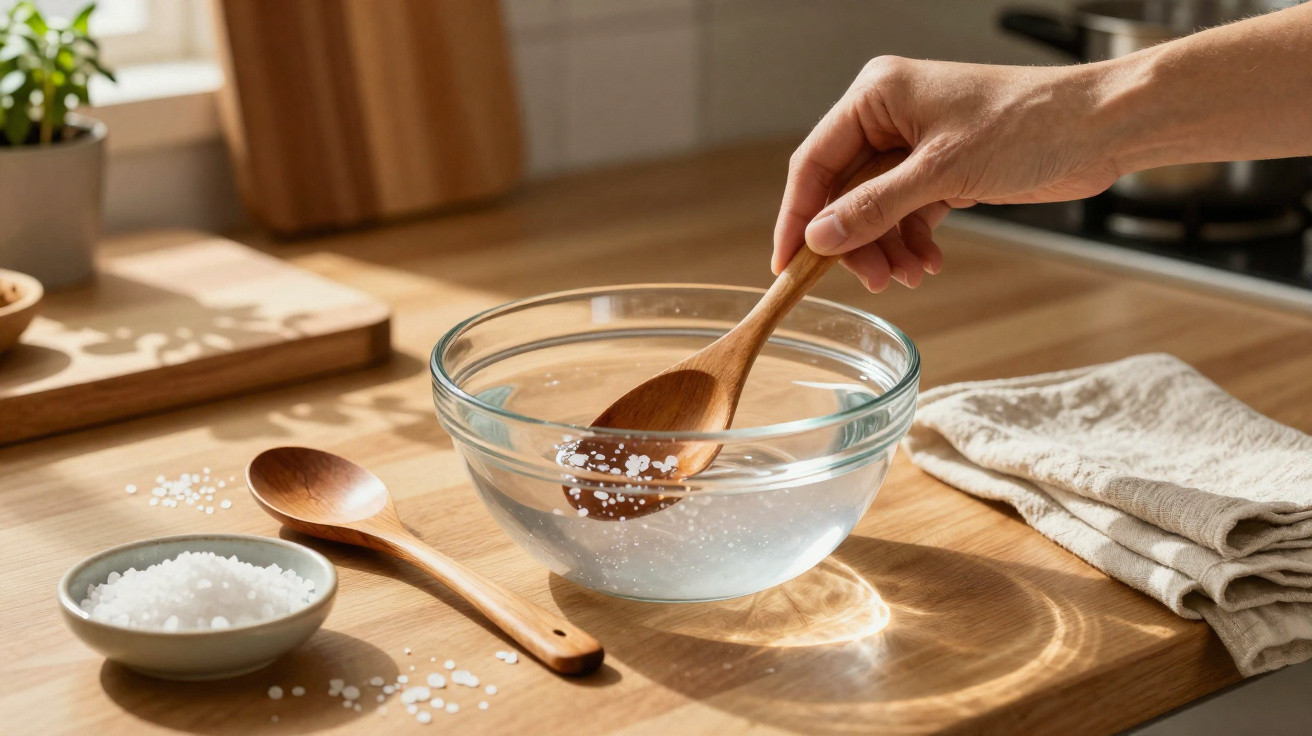
The appeal of the cold salted water approach is that it does not require saintly behaviour. Fill a jug or mixing bowl with cold water, mix in a spoonful of salt, then leave your spoons in it for twenty minutes while you clear the kitchen or scroll through the news on your phone. There are no exact quantities, specialist products or unusual tools involved. It is simply an effortless routine that quietly acknowledges the material from which your utensils are made.
How to actually do it (without turning it into a chore)
There is no formal ritual to follow, though a basic routine helps. When you buy a new wooden spoon, give it an initial bath: use a bowl of cold water with a generous teaspoon or two of salt, enough for the water to taste gently briny when you touch a finger to it. Leave the spoon submerged for 20–30 minutes, remove it, dry it with a tea towel, and allow it to air-dry completely, standing upright if possible. That is its introduction to the household.
For the spoons already in your kitchen – whether they are showing early splits or are dependable tools used daily – repeat the soak every few weeks. A brief immersion will do. Do not leave them for hours; the purpose is mild hydration and stabilisation, not a swollen, waterlogged handle. Once soaked, dry them thoroughly and place them somewhere with enough air around them. Avoid cramming them into the base of an overcrowded utensil pot, where they remain damp against metal and silicone.
What about oiling, dishwashers and old damage?
Salted water cannot undo every offence ever inflicted on a wooden spoon. If yours have already endured a dozen dishwasher cycles, their fibres may be severely strained, while deep cracks are unlikely to close on their own. A dishwasher subjects wood to hot water, strong detergent and intense drying – effectively the opposite of what this gentle, cold soaking treatment aims to do. So, however tedious it may sound, the first rule is to keep wooden spoons out of the machine.
Oiling can be beneficial too, especially with food-safe mineral oil or a dedicated board oil. It retains some moisture, slows down evaporation and gives the surface a smooth, almost silky finish. A salted-water soak and oiling work particularly well together: hydrate the wood first, let it dry until only slightly damp, then apply oil to retain that balance. Of course, plenty of people never quite get round to oiling anything. An occasional quick saline soak at least gives your spoons some chance of survival.
The secret softness of small rituals
There is something unexpectedly soothing about standing at the sink, stirring salt through cold water and lowering in a spoon that has served you for years. It is neither a grand gesture nor a major life improvement. It is simply a small decision to look after something you handle almost every day. The soft scrape of wood on ceramic, the cloudy swirl of water and salt crystals melting like slow snow can all make the kitchen feel quieter for a moment. It becomes a small pause in a room that usually requires speed.
These modest rituals distinguish a merely functional house from a home that feels lived in. You begin to see the spoon’s grain, the worn tip that has struck pan bottoms a thousand times, and the gentle staining left by tomato sauces and curries. Every mark turns into evidence not of deterioration, but of usefulness. A cared-for spoon feels different in your hand, like it’s working with you rather than being dragged reluctantly through the sauce.
Why this odd trick feels oddly comforting
At face value, soaking wooden spoons in cold salted water is simply a practical tip: fewer cracks, fewer splinters and a longer working life for inexpensive utensils. Beneath that, it connects with something more human. We live among objects designed to be discarded and replaced at the first hint of wear. Helping an unassuming spoon last a few more years through gentle care is a small act of resistance to that idea. It chooses continuity instead of convenience.
There is also quiet pleasure in understanding the reason behind the method, rather than repeating a viral tip without thinking. Wood shifts, water settles it, and salt moderates it. The science is not complicated enough to require a lab coat, but it is genuine, and understanding it makes the process feel less superstitious and more respectful of the material. You are not merely obeying your grandmother’s advice; you are carrying it on with greater awareness.
Keeping the crack from becoming a goodbye
The first crack in a wooden spoon need not signal its final days. If the split is small and shallow, repeated cold salted soaks, careful hand washing and occasional oiling can help keep it from widening. The line may not disappear, but it can be prevented from becoming a canyon. Like a wrinkle on a face, it shows use rather than immediate decline. The spoon may still have plenty of stirring to do.
When I eventually bought a replacement for my broken spoon, I soaked it that same evening and watched small air bubbles cling to its grain while the water gradually became still. It felt slightly absurd, but also quietly appropriate. None of my spoons have split since, and I no longer regard them as disposable extras. That simple bowl of cold salted water turned out to be less a hack, and more a way of saying: you matter, stay a while.
The next time you are washing up after a slow Sunday stew, look at the wooden spoon in your hand. If it is beginning to appear a little weary or slightly lined, give it that brief, briny bath. Your future self, standing over some bubbling pot on a grey evening, will be oddly grateful that you did.












Comments
No comments yet. Be the first to comment!
Leave a Comment