The sound came first: a beep.
Then came the lasagna, only half warm.
It was a Tuesday evening, one of those nights when you arrive home worn out and want dinner to be hot, quick and reassuring. The microwave buzzed, rotated and whirred, yet somehow produced a meal that was scorching around the edges and frozen in the middle. It was the sort of supper you eat on your feet while looking at your phone, convincing yourself that it does not matter.
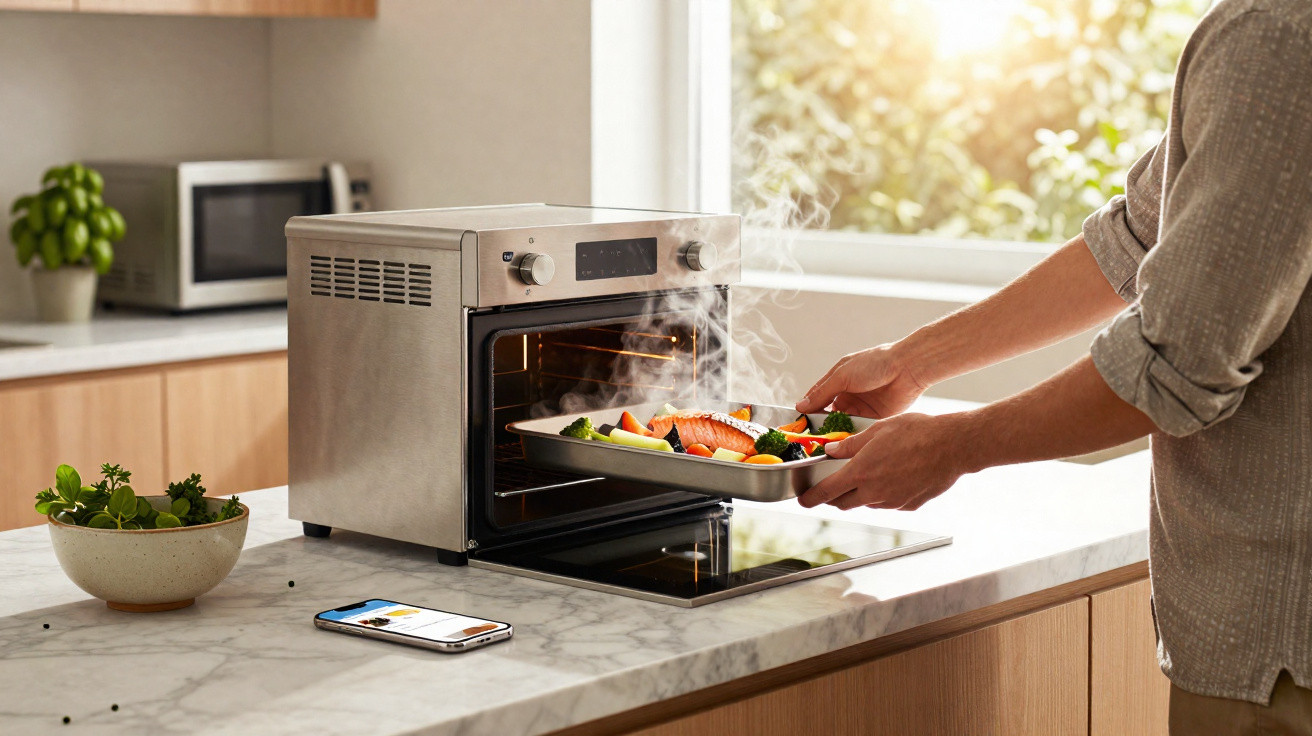
This time, though, there was a change. Beside the weary old microwave on the worktop, a new appliance was humming softly. There was no noisy fan and no gloomy revolving turntable. Instead, there was a gentle light and a promise: crisp, succulent, evenly heated food in minutes, without blasting away the flavour.
It was a modest revolution, plugged into an ordinary socket.
The subtle rise of the “microwave killer”
Visit any fashionable kitchen shop today and a curious trend becomes clear. The microwave displays that once filled the walls are getting smaller. Their place is being taken by neat, box-shaped appliances with glass doors and polished controls. They resemble tiny ovens, yet their cooking feels almost futuristic.
This emerging favourite is called the countertop combi-oven. It uses high-speed convection, grill elements and, on some models, steam. There is no radiation, no sodden leftovers and no unexplained patches that are simultaneously hot and cold. Instead, it delivers regulated heat that treats food properly.
It makes no fuss; it simply performs the task that your microwave always claimed it could do, but rarely managed well.
Imagine the scene. It is 7:43 p.m., you are ravenous, yesterday’s roast chicken is in the fridge, and you are moments away from putting it in the microwave and accepting a rubbery dinner. This time, you place it in a compact combi-oven instead.
Eight minutes later, the skin is golden and crackling audibly, while the meat remains juicy. The chips placed beside it are genuinely crisp. The vegetables have not collapsed into dreary grey mush. Sitting down to eat, you may be startled to find that leftover night now tastes like a second Sunday lunch.
For many people who try these appliances, that is when the microwave gets unplugged for good.
On the face of it, the technology is straightforward. A fan circulates hot air at speed, cooking food more rapidly and evenly than a conventional oven. An element above the food browns and grills, while certain models add steam to retain moisture. As a result, frozen pizza, roast vegetables, grilled salmon, reheated pasta and even cakes can all be prepared in the same appliance.
Speed is not the only significant distinction: texture is. Microwaves excite water molecules from within, leaving bread chewy and chips limp. High-speed ovens work from the outside in, creating a crust, colour and flavour.
Once you have become accustomed to that result, returning to a microwave can feel rather like watching VHS in a 4K world.
How a countertop combi-oven becomes part of everyday life
The change rarely begins with a grand declaration about altering your lifestyle. More often, it starts with a single small habit: warming up everything in the combi-oven rather than in the microwave. Put in your plate, press “reheat”, and the appliance takes care of the rest through circulating heat and intelligent temperature control.
At first, you may stand and watch it with suspicion, much like somebody uncertain about trusting a self-driving car. Then you find that the pasta is warmed right through, the cheese has properly browned and the sauce has not splattered across the plate.
After a week or so, the microwave door is hardly opened. It remains there as a large, beeping relic.
Naturally, there is an adjustment period. You may scorch your first batch of toast or misjudge how swiftly chicken wings move from “golden” to “oops”. Forget that fat drips, and you will have more cleaning to do than expected. We have all had that thought: “Maybe my sad old microwave wasn’t so bad.”
The real breakthrough comes when you start using the presets: reheat, air-fry, roast and bake. These settings are intended to remove the uncertainty. A chilled slice of pizza takes four to six minutes. Frozen vegetables can go directly from bag to tray without defrosting, and still retain some bite.
All at once, you are not really “cooking”; you are pressing a button and receiving food that tastes as though you made an effort.
Let us be truthful: hardly anyone cleans a microwave thoroughly every day. The familiar splashes on its ceiling, dried-on sauce at the sides and lingering, inexplicable smell of popcorn all become part of the furnishings.
With newer combi-ovens, manufacturers recognised one essential point: if cleaning is difficult, people will return to their old habits. They have therefore included crumb trays, non-stick interiors, removable racks and even brief cleaning programmes. Wipe it quickly while it is still warm, and it can look almost as new as it did in the showroom.
“We saw people using their microwaves for everything because it was easy, not because they liked the results,” explains a product designer at a major kitchen brand. “Our goal was to make the ‘better’ option just as brainless as pressing 30 seconds on a microwave.”
- A dedicated “reheat” setting that helps food stay moist
- An air-fry function for chips, nuggets and vegetables
- A compact footprint that can replace both a microwave and a toaster oven
- Less energy use than a full-size oven when preparing small meals
- Cleaning features designed around genuinely busy lives
Are we truly prepared to give up the microwave?
For many households, the microwave carries more emotional weight than practical value. It evokes student days, instant noodles, warmed-over coffee and first flats lived in alone. Replacing it can almost feel disloyal. Yet it is not usually thrown away immediately. First, it is unplugged “to make room”, the new appliance is slid into its place, and you tell yourself that it is only a trial.
Over the following weeks, that experiment turns into a routine. Your children discover that frozen fish fingers can actually be crunchy. Reheated takeaway tastes remarkably close to freshly bought takeaway. Leftover roast potatoes no longer perish in a puddle of steam.
One morning, you notice that the microwave has become a collector of dust. No one reaches for it any more. That is how revolutions tend to happen: not through a dramatic bang, but through a quiet disappearance of interest.
| Key point | Detail | Value for the reader |
|---|---|---|
| Better texture than microwaves | Crisp on the outside and moist within, using high-speed hot air and grill elements | Food that genuinely tastes and feels freshly cooked rather than rubbery or limp |
| Everyday ease | Straightforward presets for reheating, roasting and air-frying everyday foods | Less uncertainty, fewer cooking mishaps and quicker weekday evening meals |
| Space and energy saver | A single appliance replaces a microwave + toaster oven and uses less energy than a full oven | Clearer worktops, lower bills and a more streamlined kitchen |










Comments
No comments yet. Be the first to comment!
Leave a Comment