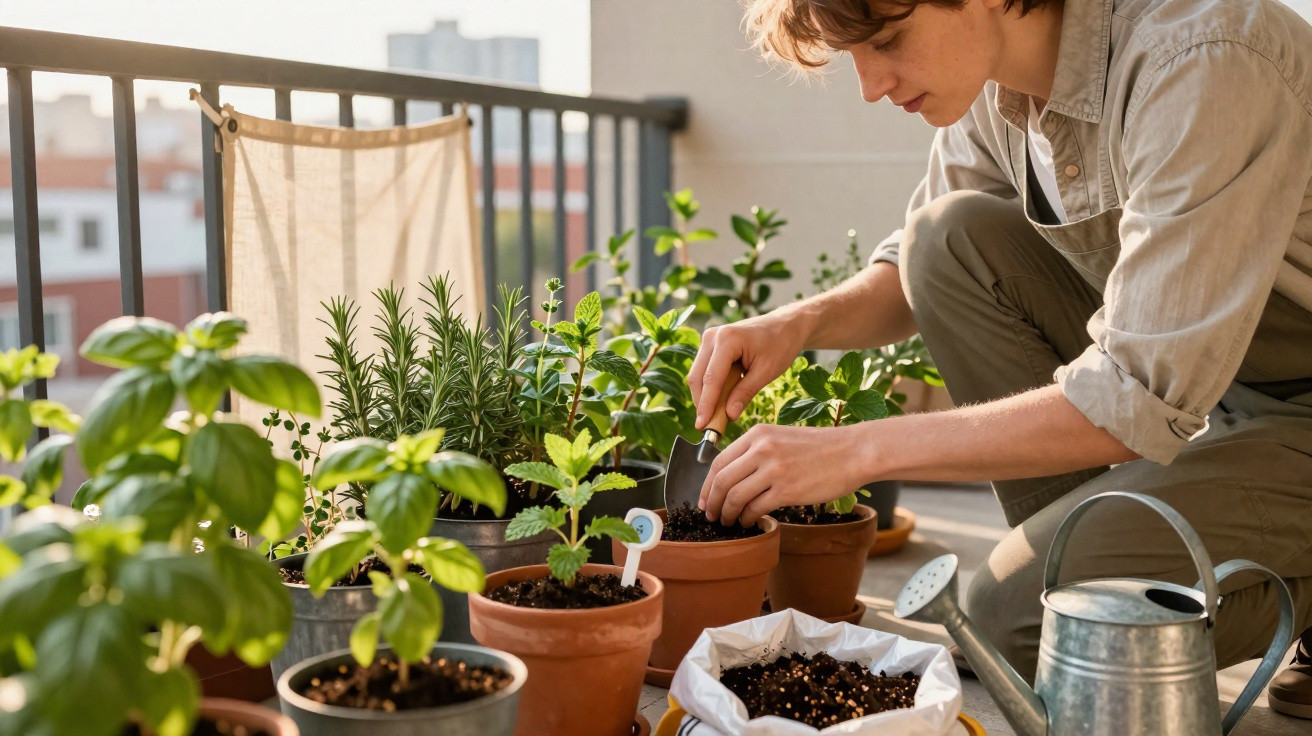
Basil is always the first to give in. In the morning, it still looks as though it belongs in a cookbook photograph; by evening, it is drooping limply over the edge of its pot as if someone has let the air out. Beside it, thyme is struggling too, with dry tips and clumpy compost that is either hard as concrete or completely waterlogged. We water, move the pots around, talk to the plants – and wonder why the herbs in the neighbour’s flower bed look as if they belong on an Italian postcard while our balcony is in survival mode. At some point, you find yourself muttering: “Maybe it isn’t me – maybe it’s the pot.” The truth is that balcony herbs follow different rules. And nobody really explains that clearly beforehand.
Why herbs in pots on the balcony so often struggle
Anyone who has put a hand into a garden bed notices the difference immediately. The soil is alive: it has spring to it and smells rich and warm. On a balcony, potting compost is more like a restricted container: there is little room, it is quickly leached out and easily overwhelmed. Roots soon reach the sides, then circle around rather than finding their own way forward. For the plant, it is like living in a flat that is too small and has poor windows. You might survive there, but truly thriving is another matter.
A familiar balcony scene: it is May, the first sunshine has arrived, and a weekend trip to the garden centre ends with basil, parsley, chives and rosemary in the trolley, all in attractive little plastic pots next to the strawberries. At home, they go into one large planter, packed tightly together. It looks brilliant on Instagram – at least for the first few days. Two weeks later, the basil has yellow leaves, the parsley is collapsing, and the compost is dusty dry at the top but soaking wet below. According to an internal survey by a major garden centre, most purchased herbs die on balconies within six weeks. It is not through bad intentions. It is simply a system never designed for the long haul.
In a garden bed, herbs have what feel like endless reserves: moisture spreads more evenly, nutrients rise from deeper layers and temperature peaks are softened. In a pot, every condition is more extreme. Sun can dry out the small volume of compost within hours, rain can wash through the drainage holes, and every watering flushes nutrients away. A pot is like a mini ecosystem with a very fragile nervous system. Then there is heat building up against house walls, gusts of wind and reflective railings. No wonder basil is the first to say: “Everyone, I’ve had enough.”
How to help balcony herbs feel as though they are growing in a bed
The most important step is not particularly glamorous: choose larger, deeper containers. Forget decorative pots that merely look good; use containers with enough capacity. Allow at least ten litres for a vigorous basil plant, and choose an even larger tub for rosemary or sage. Put a layer of expanded clay or coarse gravel at the bottom, then add a mix of quality herb compost and ordinary garden soil, with some sand if needed for drainage. This gives the root zone more of a “horizon”. Rather than stopping after five centimetres, roots can suddenly stretch out as they would in a garden bed.
Most people water herbs when the plants start to look pitiful. In other words, far too late. Or they water every day out of a sense of duty – and drown the roots. Let us be honest: nobody actually pushes a finger into every pot each morning. A more practical approach is to follow a clear routine and make one simple check: push a finger two to three centimetres into the compost. If it is dry at that depth, water thoroughly until water runs from the bottom of the pot. Then wait again. No little sips and no permanently wet compost. Also, empty saucers after rainy days, otherwise the roots will be sitting in a miniature swamp.
“Most herbs do not die because people forget them – they die because people smother them with love,” an old gardener once told me at the edge of a market.
Her words may sound harsh, but they are a useful corrective. Anyone who genuinely wants to strengthen balcony herbs should focus on a few practical details that have nothing to do with romantic ideas of gardening:
- Mix up the positions: Not every herb belongs in the same blazing full sun. Mediterranean varieties enjoy heat, while parsley and mint prefer partial shade.
- Keep varieties separate: Do not plant thirsty herbs such as basil in the same pot as drier-loving types such as thyme.
- Prune regularly: Remove flowers from basil and chives so that their energy goes into the leaves.
- Feed lightly: Use organic fertiliser a few times each season instead of constantly adding liquid feed to the watering can.
- Allow some calm: Not every brown tip is a disaster. Plants are allowed to have an off day too.
The balcony as a small laboratory for thriving herbs
A balcony is rarely thought of as “ground”. It is more often treated as a stage for furniture, fairy lights and a few pots. Yet anyone who wants herbs in containers to look as vigorous as those in a garden bed needs to view it almost as an experimental garden laboratory. When does the sun reach each spot? Where does heat build up? Which corner catches the wind? Spend a day paying close attention and you will realise that a few square metres contain several tiny microclimates. Basil that dies against a hot house wall may suddenly thrive two metres away beside the railing.
Many unsuccessful herb projects begin with unrealistic expectations. We want supermarket basil to last for months, even though it has been grown to look its best at the point of sale – not two months later on a wind-exposed balcony. We put parsley in a south-facing spot because “lots of sun must be good”. We promise ourselves that next year we will plan everything better, only for another spontaneous garden-centre weekend to arrive in May. Recognising these quiet cycles is the real turning point.
Perhaps the most honest step is to see herbs in pots less as decoration and more as small living things with limits. They reward you when they are given more room, when five varieties are not crammed into one pot, and when mistakes are treated not as personal failure but as part of learning. Once you allow for that, it suddenly becomes deeply satisfying to snip a handful of home-grown thyme that comes not from a heroic battle for survival, but from reasonably stable conditions. And you start telling other people about it – because a good harvest is always a small secret worth sharing.
| Key point | Detail | Benefit for the reader |
|---|---|---|
| Container size and compost volume | Large, deep pots with a drainage layer and structurally stable compost are the closest match to a garden bed | Better root growth, less stress and fewer losses in heat or rain |
| Water and nutrient management | Finger test, thorough watering instead of constant wetness, and restrained feeding | Helps prevent root rot and deficiency symptoms, creating more resilient plants |
| Position and variety selection | Choose suitable herbs for sunny or shady spots, and separate thirsty from dry-loving varieties | Longer-lasting herbs, bigger harvests and less frustration after unsuccessful attempts |










Comments
No comments yet. Be the first to comment!
Leave a Comment