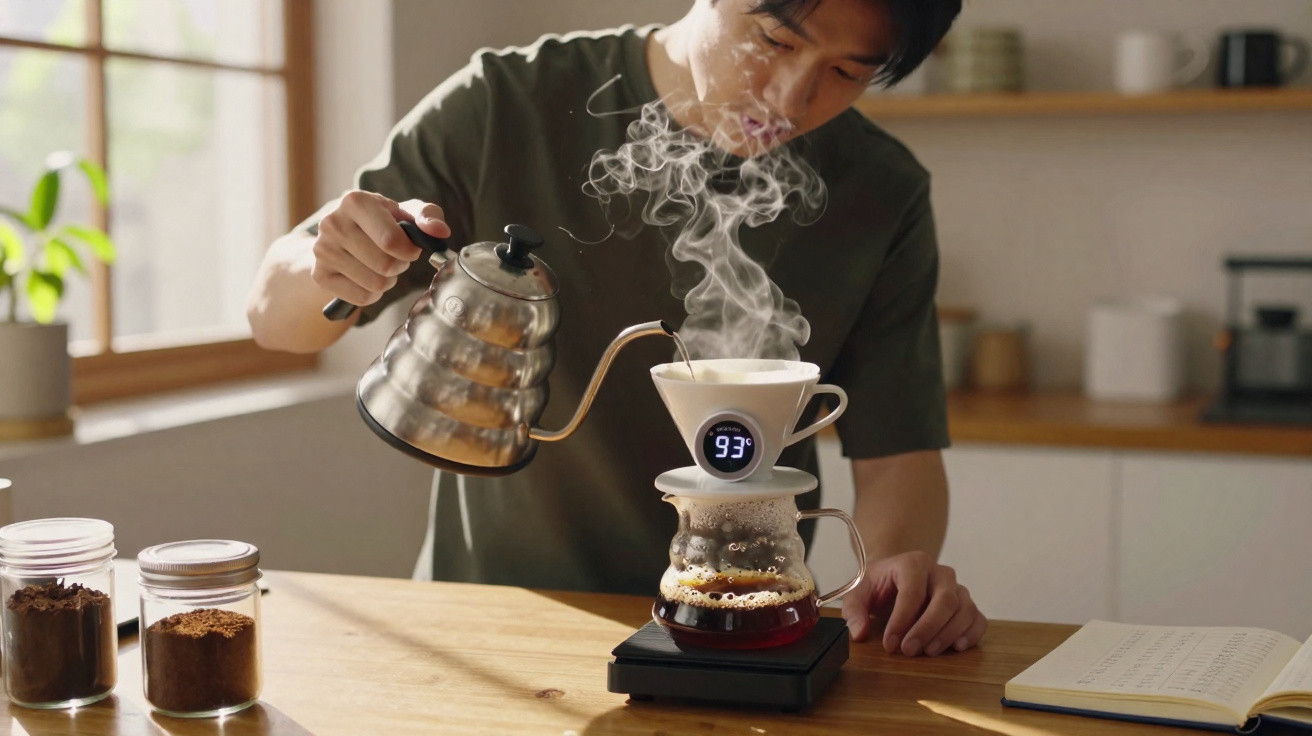
Most of us assume disappointing coffee comes down to the beans, the grinder, or the frantic dash out of the house while hunting for clean socks and keys. But a subtle culprit is displayed right on your kettle: temperature. That tiny figure determines whether your cup delivers chocolate and caramel or tastes like hot cardboard. Hardly anyone challenges it. We wait for the kettle to boil, point it vaguely at the mug and simply hope.
I gave it no thought either, until a barista in a small, steam-filled café told me with a surgeon’s gravity that five degrees could wreck a cup. Five degrees: less than the shift between a cold day and one warm enough to lose the jumper. That was when I understood that coffee temperature is not an obscure detail; it is the whole story, plainly sitting on the kitchen worktop.
Once you know the precise heat that unlocks the fullest flavour, your morning coffee never tastes quite the same again.
The day boiling water spoiled my favourite beans
My turning point arrived with a bag of ridiculously pricey Ethiopian beans. You know the sort: handsome matt packaging, tasting notes written like a wine menu, and an aroma that fills the air the instant you open it. I ground them with care, feeling rather pleased with myself, let the kettle boil until it clicked off and poured immediately. The smell seemed encouraging. Then I drank it.
It was thin, bitter and somehow sour too, as though the cup had been washed with lemon and the soap left behind. I looked at the mug in genuine confusion. These were beans that coffee-forum regulars argue over like football supporters. First I blamed the roaster, then the grinder, then my own taste buds. Temperature was the one thing I never considered. The kettle had boiled, so the task was complete, surely?
Later that week, I took the same bag into a speciality coffee shop and asked the barista where I was going wrong. He did not ask about my grinder or my method. Instead, he asked: “Are you pouring right after the boil?” When I said yes, he winced as if I had admitted to microwaving tea.
“Don’t ever pour at 100°C”
He delivered it almost like an admission: “Boiling water bullies coffee.” At 100°C, the delicate aromatics are scorched before they can dissolve as they should. Bitter compounds rush forward, like the loudest guest at a party, while softer, sweeter flavours remain behind. You end up with coffee that is forceful yet flat, a contradiction that makes perfect sense once you taste it.
He then made the same beans again, using the same grind and dose. This time, he waited for the kettle to cool and dipped a thermometer in and out like a chef. “Ninety-three degrees,” he said, before beginning the pour. Even before it reached the cup, the fragrance had changed: a gentle fruity sweetness that made every coffee I had prepared at home seem like a minor betrayal.
When I tasted it, I actually laughed. The bitterness had eased, the sharp sourness had softened, and a delicate berry note appeared that I could have sworn was absent five minutes earlier. Identical beans. Identical person. A different temperature. Suddenly, that dull kettle reading became the leading player in my morning routine.
The exact coffee brewing temperature sweet spot: 90–96°C
Ask a coffee professional for the ideal brewing temperature and the same range often comes up: 90–96°C. It is neither boiling nor tepid, but a narrow band most of us rush straight through. This is not a fussy rule designed to make you feel inadequate in your own kitchen. It is chemistry. Coffee consists of roasted plant material containing hundreds of compounds, each dissolving at a different speed according to the heat.
At too low a temperature, extraction is incomplete: the desirable sugars and oils remain in the grounds, while some acidity and harsher flavours slip into the cup. At excessive heat, you over-extract: tougher compounds burst out quickly and delicate volatile flavours are cooked away like steam from a saucepan. Within the 90–96°C zone, sweetness, acidity and body find balance rather than competing with one another.
Why 93–94°C can feel magical
Inside that range is a point many baristas quietly favour: roughly 93–94°C. Not because it was once written on a chalkboard, but because it repeatedly appears in cups that make people stop speaking halfway through a sentence. At this temperature, soluble elements including organic acids, sugars and aromatic oils extract effectively without carrying too many bitter tannins with them. It cannot promise perfection, but it gives you strongly improved odds.
You do not experience it as “93°C” so much as a change in character. Beans that felt sharp and jumpy at 96°C become softer and more welcoming. Chocolate flavours speak more clearly. Floral notes emerge where there was previously only a generic hot taste. It resembles tuning a radio that is just off-station: a slight turn transforms static into music.
We have all tasted a café coffee that seems absurdly good and assumed it must be down to some mythical machine beyond our budget. Quite often, the explanation is simply the steady discipline of reaching that temperature range every day, while at home we are blasting our beans into submission.
Different brewing methods have different temperature personalities
Here is what nobody tends to mention when you are in a shop deciding between a French press and a pour-over: these methods change more than the process; they alter the way temperature works. A French press keeps water and grounds together for several minutes, allowing the water to cool while it brews. In a pour-over, fresh hot water constantly meets the coffee. Espresso forces water through within seconds under pressure. A single rule cannot entirely suit them all.
So, when someone asks for “the” exact temperature, they really need an initial guide that matches their brewing method. From there, adjust in increments of a few degrees, not because you are a coffee obsessive, but because you want to draw out the best version of that method from the beans you enjoy. Treat it like changing the heat under a pan rather than memorising a formula, and it feels practical rather than geeky.
Pour-over and filter: 92–95°C
For pour-over, V60, Chemex or any filter cone, water at about 92–95°C is usually where the coffee shines. As water flows through the grounds, extraction depends heavily on temperature and grind size working in partnership. Increase the heat too far and the brew may race into bitter, papery flavours. Lower it too much and the result is a sour, weak cup, like tea made with miserable coffee.
When filter coffee tastes empty and sharp, raising the temperature by a degree or two can often bring out more sweetness. If it feels dense and bitter, reducing it from 95°C to 92–93°C can settle it in a way that sugar never quite can. It is striking how much control you gain once “hot” stops being a single setting and becomes more like a volume dial.
French press and immersion: 90–93°C
For a French press, an AeroPress used in immersion mode, or any approach where the coffee and water remain together, a slightly cooler starting point is sensible. Since the brew time is longer, there is no need for the forcefulness of near-boiling water. Beginning around 90–93°C gives you space for a four-minute steep without drifting into harsh flavours, particularly with darker roasts that are already more soluble.
Try this next time you use a French press: boil the kettle, then wait 60–90 seconds before pouring. That generally brings the water down into the low 90s. The first sip may catch you off guard; the thick, muddy bitterness suddenly eases, and the cup becomes more chocolatey and less like “burnt toast at the bottom of the toaster tray”. It is like discovering a better version of a song you thought you already knew.
Espresso: the hot, demanding one
Espresso is a different creature because it is brewed under pressure and the machine generally heats the water itself. You will often see 90–96°C cited here too, although many baristas settle around 92–94°C for a balanced shot. Too much heat makes this small, concentrated drink harsh and ashy. Too little leaves it thin, pale and oddly lemony.
If your machine offers temperature control, changes as small as 1–2°C can transform the shot, particularly with lighter roasts. If it does not, straightforward routines can still make a difference: allow the machine sufficient time to heat, flush a little water before pulling the shot so it is not superheated, and avoid leaving it on for hours as it gradually gets hotter and hotter. Honestly, nobody does this every day, but on the days you do, the difference is there.
What if you do not own a thermometer?
Most people do not have a digitally temperature-controlled kettle. Most own whichever model happened to be on offer at the supermarket. That does not exclude you from making good coffee; it only means becoming comfortable with timing. Boiled water cools more consistently than you might expect, especially after you have paid attention a couple of times.
One easy approach is to boil the kettle, then pause. Waiting about 30 seconds generally takes water from 100°C to around 95–96°C. After roughly 60–90 seconds, depending on the room and the type of kettle, it will usually reach somewhere near 92–94°C. If possible, borrow an inexpensive kitchen thermometer the first time, check it and remember the result. After that, you can brew by rhythm rather than figures.
Those short pauses are oddly soothing. The kettle clicks off, you take a breath, watch the light steam fade, then pour. There are no gadgets or apps, just attention. Suddenly, a routine normally rushed through on autopilot contains one extra moment of intention.
When to deliberately break the rules
Once the 90–96°C range becomes familiar, something interesting becomes clear: certain coffees improve when you intentionally move beyond it. Very light roasts, particularly Scandi-style beans that look almost beige, can seem tight, grassy or fiercely acidic at lower temperatures. Raising the heat by a couple of degrees draws more complexity into the cup, like increasing a photograph’s brightness without bleaching it out.
Conversely, very dark roasts can benefit from cooler water, even around 88–90°C in a French press. They have already been heavily developed by the roaster, with darker sugars and a more delicate structure. Hotter water strikes them hard, bringing burnt notes forward when you may prefer chocolate and smoke. You bend the rule not as an act of rebellion, but because you are responding to what is actually in the bag.
That is the understated reality of “the exact coffee brewing temperature”. No single sacred number is carved in stone. There is a sweet range where most coffees flourish, and then there is you, shifting it up or down, tasting and adjusting, giving enough attention to notice when the cup suddenly falls into place.
How it feels when you finally get it right
The first time you genuinely find your coffee’s temperature sweet spot, it does not feel technical. It feels more like producing the ideal fried egg or knowing exactly when the toast will spring up. You pour, wait and sip, then for a brief instant your mind goes quiet because the flavours are simply right. Balanced. Clear. Nothing jabbing at you from the side.
The bitterness that once required another spoonful of sugar becomes a mild structural note. Acidity that used to feel like a slap turns into the squeeze of lemon over grilled fish, lifting everything rather than battling it. At some point, the aroma lingers beneath your nose and you can identify something particular - nuts, chocolate or berries - instead of merely “coffee smell”. It is a small shift, but it can truly brighten the beginning of your day.
You may never write the number down. You may never tell another person, “Ah yes, my 93°C pour-over”, because it would sound absurd. Yet your hands remember: boil, wait, pour. You begin to trust that rhythm just as you trust the oven dial, even though you know it is ten degrees inaccurate.
The quiet power inside your kettle
Once temperature becomes the steering wheel for flavour, it is difficult to overlook it again. You stop holding the beans responsible whenever a cup lets you down. Instead, you ask smaller questions: Did I pour too quickly? Should I have given the kettle a little more time to cool? Did that lighter roast need a touch more heat? All at once, you are not merely consuming caffeine; you are actively shaping how your morning tastes.
You do not need scales, refractometers or a PhD. You only need to treat that invisible number with a little respect. Leave the kettle to stand. If you can, shift the temperature by a few degrees. Taste the coffee, not in a pretentious, wine-sniffing manner, but in the quiet, personal way you already taste food when adding salt. The exact temperature that extracts maximum flavour is not a barista secret; it is in your kitchen, waiting to be noticed.
After you have had that one cup which tastes deeper, sweeter and more alive than all the others, you will realise that the greatest upgrade to your coffee was never concealed in a new machine - it was in those missing five degrees.











Comments
No comments yet. Be the first to comment!
Leave a Comment