Sliced strawberries that wilt overnight, dull and wet at the bottom of the salad drawer: everyone is tired of throwing away this little red luxury before getting the chance to enjoy it.
They glisten with suspicious moisture, their edges slump, their red colour shifts towards brown, and suddenly breakfast loses its magic. I watched the clock, grumbled at the fridge, then tried something so simple that it felt like a joke. One teaspoon, a cold soak, one minute on the clock. The slices came out firm and clearly red, as though they had just been cut at the market.
The trick relies on a jar we all have, often pushed to the back of a cupboard with a yellowing label. Just one teaspoon really is enough. Why it works so well for 48 hours is the most surprising part.
Why sliced strawberries collapse so quickly
Strawberries are packed with water and fragile cell walls, rather like tiny balloons inflated to their limit. Slicing them breaks some of those walls and activates enzymes. Water moves around, the surface oxidises, pigments lose their brightness, and the rough cut surfaces become a motorway for fridge microbes. Within a few hours, juicy crunch turns into watery softness.
We have all seen yesterday’s bowl of strawberries begin to resemble early jam. I once weighed them: 200 g of properly fresh slices lost almost 12 g of free water after one night without precautions, while their colour looked washed out. The secret is just one teaspoon of lemon juice. No alchemy is required; it simply restores the acidity in which strawberry pigments thrive.
Strawberries get their red hue from anthocyanins, pigments that are highly sensitive to pH. In a more acidic environment, they look brighter and more distinctly strawberry-red. Acidity also slows certain enzymes that attack pectins, the small structural supports that help the fruit hold its shape. The result is a slice that keeps its structure better, with a surface that is less welcoming to unwanted visitors. Chilling slows the party down, while acid makes it decidedly less fashionable.
The teaspoon method for sliced strawberries
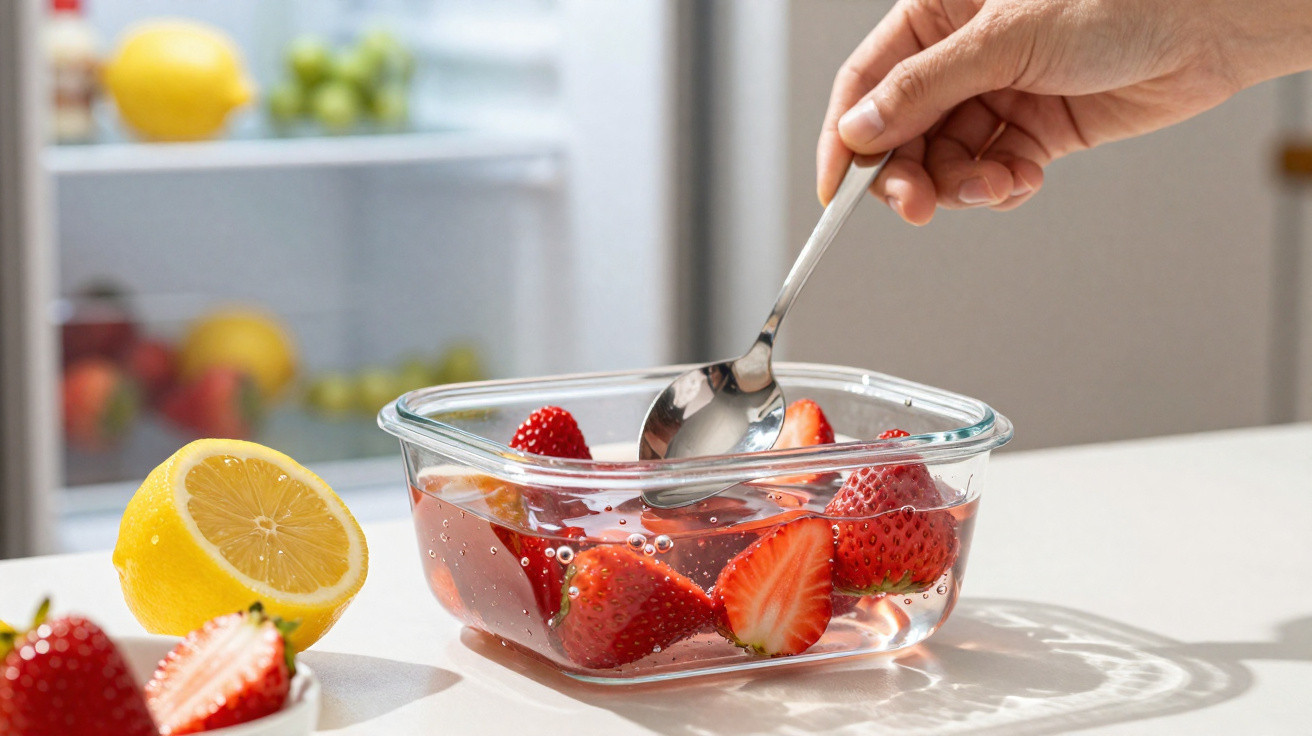
Fill a bowl with 250 ml of very cold water. Stir in 1 teaspoon of lemon juice, then immerse the sliced strawberries for 45–60 seconds, no longer. Drain them promptly, place them on a clean tea towel, pat them dry without rubbing, and store them in a single layer in a container lined with kitchen paper, with the lid resting on top rather than sealed tightly. Yes, only one teaspoon.
The lemon juice adds just enough acidity to revive the red colour and delay softening. Cold water refreshes the bite and rinses away excess acid from the surface. Keeping the slices in one layer prevents crushing, the paper absorbs free moisture, and a slightly open lid stops condensation forming on the container walls. This gives you 48 hours of breathing room, often more if the strawberries were exceptionally fresh to begin with.
Avoid soaking them for more than two minutes, otherwise water eventually enters the fruit and the strawberries absorb too much. Do not hull them before the initial rinse: leaving the green tops in place prevents water entering through the centre. The fridge cannot rescue a tired strawberry. Pick fruit that feels dry to the touch and has no soft patches, and cut thicker slices if you are saving them for the next day. Let’s be honest: nobody truly does all of this every day.
“A teaspoon of lemon in a bowl of iced water is like a quick morning tidy-up for strawberries: fast, subtle and effective.”
- 1 tsp lemon juice for 250 ml cold water
- Soak for 45–60 seconds, then dry gently
- Single layer + kitchen paper + lid left slightly open
- 48 hours of colour and firmness in the fridge
What happens in the fridge over those 48 hours
That small amount of acid returns anthocyanins to a properly red zone, even after the shock of the knife. The brief soak tightens the texture, much as plunging vegetables into iced water does, while drying removes surplus moisture: the film that makes sliced fruit sweat. The setting stays cool and dry, enzymes have less influence, and the surface does not turn into a puddle.
If you need to sweeten them, do it when serving rather than beforehand. Sugar draws out water and creates a syrup that gradually softens the fruit. If you want to boost the colour for a dessert, add a pinch of finely grated zest at the last minute: its aroma masks the lemon and the colour remains impressive. For lunchboxes, place a paper towel beneath the lid to catch moisture while you are out and about.
If you are worried about a lemon flavour, relax: after a one-minute soak and drying, your palate detects almost nothing. You taste strawberry, full stop. For very ripe fruit, reduce the soak to 30 seconds, as the acid will still do its job. For an evening fruit salad prepared in the morning, cut the slices a little thicker and keep the container on the top shelf of the fridge, away from the overly cold area that damages the edges.
Practical guide: steps, mistakes and variations
Start by rinsing whole strawberries under a cool running tap, then dry them in a single layer on a tea towel. Hull and slice them immediately before the acidic soak: 1 tsp of lemon juice for 250 ml of iced water, for 45–60 seconds. Drain, dry, transfer to a lined container, and leave the lid slightly open. When serving, add a sprinkling of sugar only if wanted, and never before refrigeration.
Common mistakes include soaking them too long, piling them up, sealing the container airtight, and adding sugar too early. Another trap is adding lemon by eye: pour in too much and you taste the acidity; use too little and the effect weakens. Measuring one teaspoon makes all the difference. For flavour, replace a quarter of the lemon with orange juice for a gentler version, or add a tiny pinch of salt to bring out the fruit. It is remarkably effective.
If the strawberries are particularly firm, increase the soak to 90 seconds while continuing to monitor the texture. If they are nearly jam-like, keep the soak below a minute; the method still works. If lemon does not appeal to you, use lime juice instead: it is just as effective and slightly more floral. Keep the technique and simply change the flavour.
“This is not laboratory chemistry; it is cupboard cooking: acid protects the colour, and cold protects the firmness.”
- Milder variation: 3/4 lemon + 1/4 orange
- Punchier variation: equal parts lime
- Lunchbox tip: place a paper towel beneath the lid
- Reminder: add sugar at the last minute, not beforehand
Why this one minute makes such a difference
This small acidic soak requires no equipment, no science and no stolen time. It turns a frustrating habit into an easy, almost automatic routine: slice, soak, dry, store, smile. You gain an extra day from a punnet, save a last-minute dessert, and make a rushed breakfast easier. It is the most worthwhile minute in the morning kitchen.
Try it once with half a punnet, leaving the other half untreated as a comparison, then look at the difference the following day. The soaked slices retain tidy edges, their red colour still stands out, and the texture responds when you bite into them. Tell others about it, test it with whole raspberries given a very quick rinse, and compare it with a sweetened version. The fridge stops being the enemy of sliced strawberries, and your container finally delivers on its promise.
| Key point | Detail | Benefit for the reader |
|---|---|---|
| 1 tsp lemon | In 250 ml cold water, soak for 45–60 seconds | One memorable step with an immediate effect |
| Drying and storage | Tea towel + kitchen paper + lid left slightly open | Less free moisture and longer-lasting firmness |
| 48 hours of freshness | Bright colour, firm slices, preserved flavour | Less waste and more enjoyment |











Comments
No comments yet. Be the first to comment!
Leave a Comment