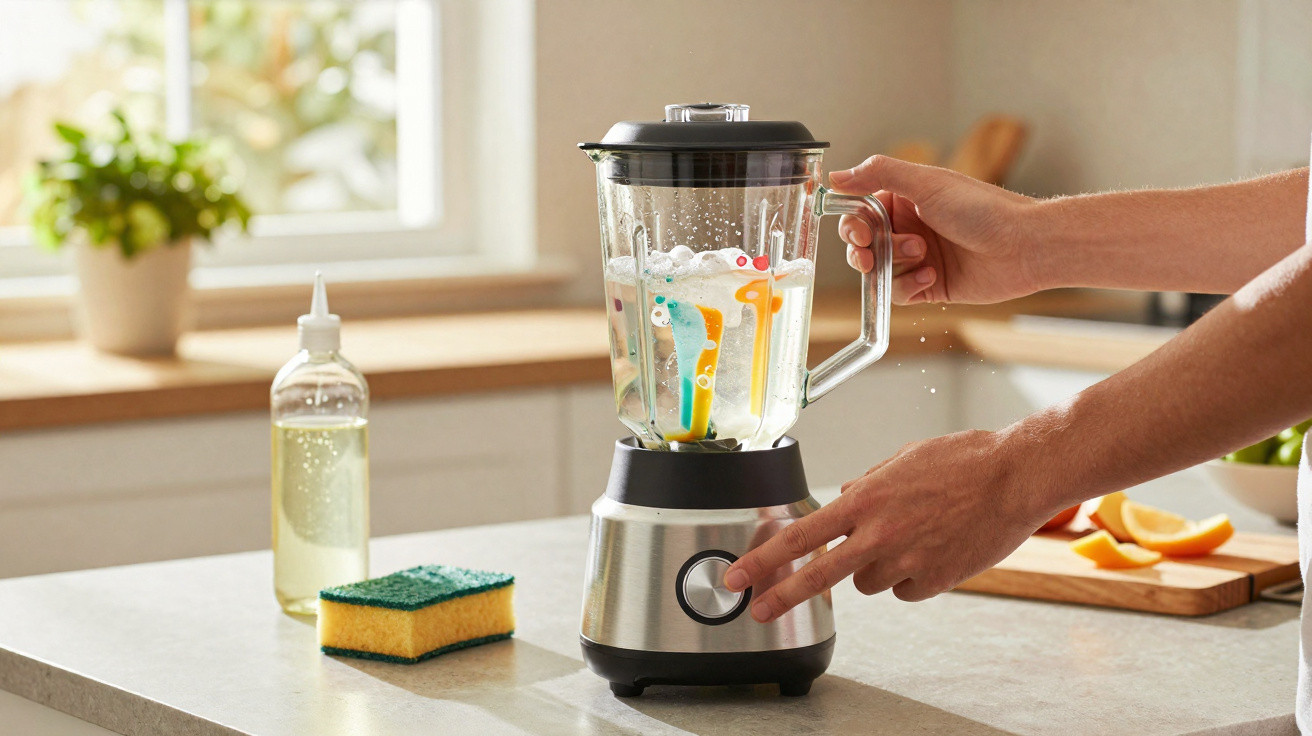
Seeds wedge themselves in there. Nut butter crusts over there. You look inside, spot the steel blades, and a voice in your head says, “Careful.” Suddenly, the kitchen sink feels like a miniature war zone of sponges and anxiety. I wanted an escape route: a solution that did not require a tea towel, a prayer and putting my thumb at risk. So I tested an almost ridiculously simple idea: washing the blender by blending soapy water in the jug.
The day I tried it, my smoothie looked like a proper crime scene. Purple stains covered the jug, grit circled the bottom, and chia seeds were stuck to the metal like moon dust. The sink was already crowded with mugs, and I had no desire to take anything apart. I filled the jug halfway with warm water, added one drop of washing-up liquid and secured the lid. The motor spluttered before picking up speed. Foam spun around like a tiny galaxy. It seemed both slightly silly and hugely satisfying. Then the sound altered, as though the mess itself had finally relaxed.
Why this seemingly lazy method works
It can look like a shortcut at first. Rather than scrubbing the blades yourself, you are letting the blades clean their own surroundings. Yet, when you watch, the reasoning is clear. Soapy water climbs the walls of the jug before sweeping back over the blades in waves. Residue loosens, seeds lift and whirl around, and the jug starts looking like glass again. No dismantling and no cuts. It turns the dirt into a whirlpool that handles the hard work before vanishing down the plughole.
I tested it on the remains of a smoothie containing frozen berries, banana, peanut butter and oats. In other words, it was a sticky disaster. To make the challenge worse, I left it sitting for twenty minutes. I used warm water, a small drop of soap, pulsed for thirty seconds and then gave it a brief burst on high. The liquid went pink, then cloudy, then mostly clear. Its scent changed from sweet fruit to clean. After pouring it away, I looked inside. The ring of chia had softened and came away with a quick rinse. Thirty seconds, zero drama.
There is some useful kitchen physics behind the approach. A blender is built to form a vortex, which pulls liquid downwards, throws it outwards and sends it back across the blades. Soap and warmth reduce surface tension while helping to release fats and proteins. Tiny particles remain suspended instead of clinging on. The process repeats: loosen, lift, carry, repeat. It is essentially a miniature jet wash, except the jet is spinning within the mess. Your fingers are not needed near the blades; they simply need warm, slippery liquid to do their job.
How to clean your blender by blending soapy water
This is the routine that kept my hands out of danger. Half-fill the jug with warm water, then add just one drop of washing-up liquid. Fasten the lid and pulse for 10–15 seconds to shift the heavier residue. Run it on medium for 15–20 seconds to create the vortex. For particularly stubborn mess, finish with 5 seconds on high. Empty the jug, rinse it in warm water and leave it upside down to air-dry. That is all there is to it. If an odour remains, add a little lemon juice and blend again for 5 seconds.
A few cautions are worth keeping in mind. Do not use boiling water, as many jugs do not cope well with sudden heat. Avoid using too much soap: extra foam does not make the blades cleaner, it only creates more rinsing. Make sure the lid is firmly in place and never run the blender dry. When residue has hardened into a crust, first soak it in warm water for five minutes, then use the blend-clean method. We have all experienced last night’s smoothie turning to concrete by morning. It happens. Go easy on both the appliance and your wrists, and allow the whirlpool to take care of the risky part.
Realistically, hardly anyone will do this every single day. Once a quick rinse becomes second nature, you will scarcely notice it. Even so, a more thorough clean once a week is worthwhile: smells disappear, cloudiness reduces and the jug remains transparent. I didn’t fancy losing a fingertip.
“Treat the blender like a mini dishwasher: warm water, a drop of soap, lid on, quick spin. The friction is your friend.” - Lina Hart, café owner
- Use one drop of soap rather than a squeeze.
- Choose warm water, not boiling water.
- Pulse first, followed by a brief spin.
- End with a rinse of clean water.
What this small blender-cleaning habit changes in your kitchen
There is a subtle comfort in knowing the intimidating part has been dealt with. You do not linger over it with a brush, recoil from the blades or negotiate with a sponge. You fill, spin and pour. The blender can return to the worktop ready for its next task-soup, ice or hummus-without that low-level sense of dread. After a week of doing this, I found myself reaching for the blender more often. A little extra ease can encourage more cooking. Forget the boiling-water myth. The benefit comes not from heat or force, but from repeated gentleness. This is the sort of kitchen trick that proves its value. It is straightforward, strangely soothing and makes washing up feel like the final chord of a song rather than a job to put off.
| Key point | Detail | Benefit for the reader |
|---|---|---|
| Warm water + one drop of soap | Reduces surface tension and releases fats without repeated rinsing | Fast cleaning, less foam and less fuss |
| Pulse, then a short spin | Pulsing shifts debris, while spinning creates the vortex that carries it away | Cleaner blades in 30 seconds with minimal noise |
| Rinse and air-dry | Rinse with warm water and place the jug upside down on a rack | Prevents odours and streaking while keeping plastic or glass clear |











Comments
No comments yet. Be the first to comment!
Leave a Comment