The spoon taps against the mug, the teabag drops in, and within a few minutes you have the ideal steaming cup.
You sip it while half-focused on other things: checking your phone, replying to a message or gazing through the window. Then the mug is left behind on the table.
When you eventually take it to the sink, there it is: a yellow-brown ring clinging to the inside like a faded watermark. You attack it with a sponge, but it will not budge. You scrub more firmly. It remains, pale and ghostly.
It is only tea. It seems harmless enough, almost transparent. Even so, it grips porcelain as though it has a point to make. Coffee marks cups too, yet tea somehow feels more subtle and persistent, particularly on your favourite white mugs.
Why can such a mild drink leave such lasting marks?
Why tea stains cups as though it belongs in the design
Watch tea being poured into a genuinely white cup and it is almost possible to picture the stain that will follow. The clear water turns a rich amber shade, swirling across the porcelain. Minute particles move through it before settling as a light film around the mug’s curved interior.
Leave that cup on the worktop for an hour and the faint colour begins to define itself as a ring. It is not striking, merely a soft shadow. Repeat the pattern every day and the mug’s inside starts to appear “permanently used”, even when it is washed each evening.
The outside may still look spotless. Look closer, however, and pale brown lines tell the tale, never quite disappearing. The stain becomes a sort of record of every cup of tea you have had from it.
Picture a shared office kitchen at 4 p.m. Mugs stand beside the sink, each with its own little tannin halo. Someone owns a favourite oversized cup, nearly caramel-coloured inside, resembling a relic from an old café. Nobody knows its true age. Nobody enquires.
In student flats, matters can be even more dramatic. You may come across a mug whose inside is closer to beige than white. It has been rinsed, certainly, but thoroughly scrubbed? Hardly ever. The level the tea reaches each time resembles a tide line in a rock pool.
We all know the cupboard with the “good” cups at the front and the stained old favourites hidden at the back. They are not dirty in the conventional sense. They are simply marked: familiar and, in a way, almost reassuring… until visitors arrive and you pause before choosing one.
The explanation begins with the leaves. Tea contains tannins, compounds of the same type that create red wine’s dry, gripping sensation. These molecules are keen to attach themselves to surfaces, and porcelain or glass offers an ideal setting.
Whenever hot water meets the leaves, tannins dissolve into the drink. Some travel to the surface and edges, where oxygen, warmth and time help them oxidise. Once altered, they are reluctant to release their hold. That is the ring that begins to appear.
Add milk, minerals from hard water and microscopic scratches within the cup, and the effect increases. Together, they form a kind of framework that lets the coloured molecules adhere more deeply. Ordinary washing-up liquid finds that microscopic hold difficult to break, allowing the stain to remain after each daily rinse and gradually build up.
How to keep tea stains at bay without becoming a cleaning robot
The easiest tip begins sooner than most people expect. As soon as you have finished your tea, rinse the mug with cold water before the stain has time to settle. A quick swish and tip-out is enough: no fuss, no scrubbing and no more than ten seconds.
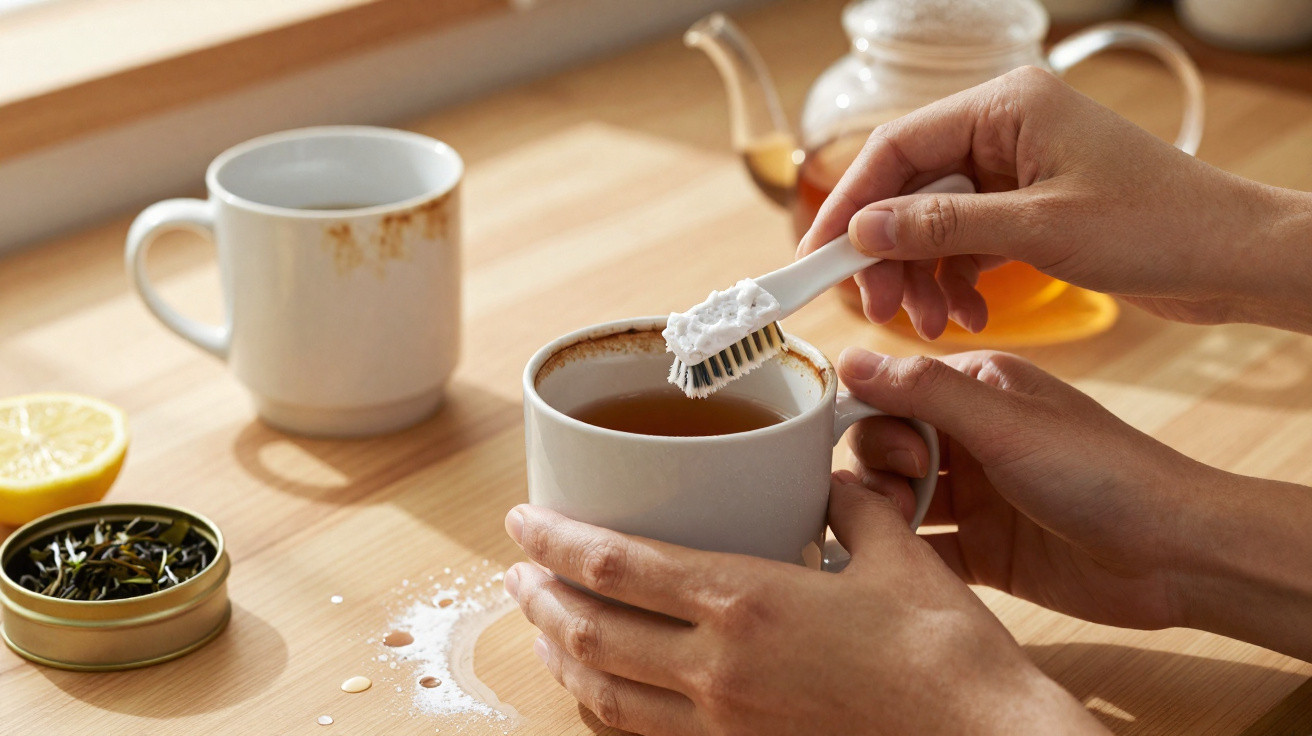
If the mark has already formed, try a simple kitchen routine: scatter a teaspoon of bicarbonate of soda into the damp mug, add several drops of water to create a paste, then rub it lightly with a soft sponge. Its fine grains work as a very gentle abrasive, removing the film without scratching the mug.
For stubborn “vintage” rings, fill the mug with hot water, add a spoonful of bicarbonate of soda or white vinegar, then leave it to soak for 15–30 minutes. On your return, most marks will wipe away in almost one pleasing movement. It feels oddly like erasing the history of a thousand tea breaks.
On a hectic day, rinsing a mug immediately after drinking can feel like one job too many. You promise yourself that you will deal with it later, and naturally you do not. Hours go by, tannins settle and the mild ring tightens its hold much like drying paint.
A small change in perspective can help: regard the mug as part of making tea, rather than merely its vessel. Drink, breathe, set your phone aside for two seconds, then rinse. That is all. There is no need for an ambitious cleaning rota, only one additional, almost effortless action before you leave.
Some mugs will, of course, always stain more quickly than others. Rougher surfaces, tiny scratches, hard water and stronger black teas all make it more likely. Let’s be honest: nobody really does this every single day. The aim is not perfection, but preventing the worst accumulation before your favourite mug shifts from “well loved” to “slightly embarrassing”.
“Tea stains aren’t a sign of dirt as much as a sign of repetition. They show up where daily habits quietly carve themselves into the objects we touch.”
To stop mugs from entering that permanently yellow stage, modest habits repeated regularly are much more effective than occasional deep-cleaning sessions. Once a month, pick the three most stained cups and give them a “spa session” using bicarbonate of soda or a denture-cleaning tablet in hot water. It requires almost no work while you get on with something else in the kitchen.
- Use a bicarbonate of soda paste for regular, gentle stain removal.
- Soak older, darker marks in hot water with vinegar or a tablet.
- When possible, rinse mugs with cold water immediately after drinking.
- Rotate your mugs so that one does not take on every stain.
- Keep one or two guest mugs made from lighter, more stain-resistant materials.
Beyond the brown ring: what a stained cup quietly reveals about you
Once tea stains catch your eye, they are difficult to ignore. They tell their own stories. A much-marked mug on a person’s desk suggests long working days, constant refills and perhaps one too many late-night deadlines. A pristine white cup without a trace of colour suggests someone who either does not drink tea… or cleans with clockwork regularity.
There is a cultural dimension hidden in plain view too. In many homes, especially those where tea is almost a constant background presence, stained cups are ordinary and unremarkable. Elsewhere, any colour inside a mug can seem careless, like an unfastened button on a dress shirt. The very same ring can feel cosy in one kitchen and “not quite clean” in another.
We seldom discuss it, but that yellow circle at the base of a mug can prompt quiet feelings: slight embarrassment when offering it to a guest, tenderness when you recognise a partner’s favourite cup, or mild annoyance with a flatmate who always leaves theirs marked and soaking. Chemically, tea stains are simply chemistry. Humanly, they concern routines, care and the small compromises we make with everyday mess.
| Key point | Detail | Benefit for the reader |
|---|---|---|
| Source of stains | Tea tannins and water minerals attach to the cup’s surface | Understand that staining is caused by a natural reaction, not poor hygiene |
| Factors that worsen staining | Strong black tea, hard water, a rough cup surface and leaving a cup for a long time | Identify why some cups stain more rapidly than others |
| Simple solutions | Quick rinsing, bicarbonate of soda, vinegar and regular soaking | Adopt easy habits that keep cups cleaner without spending hours on them |
















Comments
No comments yet. Be the first to comment!
Leave a Comment