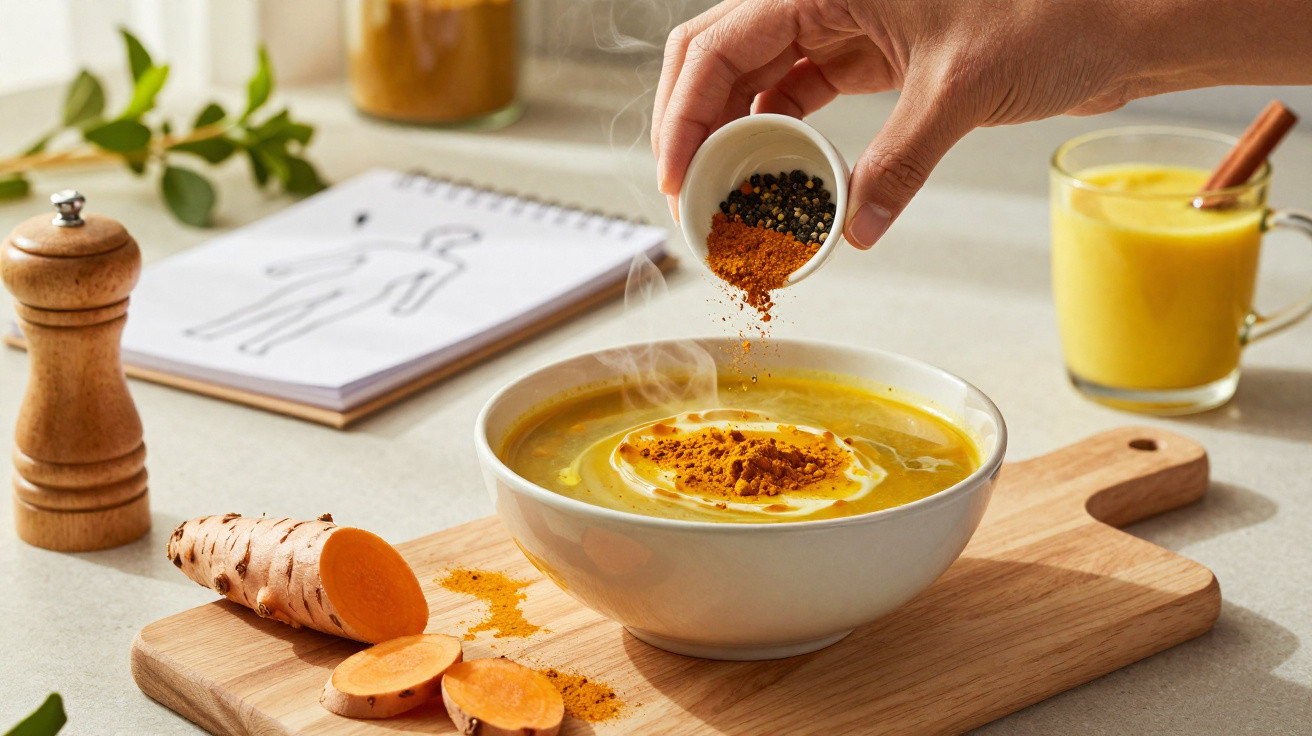
Turmeric has occupied our spice cupboards for years, but plenty of people say they “don’t feel anything.” The understated explanation is that it is often used on its own, whereas the real benefit comes from combining it with something else.
She picked up a jar, tipped out a sun-coloured mound, then-almost with a flourish-ground one twist of black pepper over it. “Taste,” she said. I expected sharp heat, but found a lingering, rounded warmth, as though the spice had finally found its voice.
Shoppers passed by carrying their baskets, unaware that a tiny act-the turn of a pepper mill-can alter what happens in the gut. The change may be felt in the body’s less obvious places: the joints, skin and sleep. It begins with a pinch.
The science behind the pinch
Curcumin, turmeric’s well-known compound, is difficult for the body to use. It does not dissolve readily in water, leaves the bloodstream quickly and can be gone before it has much chance to act. Black pepper changes the equation. Its small dark grains contain piperine, a compound that slows the breakdown and removal of curcumin. Together, they remain in circulation for longer and travel further, giving that vivid yellow powder a louder anti-inflammatory presence where it may be needed.
Picture a runner being given a head start. One frequently cited study in humans found that combining piperine with curcumin increased curcumin’s bioavailability by around 20-fold-roughly 2000%. That figure is widely repeated because it highlights the gap between a spice that merely looks appealing in a latte and one that is actually available to the body. I recall Maya, a yoga teacher who believed turmeric “never did anything” until she began having golden milk with pepper each evening. After a few weeks, climbing stairs felt easier. Anecdotes are not evidence, but they can make you take notice.
The mechanisms involved are relatively straightforward. Piperine influences enzymes in the gut and liver that would normally label compounds for swift removal, while also reducing the activity of transporters that move curcumin out. Fat matters as well. Curcumin is fat-soluble, so serving it with milk, coconut oil, olive oil or ghee helps it move through the body more effectively. Heat can release aromas and bring flavours together, which gives a warm frying pan or gently simmering pot a useful role. Small adjustments can create a substantial difference.
Using turmeric and black pepper every day
The routine is simple. When cooking, use roughly 1/2 to 1 teaspoon of turmeric powder for each person, add a pinch of freshly ground black pepper-about 1/8 teaspoon is sufficient-and include some fat. Mix it into scrambled eggs cooked in olive oil, whisk it through soup, or fry it gently in ghee at the beginning of a curry. For a drink, heat milk or a plant-based alternative with 1/2 teaspoon of turmeric, a grind of pepper and a teaspoon of honey, before stirring in a small drizzle of coconut oil. That modest combination of fat and pepper helps unlock the full potential of turmeric.
Most of us know the feeling of a new routine becoming fiddly-another instruction to remember in a day already full of them. That is why low-effort systems work well: keep a small pepper grinder beside the turmeric jar, leave a spoon in the tub, or prepare a little jar of mixed “gold dust” for hurried mornings. Realistically, nobody follows a routine perfectly every day. Fortunately, there is no need to. Add it to meals you already make and let the habit become automatic.
Questions about amounts usually have a kinder answer than expected. A pinch will do. Black pepper does not need to take over the flavour; it simply needs to be there to support turmeric’s gentler qualities. This is an easy principle to follow in a busy kitchen. If capsules are your preference, look for piperine or “black pepper extract” on the label, or take a curcumin supplement alongside a peppery meal. Choose consistent, repeatable habits rather than dramatic efforts.
“Turmeric is the headline act everyone knows. Black pepper is the sound engineer. Without it, the show doesn’t land,” the nutritionist told me, smiling over a pot of steaming lentils.
- Include a pinch of pepper whenever you use turmeric, whether in cooking or drinks.
- Add a little fat, such as olive oil, ghee, coconut milk or tahini.
- Apply gentle heat by frying it briefly or stirring it into hot liquids.
- Store a grinder next to your turmeric to make using it effortless.
- Begin modestly, repeat the habit often and watch for subtle changes over several weeks.
What this could mean for everyday inflammation
Inflammation tells its story gradually. It can appear as stiffness after a flight, swollen fingers that make rings feel tight, or the persistent background irritation of skin or sleep that refuses to settle. Turmeric alone may be subtle; with black pepper, its effect may become clear enough for the body to register. I have heard from runners who notice a difference after long distances, parents who make it through bedtime without sore knees, and office workers who can type without that faint, persistent throb in their wrists. It is not a miracle, but more like clearing grit from an engine so that it runs with less resistance.
There is important nuance here. Laboratory evidence for curcumin is strong, but results in day-to-day life differ, as they do with diet, genetics, sleep, stress and movement. Some people may notice a change quickly, while others may need a month. Speak with your clinician if you take blood thinners or have gallbladder problems. Everyday seasoning is not a replacement for medical care; it can support it. The promise of this pairing is quiet and practical: meals that do a little more for you, using ingredients that have shared spice tins for centuries.
| Key point | Detail | Why it matters to the reader |
|---|---|---|
| Turmeric + pepper synergy | Piperine can raise curcumin’s bioavailability up to ~20x | Turns a fashionable spice into a practical tool that may be noticed |
| Fat and warmth matter | Combine with oils or milk and gentle heat for improved uptake | Makes straightforward recipes more effective without additional effort |
| Everyday, repeatable habits | A pinch of pepper, a splash of fat, familiar meals | Sustainable changes that suit busy routines |












Comments
No comments yet. Be the first to comment!
Leave a Comment