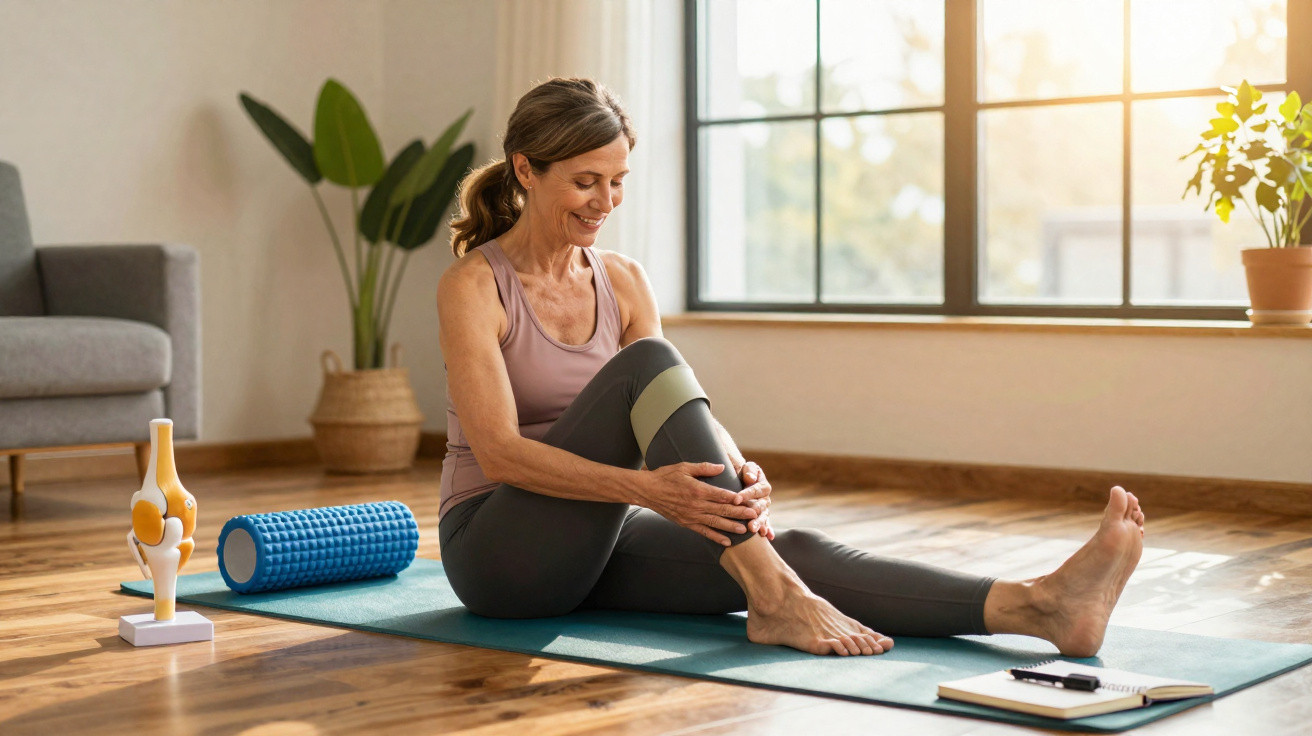
Whenever the door opens, she glances up briefly before looking back down at her knees. A bus passes outside; indoors, joints quietly crack as people stand. One man tells his wife that he once ran up two flights of stairs without a second thought. Now, he approaches every staircase as though it were a small mountain expedition. We know that moment: when a knee no longer simply cooperates, whether you are digging the garden, lifting a grandchild or just walking to the bakery. There is something between frustration and determination in the eyes of the people waiting here. The orthopaedic specialist due to emerge shortly has a clear message. And it comes down to exactly three exercises.
Three simple movements that could shape your next ten years
People over 60 often notice in their knees first that time does not stand still. Stairs suddenly seem longer, getting up from a chair requires a moment of preparation, and walks become shorter. Knees are ruthlessly honest: they reveal quite clearly the state of your muscles, weight and mobility. Many people flinch at that point and think: “Better not damage anything, so I should take it easy.” Yet that is precisely where the vicious circle begins.
Orthopaedic specialists repeatedly describe the same pattern: people walk less, bend less and challenge themselves less because they are afraid of pain. The muscles around the knee weaken, the joint cartilage receives a poorer supply, and stability declines. Before long, everyday life stops at the third stair or the kerb when the bus arrives too quickly. What began as “just a few minor aches” turns, within two or three years, into an ongoing problem that feels as stubborn as chewing gum. The opportunity to take corrective action was much earlier.
Every orthopaedic specialist I spoke with made the same sober point: if you are over 60 and want to keep your knees functioning, you need to use them. Not with the frantic ambition of a gym routine, but through calm, repeated, almost unremarkable consistency. Three exercises recur in their advice: the chair squat, seated leg raises and the mini wall squat. No costly equipment, high-tech machines or perfect sportswear are needed. All you need is a chair, a wall and the willingness to spend a few minutes each day. Let us be honest: hardly anyone will do this every single day. But even three to four sessions a week can make a substantial difference.
The three knee exercises orthopaedic specialists prescribe time and again
The first exercise seems almost alarmingly basic: sitting down on, and rising from, a sturdy chair - the classic chair squat. Place your feet hip-width apart, angle your toes slightly outwards and keep your knees pointing in the same direction. Lower yourself slowly without dropping into the chair, then stand up again with the same control. If you are just starting, it is perfectly fine to use your hands for support, perhaps resting them on your thighs. Complete ten repetitions, take a short break, then do another set. Those who are more practised can hold their hands out in front, as if fastening a seatbelt before take-off. This movement works the thighs and buttocks, the body’s natural “safety harness” for the knee joint.
The second exercise is the seated leg raise. Sit upright on the chair with both feet on the floor. Slowly extend one leg forwards until it is roughly straight, hold it for three seconds, then lower it again. Do ten on the right and ten on the left. The front thigh muscle - the quadriceps - acts like a protective shield for the kneecap. Many older people are surprised by how quickly this apparently straightforward extension becomes demanding. One orthopaedic specialist described a patient who, after doing leg raises every other day for four weeks, could suddenly get out of her car easily again without having to pull herself up using the door frame. To her, it felt like a small miracle; in reality, it was simply muscle strength brought back into use.
The third exercise quietly does its job: the mini wall squat. Stand with your back against a wall, with your feet about one foot-length in front of it and slightly apart. Then slide down by just a few centimetres, as though you were about to sit on an invisible stool, but only as far as feels safe. Hold briefly, then slide back up. There is no need for heroics or 90-degree angles. Many orthopaedic specialists stress that small angles can have a big effect. The exercise strengthens the front of the thighs, the buttocks and the deep stabilising muscles around the knee. If you feel unsure, place a cushion or folded towel behind your back for a softer sensation.
Building a genuine knee routine from three exercises
For people over 60, the best knee strategy often starts with an unassuming note containing three lines: chair squats, leg raises and mini wall squats, each alongside the number of repetitions. Orthopaedic specialists advise linking the exercises to a fixed daily cue: after morning coffee, before the evening news or before brushing your teeth. Begin with two sets of each exercise, perhaps progressing to three later on. One possible beginner programme is 8–10 chair squats, 8 leg raises on each side and 6–8 mini wall squats. If you feel pain, reduce your range of movement rather than abandoning the exercise altogether.
At first, many people make the same mistake: full of motivation, they test their limits on one day, suffer muscle soreness for the next two, and decide inwardly: “This isn’t for me.” A different inner voice is needed here. The body over 60 responds more slowly, but it is remarkably loyal when you do not overwork it. Orthopaedic specialists recommend paying attention to a mild burning feeling in the muscles, rather than dramatic stabbing pain in the joint. Anyone who already has osteoarthritis or has had surgery should discuss the exercises individually first - in most cases, they can be adapted. And yes, some days are simply sluggish; on those days, one set of each exercise is enough. The key thing is not to let the routine stop completely.
“I rarely tell my patients: ‘You have to play sport.’ I am more likely to say: ‘Give your knees a small reason every day to stay strong.’ Three targeted exercises are often enough to turn things around.” - an experienced orthopaedic specialist from Munich
- Chair squats - support getting up, climbing stairs and sitting down safely, without the knees giving way.
- Seated leg raises - improve kneecap stability and make everyday situations, such as getting in and out of a car, easier.
- Mini wall squats - build strength in a controlled way without placing the full load on the joint, making them ideal if you feel uncertain or are returning after a break.
What strong knees in later life really mean - far beyond the joint itself
When orthopaedic specialists speak of “strong knees over 60”, they are rarely referring only to impressive X-rays. They mean independence. They mean being able to pick up a grandchild spontaneously rather than saying: “Come on, let’s sit down instead.” They mean standing up on the bus before someone has to offer a hand. Training your knees ultimately also builds your own sense of security in the world. Every less painful step outside brings a tiny gain in freedom inside your mind.
At the same time, honesty matters: some knees are already seriously damaged. Osteoarthritis, old injuries and operations cannot all be trained away. Yet almost every orthopaedic practice knows stories of people who have managed to reduce their pain medication, experience fewer moments of stumbling and cover longer distances again. These are small improvements that no one celebrates on Instagram, but which are enormous in real life. Sometimes a knee does not suddenly become “good”; it simply becomes a little less prominent in daily life - and that alone is a quiet triumph.
Perhaps this is the personal test worth trying: for three weeks, do only these three exercises three to four times a week. It is not a doctrine or a self-improvement performance, but an experiment with your own body. Anyone who notices after those three weeks that standing up feels easier, or that the stairs seem slightly less threatening, will feel in their own knees what orthopaedic specialists have advocated for years. Becoming stronger does not need to be loud. Particularly in later life, these small, unremarkable movements are often what keep the door open - to your home, the park and life outside.
| Key point | Detail | Benefit for the reader |
|---|---|---|
| Targeted strengthening instead of protecting the joint too much | Three straightforward exercises (chair squat, leg raise, mini wall squat) activate the thigh and buttock muscles as a “protective shield” for the knee. | Explains why active use can make knees more stable and may reduce pain over the long term. |
| Practical everyday implementation | Link the exercises to established routines, begin with few repetitions, and adjust the range of movement rather than stopping the exercise entirely. | Makes it possible to start immediately without equipment or a gym, while adapting training to how you feel that day. |
| Realistic expectations | Small but noticeable improvements may be possible after several weeks, including with osteoarthritis or after operations. | Removes the pressure to “heal everything” and encourages a manageable three-week experiment. |














Comments
No comments yet. Be the first to comment!
Leave a Comment