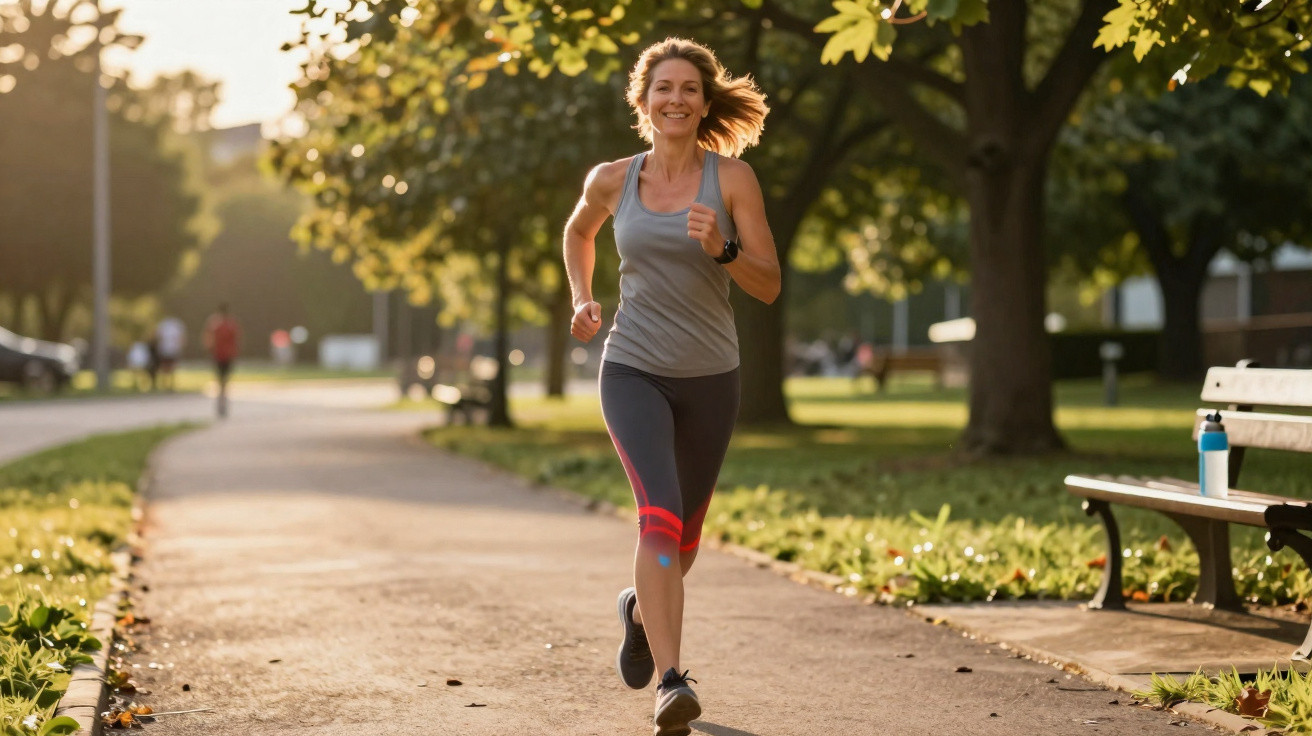
He shakes out his legs, takes a deep breath and checks his watch. He has been out for 18 minutes now, walking at an entirely ordinary pace, nothing athletic. Traffic rushes past beside him, yet his face has a calmness rarely seen in offices. A few metres away, an older woman pushes her shopping trolley, one deliberate step at a time, focused and almost defiant. We would probably overlook them both: two people who are “just” walking.
Doctors are now making it increasingly clear that these unremarkable steps can protect blood vessels. They can warm cold feet, make heavy legs feel lighter and sharpen tired minds. Quietly, they work in the background day after day. And they are far more powerful than we tend to admit in everyday life.
The real surprise is that the key is often not a workout, but the walk to the bakery.
What regular walking does for your blood vessels
Anyone who spends a lot of time sitting will know the feeling: after hours at a desk, the legs can seem as heavy as lead. The first walk to the coffee machine can feel like a small shock to the muscles. Doctors now describe this as a “sitting backlog” in the vascular system. Blood circulates more slowly, veins have to work against inertia, and arteries are not properly “flushed through”.
Once we start walking, this changes within minutes. The leg muscles contract and relax, acting like a second pump to propel the blood again. Blood vessels widen, their inner walls receive better blood flow, and tiny capillaries are activated. All at once, a system that had been half-asleep shortly beforehand is moving again.
Vascular specialists often describe a typical patient: in his mid-60s, a smoker, carrying weight around his middle and always travelling by car. He comes to the clinic because his calves start burning after 150 metres. Many call it “shop window disease”, because sufferers pretend to be looking at something in a window when in reality they have had to stop because of pain. A vascular doctor does not prescribe tablets first, but walking training.
When carried out consistently, this training can often increase the pain-free walking distance by hundreds of metres. This is not because medication is so powerful, but because the vessels themselves begin adaptation processes. New small bypass circulatory routes develop, muscles work more efficiently and blood flows more freely again. Hospitals report that patients have been able to postpone or avoid operations through consistent walking. As ordinary as that may sound, for those affected it can feel like reclaiming a piece of freedom.
From a medical perspective, the mechanism is remarkably logical. With every step, blood flow through the leg arteries briefly increases and the pressure on vessel walls changes rhythmically. This tells the body: investment here is worthwhile. It produces more cells lining the blood vessels and releases vessel-protecting messengers such as NO (nitric oxide), helping arteries remain more elastic. At the same time, regular walking reduces typical risk factors: blood pressure falls moderately, blood sugar levels become more stable, and blood fats are less likely to become unbalanced. The body loves gentle, recurring stimuli – for it, they are like a daily reminder to update its own system.
How to make walking training fit everyday life
Doctors now often suggest a surprisingly straightforward plan: walk for 30 minutes, 5 days a week. Do not stroll, but do not rush either; aim for a pace at which you can still talk but would no longer be able to sing. Anyone already experiencing circulation problems can split this into 3 sessions of 10 minutes, with short breaks in between. For people whose blood vessels are under strain, starting with just 10 minutes a day and building up slowly can sometimes be enough.
One practical approach is to establish a fixed “walking anchor” in the day. For instance, take a lap around the block after lunch every day. Or get off one stop earlier in the morning and walk the rest of the way. Those who like technology can use the step counter on their phone and set a minimum target of 4,000 to 6,000 steps. Female doctors observe that even this threshold makes a noticeable difference to many patients’ sense of wellbeing.
We all know that moment when the day is already tightly scheduled and the thought, “Go for a walk now?” prompts nothing more than a weary eye-roll. Let us be honest: nobody really manages it every day. That is precisely where even the best walking plan fails – not because of medicine, but because of real life. Anyone juggling work, childcare, housework and appointments often ends up on the sofa in the evening rather than in the park.
That is why doctors advise small, forgiving steps rather than heroic plans. Walking for 60 minutes once a week rarely replaces a daily routine. A realistic mindset helps: “10 minutes is better than nothing.” People who criticise themselves for missed walks lose motivation more quickly. Those who instead think, “Tomorrow I will start again,” tend to stick with it for longer. A matter-of-fact sentence a cardiologist recently gave to a patient sums it up: “Your blood vessels do not know perfection, only direction.”
A vascular specialist from Munich puts it this way:
“Regular walking is the cheapest and, at the same time, most underestimated treatment for circulation that we have. No gym, no membership – just the willingness to use your own legs.”
To ensure that willingness does not get lost in the demands of daily life, a few simple mental anchors can help:
- Treat walking as an appointment: Put it in your calendar as you would a meeting – 20 minutes of “Walk & Think”.
- Rethink everyday journeys: Define every trip under 1 kilometre as a “walking journey”. No car, no e-scooter.
- Build in mini-routines: Take phone calls only while walking. Choose the stairs rather than the lift whenever possible.
- Pay attention to body signals: After a week, consciously check: do your legs feel less heavy in the evening? Does your head feel clearer?
- Link it to small rewards: Listen to your favourite podcast only while walking – making movement a private break from everything else.
Why these simple steps help shape our future
Anyone speaking to cardiologists hears the same quiet concern again and again: heart attacks and vascular problems are affecting increasingly younger age groups. Sitting has become the default posture of our era, while screen-based work has become a second skin. In this setting, walking can seem almost old-fashioned. That is exactly what makes it radical. It breaks the logic of the chair without performance pressure or app overload.
For many people, a walk around the block has become a protected space. No boss, no algorithm, only their own steps. As blood flows faster, thoughts begin to settle, mental tension eases and stress hormones fall. This touches something fundamental: we move as people have always moved. The vascular system responds with a blend of relief and quiet repair work.
Perhaps it is worth looking at your own week as if it were a map: where are the blank areas in which not a single extra step happens? Where could a small new route emerge – to work, to the supermarket, to a friend around the corner? Not as a moral duty, but as a quiet promise to your own cardiovascular system. Those who walk consistently at 40, 50 or 60 are quietly helping to write their own health story. Such stories rarely appear in social media feeds. They reveal themselves later in warm hands, easier flights of stairs and longer walks with the people who remain.
| Key point | Detail | Benefit for the reader |
|---|---|---|
| Regular walking improves vascular function | Rhythmic muscle activity acts like an additional pump, vessels widen and blood flow increases | Understand why even simple walks can ease cold feet, heavy legs and tiredness |
| Everyday walking routines are crucial | 5×30 minutes per week, divided into short blocks and integrated into existing journeys | A practical, realistic plan that strengthens circulation without a gym |
| Consistency beats perfection | Small, regular sessions have a stronger effect than infrequent, long walks | Reduce pressure, increase motivation, stay with it long term and genuinely feel the health benefits |
FAQ:
- Question 1 How fast should I walk for it to genuinely benefit my circulation? A pace at which you can still speak in full sentences but could no longer sing is a useful guide. Your pulse may rise slightly, but you should not become breathless.
- Question 2 Are 3,000 steps a day enough? For people who are completely untrained or have vascular disease, this can be a sensible starting point. Medical recommendations are generally higher, with many benefits becoming apparent from around 4,000–6,000 steps a day, maintained regularly over weeks.
- Question 3 Does walking also help with varicose veins and heavy legs? Yes, often considerably. The calf muscles take pressure off the veins, blood flows back towards the heart more effectively, and feelings of congestion ease. Varicose veins do not disappear as a result, but symptoms can improve markedly.
- Question 4 I get pain in my calves when walking – should I continue? For known circulation disorders, doctors often recommend interval walking: walk up to the pain threshold, pause briefly, then start again. New or severe pain should be medically assessed first.
- Question 5 Is jogging not much more effective than walking? Jogging creates stronger training stimuli, but it also places greater strain on the joints and cardiovascular system. Many studies show that consistent, brisk walking can be similarly valuable for circulation and blood vessels – and is realistically achievable for far more people.















Comments
No comments yet. Be the first to comment!
Leave a Comment