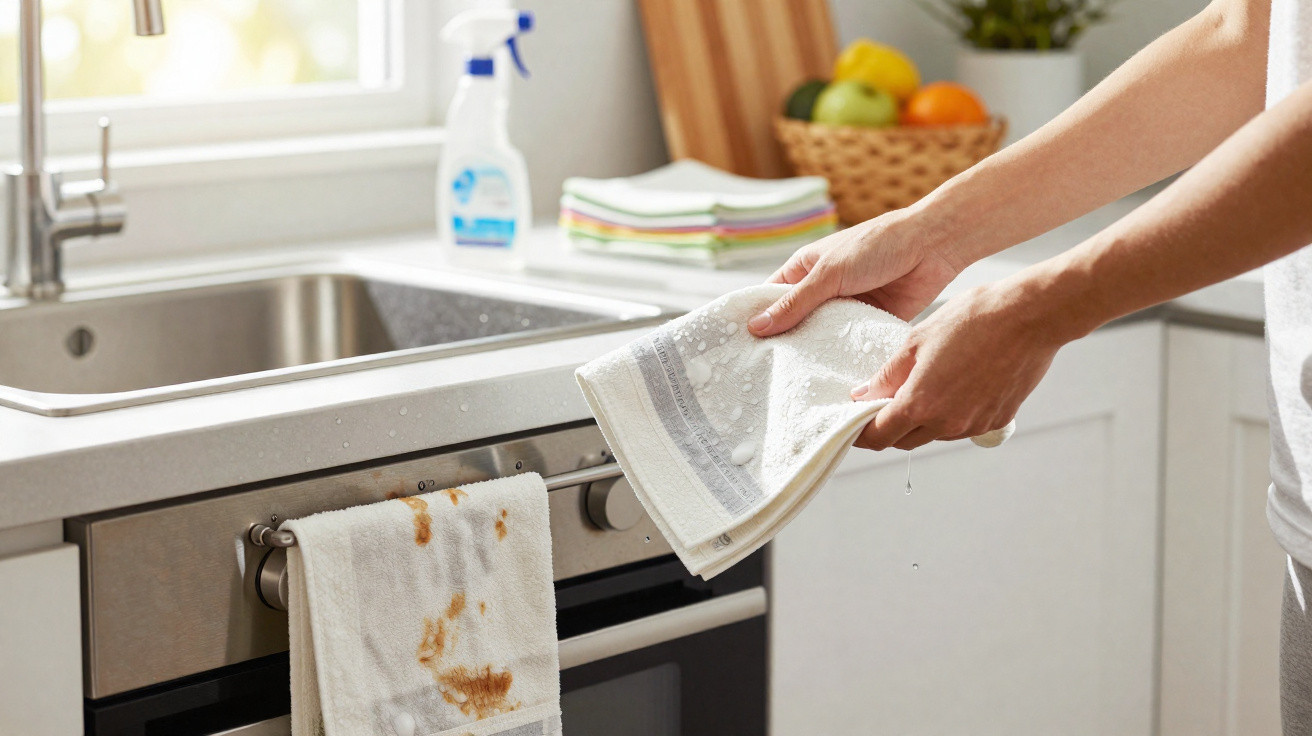
The worktop has been wiped down, the sink is clean and the floor has been mopped: everything looks “spotlessly hygienic”. Yet, right beside the sink, there is often an item that gets handled dozens of times a day – and which researchers say can be teeming with germs. This is precisely the overlooked issue.
The real germ trap in the kitchen: kitchen towels
The item in question is simply the kitchen towel: the fabric towel used to dry dishes, wipe hands or quickly mop up a splash of grease. This practical all-rounder is usually expected to do one job: everything. That is exactly what makes it a risk.
According to specialists, kitchen towels are among the most important carriers of germs and foodborne infections in the home.
A typical day often goes like this: hands are dried in the morning, a frying pan is wiped after washing up at lunchtime, a trail of sauce is cleaned from the table in between, and glasses are polished again in the evening. Few people consider changing the towel while it still looks clean. For bacteria, however, these are ideal conditions.
Why kitchen towels quickly become a breeding ground for bacteria
A standard kitchen towel provides exactly what microorganisms favour: it is often damp, slightly warm at room temperature and regularly exposed to food residue. It could hardly be a better breeding ground.
A study by the University of Mauritius examined kitchen towels from households and found that:
- 49% of the towels tested were contaminated with germs;
- 37% contained faecal coliforms;
- 36.7% were contaminated with Enterococcus faecium;
- 14% contained Staphylococcus aureus.
These bacteria repeatedly occur in cases of food poisoning, particularly where raw foods such as meat or eggs are involved and traces are spread further via the towel.
The situation becomes even more problematic when one towel is meant to handle every task:
- drying hands after marinating chicken;
- polishing clean dishes afterwards;
- then picking up crumbs from the worktop.
In this way, germs from raw meat can easily travel to plates, glasses and cutlery – and therefore straight to the dining table. Dermatologists and hygiene specialists warn that towels like these can cause diarrhoeal illnesses, especially in children, pregnant people, older people and those with weakened immune systems.
A single wipe with a contaminated kitchen towel can be enough to heavily contaminate a surface that appeared clean.
How often a kitchen towel should actually be washed
Most households replace kitchen towels by instinct: when they start to smell musty or when stains become visible. Specialists recommend a much stricter routine.
Hygiene experts advise:
- Replace a damp kitchen towel used for multiple purposes at least every two to three days.
- Anyone who washes up by hand frequently should preferably change it every two days.
- In homes with children, pregnant people, or older adults, it is better to replace towels too often rather than too rarely.
- Replace the towel immediately after contact with raw meat, raw eggs or food that has fallen on the floor.
Those who use a dishwasher and mainly use their towel for drying hands may, in some cases, extend the interval to up to a week. However, this only makes sense if the towel can dry quickly and is not left hanging soaking wet.
How to get kitchen towels genuinely hygienically clean
A quick rinse beneath the tap, a squeeze and a spot on the radiator is how many people deal with a kitchen towel. That may feel reassuring, but it is not enough for germs.
Hygiene professionals recommend the following washing rules:
- Temperature: at least 60°C, ideally using a hot wash or cotton programme.
- Regular “high-temperature check”: run a 90°C wash from time to time to reduce the germ load considerably.
- Detergent: standard biological or colour detergent is usually sufficient.
- Optional: a small splash of household vinegar in the fabric-softener compartment may reduce odours.
The drying process is at least as important as the water temperature.
A towel that stays permanently damp, regardless of how hot it was washed, will quickly become a bacterial hotspot again.
Pay attention to the following:
- Take the towel out of the washing machine after it has been spun thoroughly.
- Hang it up fully spread out rather than bunched up on a hook.
- Do not store it while damp in a closed cupboard or drawer.
- Where possible, allow it to dry in a well-ventilated place or outdoors.
Organise smartly: one kitchen towel for each task
One straightforward measure significantly lowers the risk: separate kitchen towels according to their purpose. It does not require a complicated system, just a little organisation.
Many hygiene specialists suggest:
- One towel solely for hands – always kept on the same hook near the cooker.
- A second towel only for dishes – positioned near the dishwasher or sink.
- A third towel for surfaces – worktops, tables and cupboard fronts.
Colours or patterns can help prevent the towels from being mixed up: blue for dishes, white for hands and patterned towels for surfaces, for example. This keeps the “dirtiest” towel – the one used for surfaces and spills – separate from dishes and hands.
Warning signs that should be taken seriously
If any of these signs appear, replace the kitchen towel immediately and wash it on a hot cycle:
- a musty or sour smell, even where the towel looks clean;
- visible stains from meat juices, egg, dairy products or sauces;
- a damp, clammy feel despite having hung up for some time;
- a grey, “streaky” appearance despite frequent use.
Smell in particular is a clear indication of a high germ count. A freshly washed towel should smell neutral. Anything else belongs in the laundry basket.
Why kitchen towels are especially critical for vulnerable people
In everyday life, healthy adults can generally cope with many germs without difficulty. The risk rises when the immune system is weakened or the body is especially sensitive. In these cases, even small amounts of germs can cause symptoms.
Groups at particular risk include:
- toddlers and babies;
- pregnant people;
- older people;
- people with chronic illnesses or severely weakened immune systems.
For these groups, a gastrointestinal infection can quickly become exhausting or even dangerous. Clean kitchen towels are not a “nice-to-have”; they are an easy everyday protective measure.
Dishcloths, sponges and more: the items often forgotten
Anyone beginning to pay closer attention to kitchen towels should also look at other cloth and foam cleaning aids. Dishcloths, microfibre cloths and kitchen sponges are also high on the list of germ carriers.
Some practical rules of thumb are:
- Ideally, replace dishcloths every one to two days or wash them on a hot cycle.
- Boil sponges regularly, wash them in the washing machine, or replace them more frequently.
- Keep microfibre cloths used on surfaces separate from those used for dishes.
Once a clear system is in place and enough replacements are available, there is no need to think about it constantly. Changing them becomes routine – much like brushing your teeth.
Practical tips for sticking to the new hygiene standard
Many people intend to wash kitchen towels more frequently, only to slip back into old habits after a few days. A few simple routines can make the change last:
- Build up a supply: it is better to have a few too many towels in the cupboard than to be constantly short of them.
- Set a fixed wash day: for instance, wash them with bath towels every two to three days.
- Assign clear places: each hook has one fixed purpose: hands, dishes or surfaces.
- Involve the family: children quickly learn which towel is intended for which task.
Anyone who adopts these habits can substantially reduce the risk of foodborne infections at home – without harsh chemicals, using only hot water, organisation and consistent replacement.










Comments
No comments yet. Be the first to comment!
Leave a Comment