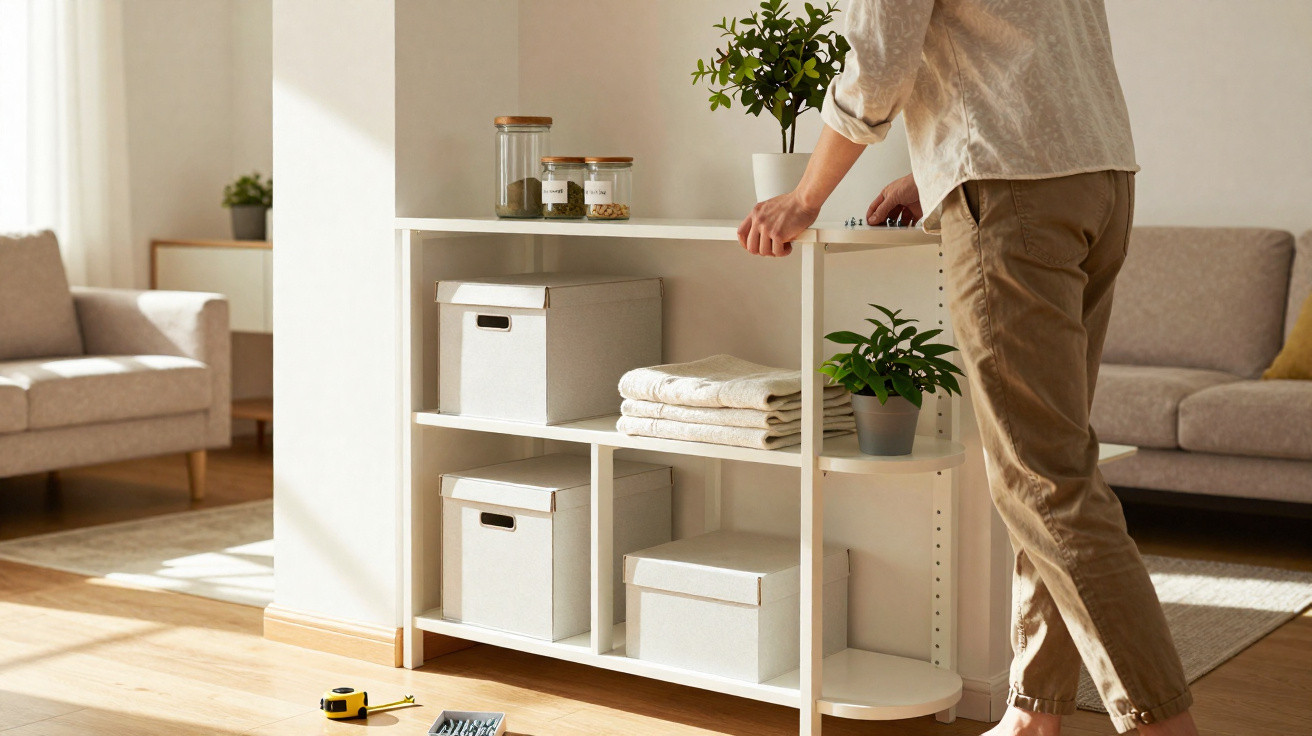
The disagreement began over a box of cereal. He insisted they had bought it two days earlier; she insisted there was nowhere on the shelf to put it. They were both correct. Their pantry was crammed with partly used bags, overlooked jars and mysterious containers that nobody wanted to investigate. Does that sound familiar? Open a cupboard at home and something seems ready to land on your head. It is not necessarily because you own “too much stuff”, but because the space has been left unchanged for too long.
One small change can make it work again.
It is not the solution most people expect.
The small adjustment that quietly changes everything
When somebody opens a cluttered cupboard, there is usually a brief hesitation. They look across the shelves, let out a sigh and push an item aside. That hesitation is the price of poorly planned storage. There is nothing wrong with the belongings themselves; the shelving is at fault. Fixed shelves are inflexible, locked at the height “because that’s how the builder installed them”.
The modest change that makes storage adaptable is not another box or smarter labelling. It is this: decide that your shelves are temporary.
Reposition them. Drill additional holes. Fit adjustable brackets. Regard every shelf level as open to negotiation.
Imagine a family kitchen evolving alongside the people who use it. Initially, its lower shelves hold plastic plates and snack tubs. Two years later, the toddler has grown, so the snack shelf needs to move upwards. Next comes buying in bulk, then baking, then smoothies. Each habit brings different objects in different shapes. With adjustable shelves, the kitchen can be reconfigured in twenty minutes on a Sunday afternoon.
Without them, everything ends up piled in front of everything else.
That is when a cereal box turns into a household dispute.
There is a straightforward reason this adjustment is so effective. Most storage systems are planned once and then left untouched for a decade. Life is not static in the same way. Interests shift, children grow, groceries are bought in bulk during offers, then vanish after a breakup with Costco. Fixed shelves make you alter your routines to suit the furniture. Adjustable shelves allow the furniture to suit your routines. That’s the whole game.
As soon as shelf height can be changed, unused vertical space becomes useful storage. Deep cupboards no longer consume objects. You also stop “losing” possessions you already have.
How to create genuinely flexible storage at home
Begin with a single cupboard, rather than the entire house. Open it, take a photo on your phone, then remove everything and examine the empty framework. Ask yourself one question: “Where are the empty pockets of air?” Look above short jars, below hanging coats and behind lines of shoes.
Then make the small adjustment. Add or move a shelf so that no vertical gap is higher than necessary. Where possible, fit rail systems with holes every few centimetres. If that is not an option, place freestanding risers inside the cupboard to divide the available height.
You are not organising anything at this stage. You are redesigning the setting.
This is the point at which many people stall. They begin enthusiastically, buy baskets and labels, then stop because the system seems too restrictive. In reality, nobody maintains this sort of system perfectly every day. Life includes late nights, ill children and weeks of saying, “I’ll deal with it later”.
That is why systems designed to be flawless tend to fail. Flexible storage gives you some leeway. When one category expands, raise a shelf by a single setting. When a seasonal pastime takes up less room, lift that shelf and reclaim valuable eye-level space.
We have all had that moment when we promise to “declutter for good”, only for life to laugh in our faces.
“Once I stopped treating my cupboards like sacred architecture and started treating them like Lego,” says Anna, a 38-year-old nurse in Manchester, “I finally felt in control of my space. I move a shelf and suddenly I’ve ‘found’ half a cabinet I thought I’d lost.”
- Fit brackets, rails or pegboard systems that allow shelves to be moved with ease.
- Keep one “floating” shelf in each room, ready to take on a different purpose every few months.
- Store lightweight, regularly used items from waist height to eye level.
- Use the highest and lowest areas for bulky belongings or items used rarely.
- Review one storage area each season, adjusting only one shelf height.
Adjustable shelves for a home that can change its mind as quickly as you do
Once you view storage as something adjustable, your home becomes a little less demanding. A hallway cupboard can serve as sports storage in winter and a travel area in summer. The wardrobe in a spare room might hold craft boxes this year and baby clothes the next. Storage spaces cease to be “final decisions” and become adaptable, editable arrangements.
You also take away a subtle source of guilt. Those heaps on the floor are often simply items left without a place because shelf spacing is poor. Give them somewhere to go and they settle down. You do not need to become a minimalist overnight; you only need to give your belongings a realistic home.
The plain truth is that most clutter problems are architecture problems dressed up as personality flaws.
| Key point | Detail | Value for the reader |
|---|---|---|
| Adjustable shelves | Fit rails, make extra holes or use risers to alter shelf height | Converts wasted air into usable space without purchasing a larger cupboard |
| One-zone-at-a-time approach | Tackle one cupboard or wardrobe in each session | Keeps the job manageable, prevents overwhelm and produces quick results |
| Seasonal reshaping | Reassess shelf positions every few months | Ensures storage reflects real life as routines, hobbies and families change |
















Comments
No comments yet. Be the first to comment!
Leave a Comment